issue contents

Journal logoIUCrDATA
ISSN: 2414-3146

May 2025 issue

Highlighted illustration

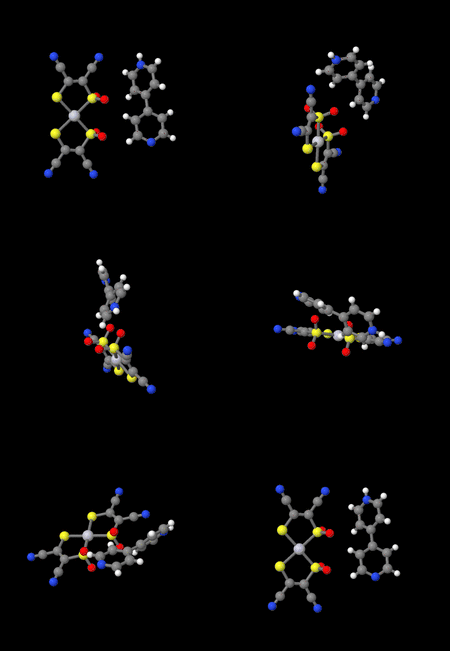
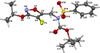
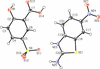
Cover illustration: Crystals of the sulfinate-containing platinate salt is(4,4′-bipyridin-1-ium) cis-bis­(1,2-di­cyano-2-sulfido­ethene-1-sulfinato-κ2S,S′)platinate(2−), (C10H9N2)2[Pt(C4N2O2S2)2], were obtained from a solution of [Pt(4,4′-bpy)2(mnt)] after a long period with minimal light (4,4′-bpy is 4,4′-bi­pyridine and mnt is maleo­nitrile­dithiol­ate). In the crystals, the cations associate via C—H⋯O hydrogen bonds with hydrogen-bonded chains of pyridinium anions. The cis-geometry of the sulfinate around the square-planar platinum atom, coupled with a torsion of one of the rings of the pyridinium, engenders multiple hydrogen bonds between the sulfinate oxygen atoms and the pyridinium hydrogen atoms. See: Welton, Reinheimer & Smucker [IUCrData (2025). 8, x250383].

metal-organic compounds


link to html
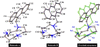
The structure of the title salt comprising two monoprotonated polyamine ligands and one tetra­chloro­zincate(II) anion was analyzed and compared with those of structurally related compounds bearing different macrocyclic frameworks and pendant arms. The protonated nitro­gen atoms engaged in intra­molecular hydrogen bonding with other nitro­gen atoms within the macrocyclic ring.

link to html
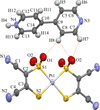
The crystal structure of the title sulfinate-containing platinate salt features cationic chains composed of 4,4′-bipyridin-1-ium surrounding slipped-stacked anions of platinum doubly chelated by a sulfinato ligand.

link to html
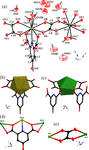
The title compound [PrIII2(HCAM)(ox)2(H2O)4]·4.29H2O features a two-dimensional coordination polymeric framework of PrIII with partially deprotonated chelidamic acid (HCAM2−) and oxalate (ox2−) linkers. The two-dimensional sheets further assemble through hydrogen bonding and π–π inter­actions into three-dimensional supra­molecular architecture.

link to html
The crystal packing is consolidated by O—H⋯N, O—H⋯O, N—H⋯O, and N—H⋯π hydrogen bonds, with the solvent water mol­ecule acting as both donor and acceptor. This results in a two-dimensional hydrogen-bonded network extending parallel to the bc plane.

link to html
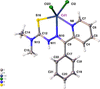
The structure of the cadmium-bound model ligand, 3,3-dimethyl-1-[(E)-[phen­yl(pyridine-2-yl)methyl­idene]amino]­thio­urea (Bp44mT), which is used across medicinal chemistry and in metal-based nanoparticles research has been determined and analyzed. This complex is used to gain insight to the specificity and selectivity of the ligand and to model how 3,3-dimethyl-1-[(E)-[phen­yl(pyridine-2-yl)methyl­idene]amino]­thio­urea might be used in chelation to counter metal poisoning and for environmental remediation.

organic compounds


link to html
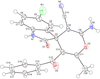
Two almost planar 1,2,3-selena­diazo­les are annulated to a cyclo­octa-1,4-diene with a boat–chair conformation, giving the mol­ecule a butterfly shape.

link to html
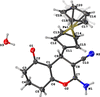
In the title compound, the indoline ring system is almost planar, while the pyran ring is in flattened-boat conformation. In the crystal, N—H⋯O and N—H⋯N hydrogen bonds link the mol­ecules, enclosing R22(8) and R22(12) ring motifs, into (001) sheets.

link to html
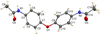
In the title compound, the phenyl groups are twisted away from coplanarity with the ether linkage, forming a dihedral angle of 59.49 (4)° with each other. In the crystal, the acetamide N—H groups form inter­molecular N—H⋯O hydrogen bonds to acetamide O atom, with both NH groups donating to the same mol­ecule. Thus, ladder-like chains exist in the [101] direction.

link to html
The crystal structure of a 4-fluoro­isoxazole compound bearing a sulfonamide functionality is described.

link to html
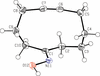
The crystal structure of cyclo­decynone oxime, C10H15NO, is reported. Two twist-boat-shaped cyclo­alkynes are centrosymmetrically connected via oxime hydrogen bridges. Deformation of the alkyne unit results from ring strain.

link to html
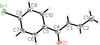
The title compound consists of a para-substituted bromo­phenyl core and an unsaturated carbonyl side chain.

link to html
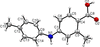
The mol­ecules of the title compound form acid–acid homodimers in the crystal structure.

link to html
In the title salt, the cation is protonated at the thia­zole N atom and in the anion, the sulfonate group is deprotonated and an intra­molecular O—H⋯O hydrogen bond occurs. In the crystal, cation-to-anion N—H⋯O and anion-to-anion O—H⋯O hydrogen bonds link the component ions into (101) sheets.

link to html
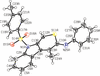
The title indolothiopyrane imine, C25H20N2O2S2, which was prepared by a [2 + 2 + 2] cycloaddition reaction, crystallizes with two molecules in the asymmetric unit. Both adopt the shape of a staircase with two steps, consolidated by intramolecular C—H⋯O interactions.
Follow IUCrData
Sign up for e-alerts
Follow IUCrData on Twitter
Follow us on facebook
Sign up for RSS feeds