issue contents

Journal logoIUCrDATA
ISSN: 2414-3146

October 2025 issue

Highlighted illustration

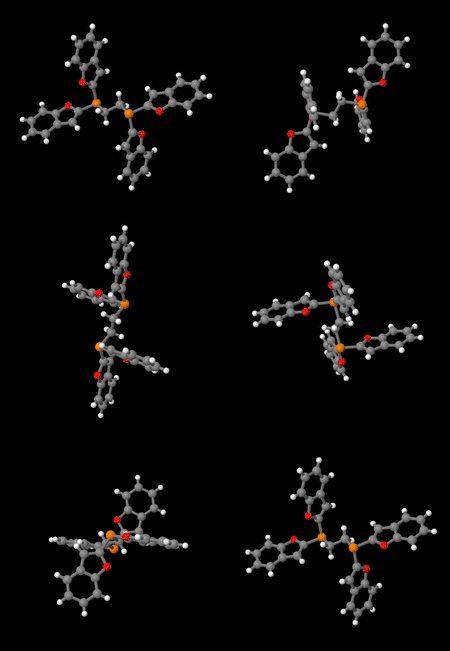
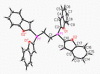
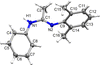
Cover illustration: Bidentate phosphine ligands play a pivotal role in homogeneous catalysis, where their chelation to a metal center enhances complex stability and allows precise control over electronic and steric properties. Benzofurylphosphines represent an alternative structural motif to conventional aryl phosphines, offering distinct electronic and steric properties that can significantly influence catalytic activity. 1,2-Bis­[di­(benzo­furan-2-yl)phosphan­yl]ethane, which consists of an ethyl­ene-bridged diphosphine with benzo­furan residues, reflects the characteristic features of ethyl­ene-bridged diphosphines with the P–C–C–P backbone forming a zigzag chain and exhibiting an anti-conformation. See: Ahrens, Spannenberg, Beller & Junge [IUCrData (2025). 8, x250916]

raw data letters


link to html
The natural amino acid L-aspartic acid contains two carboxylic acid groups, and the crystal structures are characterized by strong intermolecular hydrogen bonds between these groups. Data quality and proper handling of the twinning are essential for the analysis of the protonation states.

metal-organic compounds


link to html
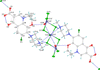
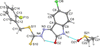
A trinuclear copper(II)–levofloxacin complex, (C18H22FN3O4)2[Cu3Cl9(H2O)2]Cl, was synthesized and its crystal structure determined. It features five-coordinated CuII centres with Jahn–Teller distortion and a three-dimensional hydrogen-bonded supra­molecular network.

link to html
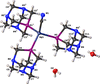
The compound is a neutral discrete complex where the silver(I) center is coordinated by three phospho­rus atoms from three distinct PTA ligands and one carbon atom from the nitrile ion, resulting in a distorted tetra­hedral geometry around the Ag centre.

organic compounds


link to html
The packing of the title solvate features hetero-halogen⋯halogen (Cl⋯F), and chalcogen (S⋯O) bonding, as well as non-standard offset π–π stacking.

link to html
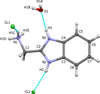
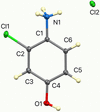
The title hydrated salt, a new monoclinic polymorph, crystallizes in space group P21/c. The components pack in sheets in the ab plane and these sheets are hydrogen bonded to their neighbours, generating a three-dimensional network.

link to html
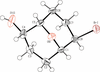
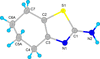
Both six-membered rings in the title bi­cyclo­[3.3.1] system, adopt a chair conformation. Hydrogen bonds from the hy­droxy group to the ether bridge connect the mol­ecules into zigzag chains: single-enantiomer chains propagating along the b-axis direction form the crystal.

link to html
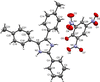
The title mol­ecular salt, C23H21N2+·C6H2N3O7, featuring discrete ion pairs, crystallizes from ethanol through slow solvent evaporation. In the crystal, the imidazolium cation and the picrate anion are linked by N—H⋯O hydrogen bonds as a result of proton transfer from picric acid to the pyrimidine-type nitro­gen atom of the imidazole ring.

link to html
The title compound crystallizes in ortho­rhom­bic space group Pnma with both cations and anions lying on a mirror plane in the crystal. Parallel mol­ecules form stacks with inter­planar spacing 3.1473 (2) Å, but slipped by 1.97 Å.

link to html
In the title compound, the six-membered ring is disordered over two half-chair orientations. In the crystal, infinite [001] chains linked by N—H⋯N hydrogen bonds occur.

link to html
A new electron-rich, bidentate phosphine, 1,2-bis­[di­(benzo­furan-2-yl)phosphan­yl]ethane, was synthesized and structurally characterized by single-crystal X-ray diffraction.

link to html
In the title compound, the dihedral angle between the planes of the pyridine and oxo­pyrroli­dine rings is 6.9 (2)°. In the crystal, inversion dimers linked by pairwise N—H⋯O hydrogen bonds generate R22(14) loops.

link to html
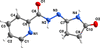
The extended structure of the title compound features strong N—H⋯N hydrogen bonds forming infinite C(4) chains propagating along the c-axis direction.

link to html
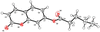
In the title compound, C14H14O4, the dihedral angle between the coumarin nucleus and the penta­noate moiety is 84.6 (9)°. In the crystal, mol­ecules are linked by C—H⋯O hydrogen bonds into centrosymmetric dimers with an R22(8) graph-set motif, and π–π inter­actions are also observed.

link to html
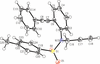
The title compound, C24H19NO2S, was prepared by propargylation of the sulfonamide. The tolyl group points to the planar tolane unit. In the extended structure, two inter­molecular hydrogen bridges connect the mol­ecules to form chains.

link to html
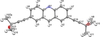
The title acridine derivative, which has two 2-methyl­but-3-yn-2-ol moieties at the 2,7-positions, was synthesized by Sonogashira coupling reaction. In crystal, a columnar structure is formed by the π–π stacking of acridine units. The 2-methyl­but-3-yn-2-ol moieties form inter­molecular hydrogen bonds.
Follow IUCrData
Sign up for e-alerts
Follow IUCrData on Twitter
Follow us on facebook
Sign up for RSS feeds