


 journal menu


issue contents
November 2025 issue
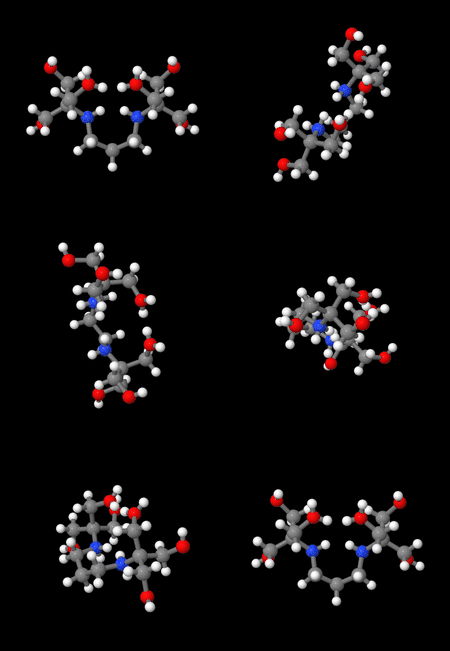
Cover illustration: N,N′-Bis[tris(hydroxymethyl)methyl]propane-1,3-diamine (bis-tris propane or BTP), used for the preparation of buffer solutions and high-nuclearity coordination complexes, crystallizes with a half molecule in the asymmetric unit. The full molecule is completed through mirror symmetry m in the space group Pnma. The molecular shape is bent and this unexpected conformation could be a consequence of a propensity to polymorphism. An assessment of hydrogen-bond coordination likelihood suggests that this structure probably represents the less-stable form in a set of polymorphs. See: Angel-Nieto, Arroyo-Carmona, Pérez-Benítez & Bernès [IUCrData (2025). 8, x250954].
inorganic compounds


Download citation


Download citation
Open  access
access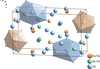
The crystal structure of (Al13.28Si2.72)(Fe1.19Ni2.81) comprises eight sites in the asymmetric unit, one of which is co-occupied by pairs of (Al,Si) atoms, and two by pairs of (Fe,Ni) atoms.
CCDC reference: 2503943
Download citation
Download citation
Open access
access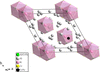
The title quaternary intermetallic material is a new γ-brass obtained using a high-pressure sintering process.
CCDC reference: 2504093
metal-organic compounds
Download citation
Download citation
Open access
access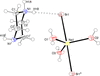
In the title compound, the complete organic cation, which adopts a typical chair conformation, is generated by crystallographic inversion symmetry and one of the N-bonded H atoms is half occupied. The sodium ion (site symmetry m) at the centre of the complex anion adopts a distorted trigonal–bipyramidal coordination geometry with the water molecules in the equatorial sites and the bromide ions in the axial sites. In the extended structure, O—H⋯Br hydrogen bonds generate a porous ‘honeycomb' three-dimensional network of complex anions encapsulating [010] channels occupied by the cations.
CCDC reference: 2500621
Download citation
Download citation
Open access
access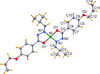
In the bis-chelated mononuclear nickel(II) title complex with benzohydrazide ligands bearing an allyloxy group, the nickel(II) atom exhibits a slightly distorted square-planar coordination environment with the metal located on a crystallographic center of symmetry that induces a trans configuration of the N,O chelating ligands..
CCDC reference: 2335124
Download citation
Download citation
Open access
access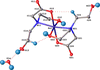
The ZnII atom in the title compound has distorted octahedral N2O4 coordination geometry. The intermolecular interactions in the crystal structure consist of O–H⋯O and weak C–H⋯O hydrogen bonds.
CCDC reference: 2502108
Download citation
Download citation
Open access
access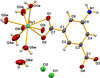
The title compound contains zigzag polymeric chains built up from nine-coordinated DyIII centers and bridging 5-azaniumylisophthalate ligands.
CCDC reference: 2502795
organic compounds
Download citation
Download citation
Open access
access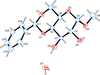
The title compound is a hydrated, partially protected derivative of D-glucopyranose. Intermolecular interactions connect the entities of the asymmetric unit to a three-dimensional network.
CCDC reference: 2498654
Download citation
Download citation
Open access
access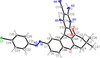
In the title compound, much of the molecule (excluding the pyridinic ring) is approximately planar. In the extended structure, various hydrogen bonds combine to form a layer structure parallel to (111).
CCDC reference: 2497635
Download citation
Download citation
Open access
access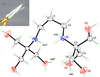
The crystal structure of a reagent frequently used for the preparation of buffer solutions is reported, showing that the molecule lies on a crystallographic mirror plane, and has a bent conformation.
CCDC reference: 2498903
Download citation
Download citation
Open access
access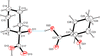
The title compound is a derivative of cyclohexanecarboxylic acid bearing a hydroxyl group in its α-position and is a polymorph of the previously reported monoclinic form.
CCDC reference: 2500425
Download citation
Download citation
Open access
access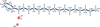
The title compound, C21H38N+·Br−·H2O, is the bromide salt of a quarternary pyridinium cation bearing a hexadecyl chain on the nitrogen atom. One molecule of solvent water is present in the asymmetric unit. Classical hydrogen bonds of the O—H⋯Br type are observed next to C—H⋯Br and C—H⋯O contacts that connect the entities of the title compound to sheets parallel to the ab plane.
CCDC reference: 2501304
Download citation
Download citation
Open access
access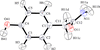
In the title molecule, an isomer of acetaminophen, the acetamide plane is perpendicular to the phenyl ring plane with the –NH2 group directed outward, in contrast to an in vacuo DFT geometry optimization in which the –NH2 group is directed inward.
CCDC reference: 2502168
Download citation
Download citation
Open access
access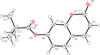
In the title compound, the dihedral angle between the 2H-chromen-2-one moiety and the C—CO2 ester grouping is 54.30 (5)°. In the crystal, the molecules are linked by C—H⋯O hydrogen bonds forming C(6) [100] chains.
CCDC reference: 2498840
Download citation
Download citation
Open access
access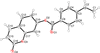
In the title compound, C—H⋯O hydrogen bonds generate infinite (101) sheets.
CCDC reference: 2503393
Download citation
Download citation
Open access
access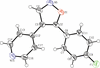
The title compound, C14H9FN2O, crystallizes in the monoclinic space group P21/c. The dihedral angles between the central isoxazole ring and the 4-fluorophenyl and pyridine rings are 32.64 (5) and 32.70 (7)°, respectively.
CCDC reference: 2500863
Download citation
Download citation
Open access
access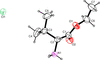
The title compound is the hydrochloride salt of the ethyl ester of L-valine. Intermolecular interactions connect the entities of the asymmetric unit into sheets lying parallel the the bc plane.
CCDC reference: 2505000
Download citation
Download citation
Open access
access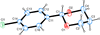
The title compound is the acetal of 4-chlorobenzaldehyde and 1,3-propanediol. In the crystal, weak C—H⋯O contacts connect the molecules to centrosymmetric dimers.
CCDC reference: 2504999
Download citation
Download citation
Open access
access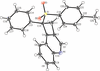
The title compound forms strands along the b-axis direction via hydrogen bonds from the tolyl group to the sulfonyl oxygen atoms. The tricyclic framework is almost planar and the two six-membered aromatic substituents are nearly coparallel.
CCDC reference: 2502744
![[publCIF]](/logos/authorchecklist11.gif)