

 journal menu


issue contents
May 2026 issue
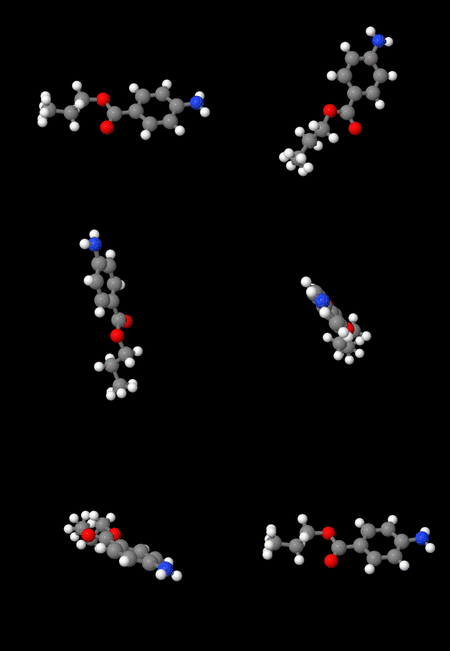
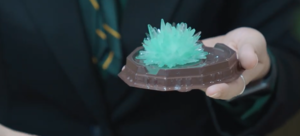
Cover illustration: Propyl 4-aminobenzoate, C10H13NO2, was synthesized through a Fischer esterification. The crystal structure complements the physical and spectroscopic data collected as part of a guided inquiry undergraduate Organic Chemistry laboratory experiment. See: Gutzwiller, Hermann & Harakas [IUCrData (2026). 8, x260456].
organic compounds


Download citation


Download citation
Open  access
access
The crystal and molecular structure of 4-[4-(4-chloro-1,2,5-thiadiazol-3-yl)phenyl]morpholine are reported.
CCDC reference: 2548183
Download citation
Download citation
Open access
access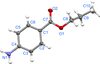
The title compound C10H13NO2 was synthesized through a Fischer esterification. The crystal structure complements the physical and spectroscopic data collected as part of a guided inquiry undergraduate Organic Chemistry laboratory experiment.
CCDC reference: 2550860
Download citation
Download citation
Open access
access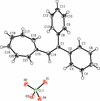
In the title salt, two hydrogen bonds from the tropylium moiety and the vinyl group connect the cation with oxygen atoms of the perchlorate anion. The perchlorate anion is surrounded by three tropylium cations. The tropylium rings of the cations, which are related via a C2 axis, are mostly parallel with a short distance between the centroids.
CCDC reference: 2551594
Download citation
Download citation
Open access
access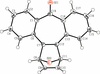
The molecules of the title compound, C19H12O2, adopt a saddle shape with almost planar o-xylylene fragments. The carbonyl group and the ether oxygen atom are located on the same side of the carbon skeleton. The molecules are arranged in strands with alternating directions.
CCDC reference: 2553510
Download citation
Download citation
Open access
access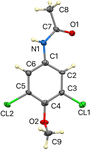
The title compound crystallizes as a two-component twin in space group P1 with Z′ = 6, exhibiting packing-driven conformational multiplicity and N—H⋯O hydrogen-bonded chains propagating along [110].
CCDC reference: 2536293
Download citation
Download citation
Open access
access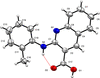
In the title compound,the dihedral angle between the quinoline ring system and the pendant phenyl ring is 6.19 (6)° and an intramolecular N—H⋯O hydrogen bond supports the near-planar conformation. In the extended structure, the molecules associate to form centrosymmetric carboxylic acid dimers linked by pairs of O—H⋯O hydrogen bonds.
CCDC reference: 2556750
Download citation
Download citation
Open access
access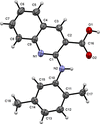
The title compound was synthesized using a Buchwald–Hartwig cross-coupling reaction followed by hydrolysis. Single crystals were obtained by slow evaporation of an ethanol solution of it at room temperature. In the crystal, adjacent molecules form carboxylic acid dimers via intermolecular hydrogen bonding.
CCDC reference: 2556276
Download citation
Download citation
Open access
access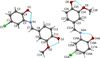
The title compound was obtained from the reaction of 2-amino-4-chloro phenol with vanillin (4-hydroxy-3-methoxybenzaldehyde). It crystallizes with two independent and conformationally different molecules in the asymmetric unit.
CCDC reference: 2448683
![[publCIF]](/logos/authorchecklist11.gif)