


 menu
menu


issue contents
August 2026 issue
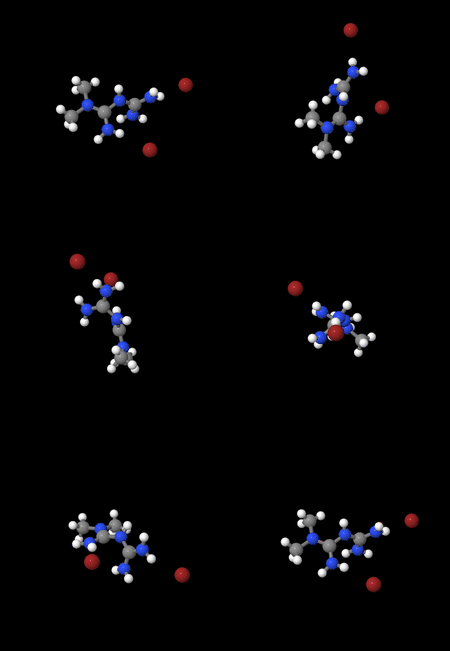
Cover illustration: The crystal structure of the salt metformindiium dibromide, C4H13N52+·2Br−, is reported in space group P21/c, with Z = 4. Unexpectedly, this crystal is not isomorphous to the dichloride analogue, which has been reported in space group P21 (Z = 2). This originates from the shift of one halide anion in the asymmetric unit, which modifies the network of N—H⋯halide hydrogen bonds. This report is an example of a routine refinement carried out using now well-established techniques of quantum crystallography. See: Pérez-Benítez, Hernández Márquez, Arroyo-Carmona & Bernès [IUCrData (2026). 8, x260791].
raw data letters


Open  access
access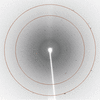
A query over the electron density fit of a monosaccharide in pdb_00004dda was resolved through applying the data metrics of the raw diffraction data processing that have evolved though the decade since the original publication. This improved the electron-density quality to allow a definitive model fit.
inorganic compounds

Download citation


Download citation
Open access
access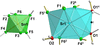
Sr[SnF6]·2H2O is isostructural with the analogous hexafluoridoiridate(IV) and consists of almost undistorted [SnF6]2– octahedra and of distorted [SrF5(H2O)3] square antiprisms linked via common water molecules into centrosymmetric dimers.
CCDC reference: 2577756
Download citation
Download citation
Open access
access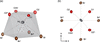
The crystal structure of Pb2O(OH)Br has tetragonal symmetry and differs from those of the Cl (orthorhombic) and I (monoclinic) analogues.
CCDC reference: 2578647
Download citation
Download citation
Open access
access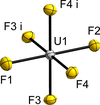
Re-refinement of the crystal structure of UF6 using single-crystal X-ray diffraction data at 100 K allowed to obtain a more precise structural model in comparison with previous studies.
CCDC reference: 2580701
Download citation
Download citation
Open access
access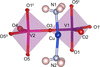
[Cu(NH3)2]V2O5 contains layers of {V2O5}− anions expanding in the bc plane, separated by almost linear [Cu(NH3)2]+ cations.
CCDC reference: 2583502
metal-organic compounds
Download citation
Download citation
Open access
access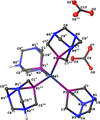
In the title salt, the silver(I) ion is coordinated by both neutral 1,3,5-triaza-7-phosphaadamantane (PTA) and protonated PTAH+ ligands.
CCDC reference: 2578472
Download citation
Download citation
Open access
access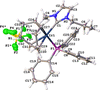
The complex cation in the title compound has a distorted square-planar conformation around the IrI atom, formed by a bidentate cycloocta-1,5-diene (COD) ligand, a phosphane ligand, and an N-heterocyclic carbene (NHC) ligand.
CCDC reference: 2581838
Download citation
Download citation
Open access
access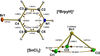
The crystal structure of the title compound comprises [SnIICl3]− and [4-BrPyH]+ ions. The structural parameters of the anion and the cation are presented and compared with those in other compounds. Intermolecular interactions such as tetrel bonds, π–π interactions and N—H⋯Cl hydrogen bonds are analysed.
CCDC reference: 2582901
organic compounds
Download citation
Download citation
Open access
access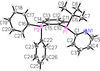
The title compound, C27H27NP2, consists of a diphenylphosphino and a tert-butyl(2-pyridyl)phosphino group bridged by a 1,2-phenylene backbone.
CCDC reference: 2578570
Download citation
Download citation
Open access
access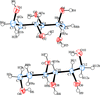
The title compound, 2-deoxy-D-galactitol, was prepared by sodium borohydride reduction of 2-deoxy-D-galactose and crystallized from water. Its crystal structure contains two crystallographically independent molecules in the asymmetric unit, which are linked by O—H⋯O hydrogen bonds into a three-dimensional network.
CCDC reference: 2574888
Download citation
Download citation
Open access
access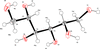
The title compound, L-iditol, was crystallized from aqueous solution. It crystallizes in the monoclinic space group P21 with one molecule in the asymmetric unit. The molecules are linked by O—H⋯O hydrogen bonds into a three-dimensional network.
CCDC reference: 2577698
Download citation
Download citation
Open access
access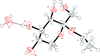
The title compound, ethyl α-D-sorboside monohydrate, was prepared by Fischer glycosylation of D-sorbose with ethanol. The crystal structure contains one water molecule per sorboside molecule, and the components are linked by O—H⋯O hydrogen bonds.
CCDC reference: 2577733
Download citation
Download citation
Open access
access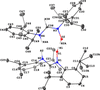
The title compound is a symmetrical diarylformamidine derivative bearing diisopropyl substituents. The compound contains two independent molecules in the asymmetric unit, one being the zwitterionic and the other the neutral forms of the diarylformamidine derivative. The two molecules are connected by O—H⋯O and N—H⋯N hydrogen-bonding interactions within a cyclic assembly.
CCDC reference: 2578952
Download citation
Download citation
Open access
access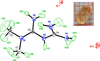
The crystal structure of the dibromide salt of metforminium(2+) in space group P21/c is compared to that of the dichloride analogue, previously reported in space group P21.
CCDC reference: 2578518
Download citation
Download citation
Open access
access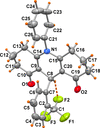
The two crystallographic independent molecules in the title compound display short intramolecular C—H⋯F hydrogen bonds.
CCDC reference: 2579961
Download citation
Download citation
Open access
access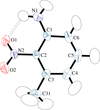
The structure of the title compound completes structural characterization for the family of methyl-2-nitroaniline isomers. Bond lengths and angles conform to reported values in other methyl-2-nitroaniline structures, except for the large angle [36.82 (4)°] formed between the phenyl ring and nitro group mean planes, which is due to steric crowding by the neighboring methyl group
CCDC reference: 2580961
Download citation
Download citation
Open access
access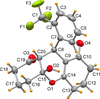
The title compound, C20H19F3O4, crystallizes with two independent molecules with similar geometry. In both molecules the tetrahydropyran, cyclohexene and cyclohexane rings of the xanthene moiety adopt half-chair, half-boat and chair conformations, respectively.
CCDC reference: 2580767
Download citation
Download citation
Open access
access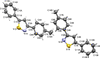
The asymmetric unit of the title 3-(4-methylphenyl)-5-phenyl-1,2-thiazole compound comprises two independent molecules with nearly planar geometries. No classical hydrogen bonds are found in the crystal structure.
CCDC reference: 2580089
Download citation
Download citation
Open access
access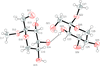
The title compound, methyl α-D,L-sorboside, was prepared from an equimolar mixture of D- and L-sorbose (D:L = 1:1) by Fischer glycosidation in methanol. The asymmetric unit contains one molecule each of methyl α-D-sorboside and methyl α-L-sorboside, which are linked by O—H⋯O hydrogen bonds into a two-dimensional network parallel to (001).
CCDC reference: 2582017
Download citation
Download citation
Open access
access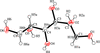
The crystal structure of L-talitol, the sugar alcohol corresponding to L-talose, is presented. The molecules are linked by O—H⋯O hydrogen bonds into a three-dimensional network.
CCDC reference: 2577672
Download citation
Download citation
Open access
access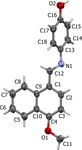
The title compound was obtained from the reaction of 4-hydroxy-aniline and 4-methoxy-1-naphthaldehyde in ethanol. The dihedral angle between the phenol ring and the mean plane of the naphthalene ring system is 75.81 (6)°.
CCDC reference: 2582009
Download citation
Download citation
Open access
access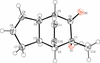
The tricyclic molecule of the title compound is composed of four nearly planar subunits. Hydrogen bonds connect the ketol units to chains along the a-axis direction. The structure is further consolidated by two C—H⋯O hydrogen bonds, one to the carbonyl and one to the hydroxy group.
CCDC reference: 2583168
Download citation
Download citation
Open access
access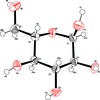
The title compound, α-L-glucose, was crystallized by slow evaporation from aqueous solution. It crystallizes in the orthorhombic space group P212121, and the molecules are linked by O—H⋯O hydrogen bonds into a three-dimensional network.
CCDC reference: 2577717
![[publCIF]](/logos/authorchecklist11.gif)