


 menu
menu


issue contents
July 2026 issue
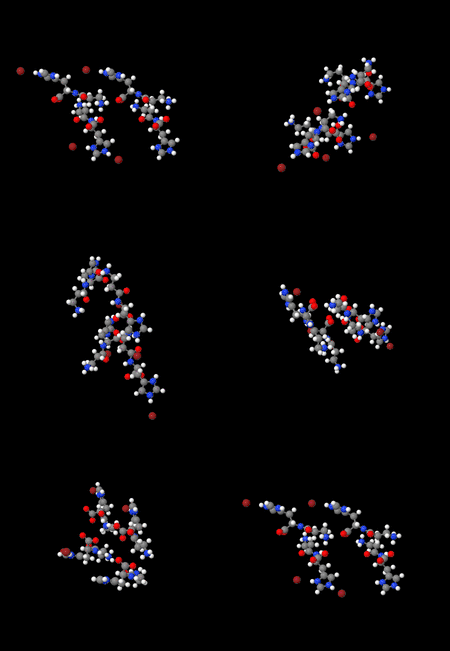
Cover illustration: The asymmetric unit of the salt carnosinium bromide contains four cations and four anions. The dipeptide is a 'cationic zwitterion' with two localized positive charges and one delocalized negative charge. Two of the cations adopt an anti conformation for the non-hydrogen atoms of the –C(=O)—CH2—CH2—NH3+ grouping and two adopt a gauche conformation. In the extended structure, numerous N—H⋯O, N—H⋯(O,O) and N—H⋯Br hydrogen bonds link the components into (010) sheets and the structure is consolidated by weak C—H⋯O and C—H⋯Br interactions. See: Hamilton & Harrison [IUCrData (2026). 8, x260726].
inorganic compounds


Download citation


Download citation
Open  access
access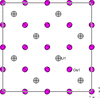
Refinement of the crystal structure of UOs2 was performed for the first time by using single-crystal X-ray diffraction data, which allowed the refinement of all Uij terms of the displacement parameters.
CCDC reference: 2567529
metal-organic compounds
Download citation
Download citation
Open access
access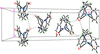
Two molecules with slightly different five-coordinate CuII atoms are present in the asymmetric unit of thetitle complex.
CCDC reference: 2566612
Download citation
Download citation
Open access
access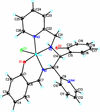
The title copper(II) complex shows the central CuII cation to be in a slightly distorted square-pyramidal coordination by the [ClN3O] coordination set.
CCDC reference: 2572974
Download citation
Download citation
Open access
access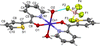
A complex of CoII with the ligand 2-thienyl-2-pyridyl ketone shows pseudo-octahedral binding of the central metal cation with two ligands bound through the carbonyl oxygen and pyridyl nitrogen, and two coordinating water molecules in the axial positions.
CCDC reference: 2574968
organic compounds
Download citation
Download citation
Open access
access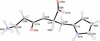
The asymmetric unit of the title salt contains four cations and four anions. The dipeptide is a 'cationic zwitterion' with two localized positive charges and one delocalized negative charge. Two of the cations adopt an anti conformation for the non-hydrogen atoms of the –C(=O)—CH2—CH2—NH3+ grouping and two adopt a gauche conformation. In the extended structure, numerous N—H⋯O, N—H⋯(O,O) and N—H⋯Br hydrogen bonds link the components into (010) sheets and the structure is consolidated by weak C—H⋯O and C—H⋯Br interactions.
CCDC reference: 2573338
Download citation
Download citation
Open access
access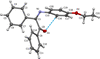
In the title compound, an imino-ketone Schiff base, the configuration about the azomethine bond is E.
CCDC reference: 2574557
Download citation
Download citation
Open access
access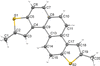
The title molecule is puckered due to steric crowding. The extended structure features C—H⋯π interactions.
CCDC reference: 2570636
![[publCIF]](/logos/authorchecklist11.gif)