


 journal menu


issue contents
February 2026 issue
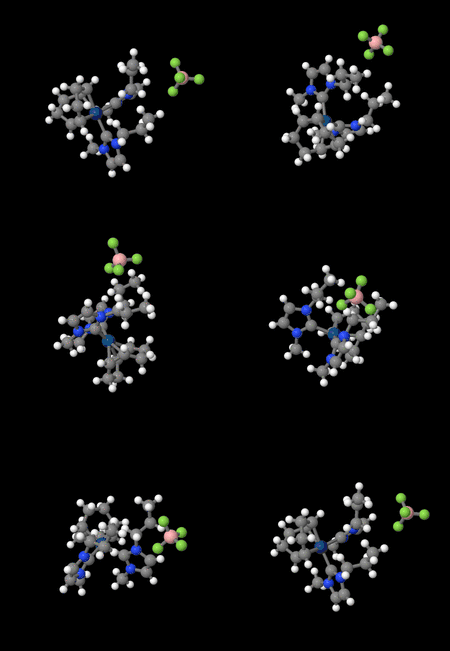
Cover illustration: N-heterocyclic carbenes (NHCs) have emerged as excellent alternative ligands for phosphines to synthesize active metal complexes in homogeneous catalysis. The NHC ligands can be tuned sterically and electronically by having different substituents (wing tips) on the nitrogen atoms. In [(1,2,5,6-η)-cycloocta-1,5-diene]bis(1-methyl-3-propylimidazol-2-ylidene-κC)iridium(I) tetrafluoridoborate, [Ir(C8H12)(C7H12N2)2]BF4, the central IrI atom of the cationic complex has a distorted square-planar coordination environment, formed by a bidentate cycloocta-1,5-diene (COD) ligand and two N-heterocyclic carbene ligands. Non-classical hydrogen-bonding interactions between the [BF4]− anion and the N-heterocyclic carbenes on three distinct cationic iridium(I) complexes serve to establish the orientation of the [BF4]− anion in the extended structure. See: Kienle, Gau, Albert & Rajaseelan [IUCrData (2026). 8, x260189].
inorganic compounds


 access
metal-organic compounds
access access
 access
organic compounds
access access
 access
 access
 access
addenda and errata
access
![[publCIF]](/logos/authorchecklist11.gif)