


 journal menu


issue contents
March 2026 issue
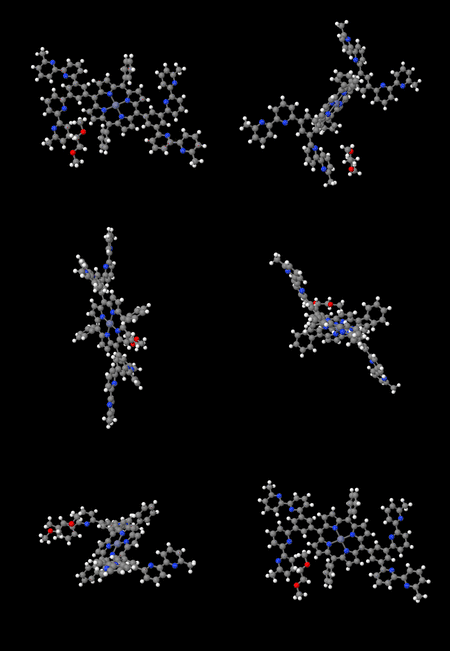
Cover illustration: In {5,15-bis[3,5-bis(6′-methyl-2,2′-bipyridyl-6-yl)phenyl]-10,20-diphenylporphyrin}zinc(II) 1,2-dimethoxyethane 0.296-solvate, [Zn(C88H60N12)]·0.296C4H10O2, the porphyrin macrocycle is essentially planar, with the Zn atom located in the plane on an inversion centre. The bipyridine units are located on both sides of the porphyrin plane due to the substitution at the 3- and 5-positions of the meso-phenyl ring. One bipyridine moiety folds back towards the porphyrin, while the other extends away from the porphyrin. See: Akitomi, Kato, Hosoya, Sugawa & Otsuki [IUCrData (2026). 8, x260259].
inorganic compounds


Download citation


Download citation
Open  access
access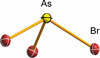
The crystal structure of AsBr3 was redetermined by low-temperature single-crystal X-ray diffraction, leading to higher precision in the obtained bond lengths and angles.
CCDC reference: 2535582
Download citation
Download citation
Open access
access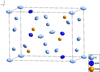
The Al8.77Fe0.80Ni1.20Si0.23 (aluminium iron nickel silicate) phase, obtained via high-pressure sintering of an Al-rich prealloy (nominal composition Al78.08Fe8.65Ni8.69Si4.58), is characterized as a novel phase in the Al—Si—Ni—Fe quaternary system.
CCDC reference: 2537011
metal-organic compounds
Download citation
Download citation
Open access
access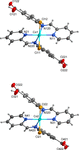
Two chlorido and two chelating pyridinyliminobenzoic acid ligands coordinate a cobalt(II) centre with the carboxylic being non-coordinating.
CCDC reference: 2063851
Download citation
Download citation
Open access
access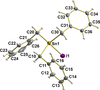
Single crystals of tribenzyltin(IV) iodide, prepared from hexabenzyldistannoxane, Bz3SnOSnBz3, and hydroiodic acid, have been characterized by single-crystal X-ray diffraction in order to clarify some inconsistencies in the original structure determination. In particular, the present study provides a significantly longer tin–iodide distance, which corresponds much better with those in related structural studies.
CCDC reference: 2533567
Download citation
Download citation
Open access
access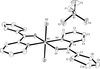
The NiII atom in the complex cation of the title salt is located on an inversion center and shows a pseudo-octahedral coordination with two ligands bound through the carbonyl oxygen and pyridyl nitrogen atoms in the equatorial and two aqua ligands in the axial positions.
CCDC reference: 2535729
Download citation
Download citation
Open access
access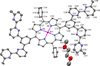
In the title compound, the porphyrin macrocycle is essentially planar, with the Zn atom located in the plane on an inversion centre. The bipyridine units are located on both sides of the porphyrin plane due to the substitution at the 3- and 5-positions of the meso-phenyl ring. One bipyridine moiety folds back towards the porphyrin, while the other extends away from the porphyrin.
CCDC reference: 2536703
Download citation
Download citation
Open access
access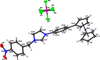
In the title ferrocenylphenyl functionalized imidazolium salt, the 1-(4-ferrocenylphenyl)-3-(4-nitrobenzyl)imidazolium cation adopts a syn-periplanar arrangement, with the ferrocenylphenyl substituent tilted by 38.32 (7)° relative to the imidazolium core. In the crystal, interionic C—H⋯F hydrogen bonds generate graph-set motifs R12(7) and R21(4), assembling the ions into chains that propagate along the c-axis direction.
CCDC reference: 2537159
organic compounds
Download citation
Download citation
Open access
access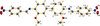
The title compound crystallizes in the monoclinic space group I2/a with one half-molecule in the asymmetric unit. The structure exhibits non-planar Schiff base moieties, extended π-conjugation, and a supramolecular framework consolidated by C—H⋯O, π–π stacking, and C—H⋯π interactions forming layers parallel to the (101) plane.
CCDC reference: 2487703
Download citation
Download citation
Open access
access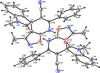
In the two molecules in the asymmetric unit of the title compound, C22H16N4O2, the isoxazole ring is inclined to the pyridine ring system, the indoline ring, and the phenyl ring by 8.00 (10), 70.93 (10), and 35.89 (12)°, respectively, for molecule A, and 4.24 (10), 84.62 (9), and 30.02 (11)° for molecule B. In the crystal, molecules are linked by N—H⋯O, C—H⋯O and C—H⋯N interactions, forming layers parallel to the (100) plane.
Download citation
Download citation
Open access
access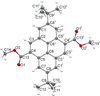
The title compound crystallizes in space group Pbca with four molecules in the unit cell.
CCDC reference: 2535992
Download citation
Download citation
Open access
access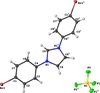
The crystal structure of the title imidazolium salt exhibits structure-directing, intermolecular halogen-bonding patterns through F⋯Br and F⋯πphenyl interactions via the tetrafluoroborate anion.
CCDC reference: 2536403
Download citation
Download citation
Open access
access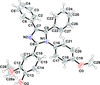
In the title compound, which was synthesized via a four-component Debus–Radziszewski reaction, the OH group of the vanillin substituent forms both an intramolecular and an intermolecular hydrogen bond, the latter generating [010] chains. The extended structure is consolidated by weak C—H⋯O and C—H⋯π interactions, generating a criss-cross motif.
CCDC reference: 2263383
Download citation
Download citation
Open access
access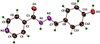
The crystal structure of a polymorph of N′-[(4-hydroxyphenyl)methylidene]pyridine-4-carbohydrazide reveals a distinct supramolecular arrangement arising from variations in intermolecular hydrogen bonding relative to the known polymorph.
CCDC reference: 2540578
![[publCIF]](/logos/authorchecklist11.gif)