


 journal menu


issue contents
December 2025 issue
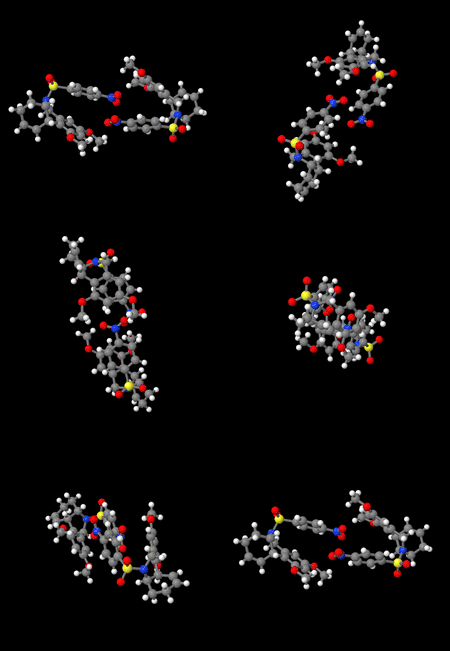
Cover illustration: (4aR*,10bR*)-8,10-Dimethoxy-5-[(4-nitrophenyl)sulfonyl]-3,4,4a,5,6,10b-hexahydrophenanthridine, which was obtained during a study directed to the synthesis of the anti-cancer natural product, pancratistatin, crystallizes with two independent molecules in the asymmetric unit, related by an approximate inversion center near (1/4, 1/2, 1/4) in space group P21/c. They have similar but not identical shapes. The crystal structure confirms the expected molecular structure of the compound. In the extended structure, C—H⋯O interactions connect the molecules into a two-dimensional network lying perpendicular to the b axis. See: DiGrandi, Neary & Corfield [IUCrData (2025). 8, x251115].
inorganic compounds


Download citation


Download citation
Open  access
access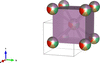
The refractory high-entropy alloy Mo0.20Nb0.21Ta0.19V0.20W0.20 crystallizes in a tungsten-type structure with all elements located on a single crystallographic site.
CCDC reference: 2514546
metal-organic compounds
Download citation
Download citation
Open access
access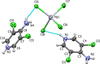
In the complex anion of the title salt, the Hg2+ ion is coordinated by four Cl− ligands, forming a distorted tetrahedral geometry. In the extended structure, the cations and anions are linked via N—H⋯Cl and C—H⋯Cl hydrogen bonds.
CCDC reference: 2502353
organic compounds
Download citation
Download citation
Open access
access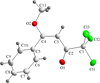
The crystal structure and Hirshfeld analysis of the title compound is reported. The E isomer of the central alkene entity was unequivocally determined, in which weak intramolecular interactions between the ketone and the phenyl groups are suggested. In addition, the molecules are connected by weak intermolecular Cl⋯O interactions along [100].
CCDC reference: 2513465
Download citation
Download citation
Open access
access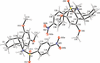
(4aR*,10bR*)-8,10-Dimethoxy-5-[(4-nitrophenyl)sulfonyl]-3,4,4a,5,6,10b-hexahydrophenanthridine
The title compound, C21H22N2O6S, which was obtained during a study directed to the synthesis of the anti-cancer natural product, pancratistatin, crystallizes with two independent molecules in the asymmetric unit with similar but not identical shapes. The crystal structure confirms the expected molecular structure of the compound.
CCDC reference: 2514900
Download citation
Download citation
Open access
access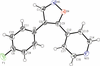
In the title compound, the dihedral angles between the central isoxazole ring and the 4-fluorophenyl and pyridine rings are 37.51 (10) and 12.11 (15)°, respectively.
CCDC reference: 2514389
Download citation
Download citation
Open access
access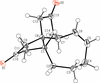
The title compound features a diquinane being annulated to a cyclooctene in twist-boat-chair conformation. In the crystal, hydrogen bonds connect the molecules into centrosymmetric dimers, which are further connected into chains.
CCDC reference: 2515991
Download citation
Download citation
Open access
access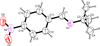
In this Schiff base derived from tert-butylamine and para-nitrobenzaldehyde, C—H⋯O contacts connect the molecules into chains along the b-axis direction.
CCDC reference: 2516436
Download citation
Download citation
Open access
access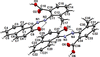
The title compound crystallizes with two zwitterionic molecules (A and B) in the asymmetric unit, each featuring an intramolecular N—H⋯O hydrogen bond. In the extended structure, A + A and B + B carboxylic-acid inversion dimers linked by pairwise O—H⋯O hydrogen bonds arise, which generate R22(8) loops in each case. The dimers are linked by weak C—H⋯π and π–π stacking interactions.
CCDC reference: 2517770
Download citation
Download citation
Open access
access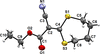
In the title compound, the seven-membered 1,3-dithiepane ring adopts a distorted chair conformation. In the extended structure, inversion dimers linked by pairwise C—H⋯O hydrogen bonds generate R22(14) loops.
CCDC reference: 2517231
![[publCIF]](/logos/authorchecklist11.gif)