

 menu


metal-organic compounds
 | IUCrDATA |
 access
Pyridinium tribromidostannate(II)

aChemistry, Osnabrück University, Barabarstr. 7, 49069 Osnabrück, Germany
*Correspondence e-mail: [email protected]
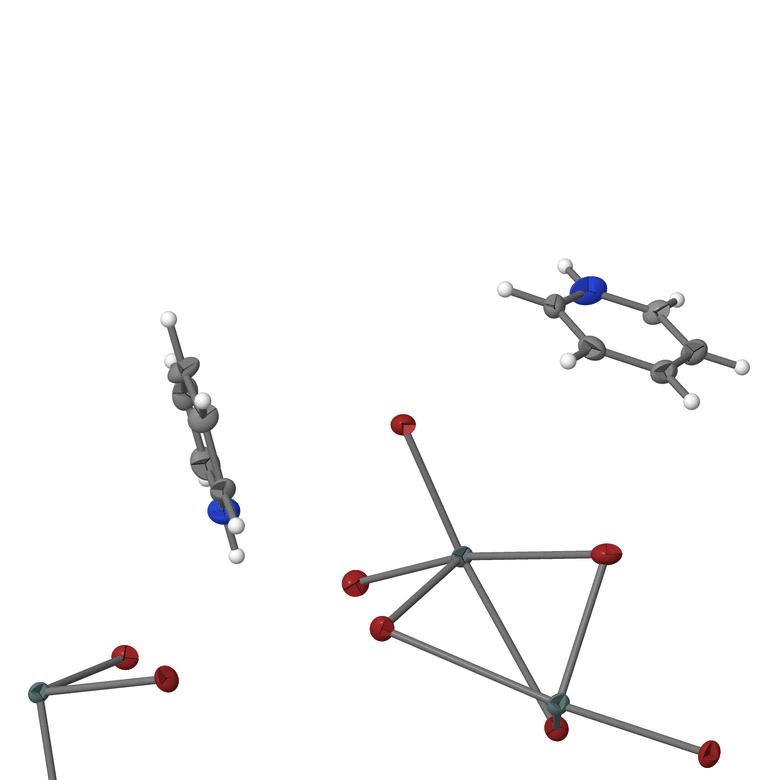
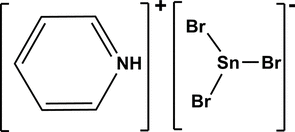
Single crystals of the title compound, (C5H6N)[SnBr3] or [PyH][SnBr3], were grown from aqueous solutions of pyridinium bromide, [PyH]Br, and tin dibromide, SnBr2. The compound crystallizes in the monoclinic space group P21/n with two formula units in the asymmetric unit. The cations have bond lengths and angles similar to those found in other pyridinium salts. In its first coordination sphere, the anions have a trigonal–pyramidal (tpy) shape with the SnII atoms at the apex and the three bromine atoms at the base. The tin–bromine bond lengths are all greater than 2.5 Å, and the bond angles are all less than 92°, which indicates the presence of tetrel bonds. These occur along the twofold screw axis and extend the coordination sphere of the tin atoms to highly distorted, 33-aaa octahedra. In the crystal, the two pyridinium cations are aggregated via weak π–π interactions into centrosymmetric dimers, which form angles of 61.4 (4)° between them. Additional N—H⋯Br hydrogen bonds between cations and anions are bifurcated and weak.
Keywords: crystal structure; tribromidostannate ion; tetrel bonds; π–π interaction; N—H⋯Br hydrogen bonds.
CCDC reference: 2592101
Structure description
To date, no compounds of divalent tin with pyridinium cations are known. The title compound, pyridinium tribromidostannate(II), is the first example in this class of compounds and, at the same time, provides new insights into the tetrel-like interaction between the anions, on the one hand, and the π–π interactions between the cations, on the other.
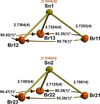
The title compound crystallizes in the monoclinic space group P21/n with Z = 8 and Z′ = 2. Based on the observed internal structural parameters (Fig. 1 ), the two [SnBr3]− anions do not belong to the class of ‘isolated' tribromidostannate anions, which are typically characterized by bond angles all larger than 92.7° and atomic distances all shorter than 2.654 Å as they appear in the compounds [Ph4P][SnBr3] (Müller et al., 1982), [SnBr(crypt-222][SnBr3] (Avery et al., 2012), or [Cy3PH][SnBr3] (Naglav et al., 2021). Rather, they belong to the class of ‘associated' anions. In this group, one, two or all three tin–bromine bonds are longer than 2.654 Å, and one or more bond angles are less than 90°. Typical examples are: [3-MePipH][SnBr3] (Wang et al., 2025), [C6H10N2][SnBr3]2 (Matheu et al., 2022) or [PipH][SnBr3] (Abrahams et al., 1994). In this group of tribromidostannate anions, association occurs via the tin atoms, which form additional, so-called tetrel bonds (Bauzá et al., 2019; Brammer et al., 2023), characterized by the fact that these additional bonds occur in a trans position to existing strong, two-centre-two-electron (2c–2e) bonds. In the broadest sense, tetrel bonds can be regarded as extensive three-centre-four-electron (3c–4e) bonds based on an almost linear alignment of the p-orbitals of the three atoms involved in the X—Sn⋯Y arrangement (Reuter, 2025).
|
Figure 1
The two [SnBr3]− anions of the asymmetric unit with atom numbering, bond lengths (Å), bond angles (°) and distance (Å) of the tin atom from the basal plane in square brackets. All atoms are drawn as anisotropic displacement ellipsoids at the 50% probability level. |
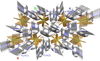
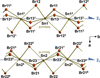
A look at the crystal structure (Fig. 2) shows that these intermolecular interactions occur along the b-axis direction and are associated with the two twofold screw axes of the space group. This symmetry element, which determines the association of the [SnBr3]− ions into chains, is also found, for example, in the compound [3-CF3PyH][SnBr3] (Chen et al., 2026). In the case of the anions, the interactions result in three tetrel bonds (Fig. 3, Table 1) for each of the two tin atoms. With the asymmetry quotients Q = d(Sn⋯Br)/d(Sn—Br) listed in Table 1, these 3c–4e bonds are highly asymmetric, causing the trigonal–pyramidal, 30 configuration (Schröder et al., 2024) of the first coordination sphere being extended to a highly distorted octahedral, 33-aaa configuration. Similarly, the interpenetration indices ρ (Echeverría & Alvarez, 2023) using the van der Waals radii [rvdW(Br) = 1.83 Å, rvdW(Sn) = 2.17 Å; Cordero et al., 2008] and the covalent radii [rcov(Br) = 1.20 Å, rcov(Sn) = 1.39 Å); Mantina et al., 2009] support this concept. Furthermore, the calculation of bond valences (BV) according to Hu et al. (2012) [Rij = 2.50, b = 0.37] shows that the intermolecular Sn⋯Br distances contribute only slightly [0.26/0.24 valence units for Sn1/Sn2] to the calculated overall bond valence sum [BVScal = 1.85/1.89] of the divalent tin atoms.
|
|
Figure 2
Perspective view into the crystal of [PyH][SnBr3] looking down the b axis. All components are drawn as stick models with the cations in the background additionally represented as space-filling models. Colour code and van der Waals radii used: Sn = bronze, C = dark grey, 1.70 Å, H = white, 1.20 Å, N = light blue, 1.55 Å, Br = brown. |
|
Figure 3
Side-view on the twofold screw axis causing the tetrel bond formation in case of Sn1 (top) and Sn2 (bottom) with their distances from the screw axis in square brackets. Tin-bromine bonds of the first coordination spheres are drawn as solid sticks, those characterizing the tetrel bonds are visualized as dashed sticks. [Symmetry codes: (1)  − x, −  + y, − z; (2) x, −1 + y, z; (3) − x, + y, − z; (4) x, 1 + y, z; (5) − x, − + y, − z; (6) x, −1 + y, z; (7) − x, + y, − z; (8) x, 1 + y, z.] |
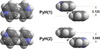
The pyridinium cations are each linked on one side via centers of symmetry to form dimers (Fig. 4). The centers of symmetry are located at Wyckhoff position c for the pyridinium ion PyH(1) and Wyckhoff position d for the pyridinium ion PyH(2). The least-squares planes of the two pyridinium rings are at an angle of 61.4 (1)° to one another, excluding any additional π–π interactions between both. In the dimers, the distance between the least-squares planes is 3.123 Å in the case of PyH(1) and 3.085 Å in the case of PyH(2). Although, or rather because, these distances are relatively short, the overlap occurs essentially only in the region of the hydrogen atoms and not in the region of the ring atoms, so that π–π interactions are largely ruled out.
|
Figure 4
Different representations of the cation stacking. (left) Space-filling model with stick model overlayed viewed perpendicular to the least-squares planes showing the extend of the overlap as resulting from the different centres of symmetry in Wyckhoff positions c (PyH1) and d (PyH2). (right) Space-filling model of the centrosymmetric dimers in side-view with distances [Å] between the least-squares planes. |
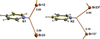
The hydrogen atoms on the nitrogen atoms of the two pyridinium cations are each involved in hydrogen bonds with two bromine atoms (Table 2). The donor⋯acceptor distances are quite long and these N—H⋯Br hydrogen bonds are weak, as they are bifurcated (Fig. 5).
|
||||||||||||||||||||||||||||||||
 ; (ii)
 .
|
Figure 5
Bifurcated N—H⋯Br hydrogen bonds (dashed sticks, brown) between the pyridinium and tribromidostannate(II) ions with H⋯ Br distances in Å. Br—Sn bonds are indicated as short, two-coloured sticks. All atoms are drawn as anisotropic displacement ellipsoids at the 50% probability level. [Symmetry codes: (1) x − , −y + , z + ; (2) −x + , y − , −z + .] |
Synthesis and crystallization
On a Petri dish, a small amount of pyridinium bromide, PyHBr, prepared from pyridine and hydrobromic acid, was added to a spatula-tip of tin(II) bromide, SnBr2, and the mixture covered with two drops of water. This immediately led to the formation of crystals of the title compound in question, which, however, decompose within a very short time.
Refinement
Crystal data, data collection and structure refinement details are summarized in Table 3.
|
Structural data
CCDC reference: 2592101
Crystal structure: contains datablock I. DOI: https://doi.org/10.1107/S2414314626010187/wm4260sup1.cif
Structure factors: contains datablock I. DOI: https://doi.org/10.1107/S2414314626010187/wm4260Isup2.hkl
| (C5H6N)[SnBr3] | F(000) = 1584 |
| Mr = 438.53 | Dx = 2.909 Mg m−3 |
| Monoclinic, P21/n | Mo Kα radiation, λ = 0.71073 Å |
| a = 16.3640 (5) Å | Cell parameters from 9978 reflections |
| b = 8.0330 (2) Å | θ = 2.7–27.9° |
| c = 16.4846 (5) Å | µ = 14.46 mm−1 |
| β = 112.458 (2)° | T = 100 K |
| V = 2002.59 (10) Å3 | Prism, colourless |
| Z = 8 | 0.25 × 0.08 × 0.05 mm |
| Bruker APEXII CCD diffractometer | 4040 reflections with I > 2σ(I) |
| φ and ω scans | Rint = 0.073 |
| Absorption correction: multi-scan (SADABS; Krause et al., 2015) | θmax = 28.0°, θmin = 1.5° |
| Tmin = 0.414, Tmax = 0.732 | h = −21→21 |
| 171951 measured reflections | k = −10→10 |
| 4844 independent reflections | l = −21→21 |
| Refinement on F2 | Primary atom site location: structure-invariant direct methods |
| Least-squares matrix: full | Hydrogen site location: inferred from neighbouring sites |
| R[F2 > 2σ(F2)] = 0.019 | Only H-atom displacement parameters refined |
| wR(F2) = 0.040 | w = 1/[σ2(Fo2) + (0.0098P)2 + 4.8363P] where P = (Fo2 + 2Fc2)/3 |
| S = 1.06 | (Δ/σ)max = 0.001 |
| 4844 reflections | Δρmax = 0.62 e Å−3 |
| 183 parameters | Δρmin = −0.70 e Å−3 |
| 0 restraints |
Geometry. All esds (except the esd in the dihedral angle between two l.s. planes) are estimated using the full covariance matrix. The cell esds are taken into account individually in the estimation of esds in distances, angles and torsion angles; correlations between esds in cell parameters are only used when they are defined by crystal symmetry. An approximate (isotropic) treatment of cell esds is used for estimating esds involving l.s. planes. |
Refinement. The H atoms were refined in idealized positions and allowed to ride on the parent carbon [d(C—H) = 0.95 Å] and nitrogen atoms [d(N—H) = 0.88 Å], with one common Uiso(H) factor for each of the two pyridinium cations. |
| x | y | z | Uiso*/Ueq | ||
| Sn1 | 0.74639 (2) | 0.49613 (3) | 0.24574 (2) | 0.01520 (5) | |
| Br11 | 0.64795 (2) | 0.68624 (4) | 0.31135 (2) | 0.01976 (7) | |
| Br12 | 0.60039 (2) | 0.30687 (4) | 0.15703 (2) | 0.02148 (8) | |
| Br13 | 0.71023 (2) | 0.69213 (4) | 0.10145 (2) | 0.02061 (7) | |
| Sn2 | 0.25755 (2) | 0.48288 (3) | 0.25112 (2) | 0.01560 (5) | |
| Br21 | 0.34456 (2) | 0.30922 (4) | 0.39993 (2) | 0.02048 (7) | |
| Br22 | 0.39956 (2) | 0.68550 (4) | 0.28617 (2) | 0.01992 (7) | |
| Br23 | 0.31740 (2) | 0.28145 (4) | 0.15074 (2) | 0.02476 (8) | |
| N1 | 0.5280 (2) | 0.2781 (5) | 0.3318 (2) | 0.0435 (9) | |
| H1 | 0.5070 | 0.3326 | 0.2817 | 0.049 (5)* | |
| C11 | 0.5631 (2) | 0.3630 (4) | 0.4065 (2) | 0.0235 (8) | |
| H11 | 0.5658 | 0.4811 | 0.4051 | 0.049 (5)* | |
| C12 | 0.5237 (3) | 0.1085 (5) | 0.3311 (3) | 0.0339 (9) | |
| H12 | 0.4985 | 0.0497 | 0.2772 | 0.049 (5)* | |
| C13 | 0.5563 (2) | 0.0243 (5) | 0.4091 (3) | 0.0294 (8) | |
| H13 | 0.5542 | −0.0938 | 0.4103 | 0.049 (5)* | |
| C14 | 0.5921 (2) | 0.1136 (4) | 0.4855 (2) | 0.0282 (9) | |
| H14 | 0.6153 | 0.0566 | 0.5401 | 0.049 (5)* | |
| C15 | 0.5948 (2) | 0.2826 (4) | 0.4841 (2) | 0.0257 (8) | |
| H15 | 0.6189 | 0.3436 | 0.5374 | 0.049 (5)* | |
| N2 | 0.0994 (3) | 0.1248 (4) | 0.4380 (2) | 0.0399 (9) | |
| H2 | 0.1048 | 0.0160 | 0.4365 | 0.033 (5)* | |
| C21 | 0.1725 (2) | 0.2187 (5) | 0.4724 (2) | 0.0274 (8) | |
| H21 | 0.2294 | 0.1686 | 0.4958 | 0.033 (5)* | |
| C22 | 0.1632 (2) | 0.3898 (5) | 0.4730 (2) | 0.0271 (8) | |
| H22 | 0.2140 | 0.4586 | 0.4967 | 0.033 (5)* | |
| C23 | 0.0802 (2) | 0.4604 (4) | 0.4392 (2) | 0.0237 (8) | |
| H23 | 0.0733 | 0.5778 | 0.4392 | 0.033 (5)* | |
| C24 | 0.0079 (2) | 0.3587 (5) | 0.4057 (2) | 0.0276 (8) | |
| H24 | −0.0497 | 0.4059 | 0.3825 | 0.033 (5)* | |
| C25 | 0.0177 (2) | 0.1928 (4) | 0.4055 (2) | 0.0212 (7) | |
| H25 | −0.0328 | 0.1231 | 0.3825 | 0.033 (5)* |
| U11 | U22 | U33 | U12 | U13 | U23 | |
| Sn1 | 0.01591 (10) | 0.01134 (10) | 0.01766 (11) | 0.00070 (8) | 0.00562 (8) | 0.00067 (9) |
| Br11 | 0.02074 (16) | 0.02002 (16) | 0.02100 (16) | −0.00036 (13) | 0.01074 (13) | −0.00295 (13) |
| Br12 | 0.02261 (17) | 0.01927 (16) | 0.02105 (17) | −0.00553 (13) | 0.00665 (13) | −0.00294 (13) |
| Br13 | 0.02543 (17) | 0.02005 (16) | 0.01762 (16) | −0.00159 (14) | 0.00964 (13) | 0.00205 (13) |
| Sn2 | 0.01692 (11) | 0.01060 (10) | 0.01852 (11) | −0.00050 (8) | 0.00591 (9) | −0.00026 (9) |
| Br21 | 0.02247 (17) | 0.01933 (16) | 0.02084 (17) | 0.00069 (13) | 0.00961 (13) | 0.00407 (13) |
| Br22 | 0.01760 (15) | 0.01548 (15) | 0.02604 (18) | −0.00319 (12) | 0.00764 (13) | 0.00006 (13) |
| Br23 | 0.03087 (19) | 0.02348 (18) | 0.01994 (17) | 0.00076 (15) | 0.00974 (15) | −0.00550 (14) |
| N1 | 0.041 (2) | 0.059 (3) | 0.033 (2) | 0.0116 (19) | 0.0174 (17) | 0.0185 (18) |
| C11 | 0.0214 (17) | 0.0151 (16) | 0.034 (2) | −0.0003 (14) | 0.0109 (16) | 0.0069 (15) |
| C12 | 0.035 (2) | 0.043 (2) | 0.026 (2) | −0.0012 (19) | 0.0137 (18) | −0.0102 (18) |
| C13 | 0.0244 (18) | 0.0227 (18) | 0.039 (2) | −0.0003 (15) | 0.0098 (17) | −0.0076 (17) |
| C14 | 0.0266 (19) | 0.0218 (18) | 0.0257 (19) | 0.0005 (15) | −0.0020 (16) | 0.0065 (15) |
| C15 | 0.0270 (19) | 0.0205 (17) | 0.0245 (19) | −0.0040 (15) | 0.0043 (15) | −0.0046 (15) |
| N2 | 0.066 (3) | 0.0248 (17) | 0.0325 (19) | 0.0105 (17) | 0.0235 (18) | 0.0001 (15) |
| C21 | 0.0221 (18) | 0.034 (2) | 0.028 (2) | 0.0091 (16) | 0.0126 (16) | 0.0103 (17) |
| C22 | 0.0236 (18) | 0.033 (2) | 0.027 (2) | −0.0037 (16) | 0.0119 (16) | 0.0052 (16) |
| C23 | 0.0286 (19) | 0.0177 (17) | 0.0256 (19) | 0.0025 (14) | 0.0112 (15) | 0.0029 (14) |
| C24 | 0.0231 (18) | 0.0271 (19) | 0.028 (2) | 0.0020 (15) | 0.0053 (16) | 0.0055 (16) |
| C25 | 0.0198 (16) | 0.0171 (16) | 0.0184 (17) | −0.0045 (14) | −0.0019 (13) | −0.0025 (14) |
| Sn1—Br13 | 2.7224 (4) | C12—H12 | 0.9500 |
| Sn1—Br11 | 2.7253 (4) | C13—C14 | 1.372 (5) |
| Sn1—Br12 | 2.7364 (4) | C13—H13 | 0.9500 |
| Sn1—Br11i | 3.3638 (4) | C14—C15 | 1.359 (5) |
| Sn1—Br13i | 3.3833 (4) | C14—H14 | 0.9500 |
| Sn1—Br12ii | 3.4665 (4) | C15—H15 | 0.9500 |
| Sn2—Br21 | 2.7061 (4) | N2—C21 | 1.343 (5) |
| Sn2—Br22 | 2.7125 (4) | N2—C25 | 1.350 (5) |
| Sn2—Br23 | 2.7483 (4) | N2—H2 | 0.8800 |
| Sn2—Br23iii | 3.3749 (4) | C21—C22 | 1.383 (5) |
| Sn2—Br22iv | 3.3892 (4) | C21—H21 | 0.9500 |
| Sn2—Br21iii | 3.5616 (4) | C22—C23 | 1.378 (5) |
| N1—C11 | 1.330 (5) | C22—H22 | 0.9500 |
| N1—C12 | 1.365 (5) | C23—C24 | 1.368 (5) |
| N1—H1 | 0.8800 | C23—H23 | 0.9500 |
| C11—C15 | 1.349 (5) | C24—C25 | 1.343 (5) |
| C11—H11 | 0.9500 | C24—H24 | 0.9500 |
| C12—C13 | 1.368 (5) | C25—H25 | 0.9500 |
| Br13—Sn1—Br11 | 93.353 (12) | C11—N1—C12 | 121.5 (4) |
| Br13—Sn1—Br12 | 90.025 (12) | C11—N1—H1 | 119.2 |
| Br11—Sn1—Br12 | 89.754 (12) | C12—N1—H1 | 119.2 |
| Br13—Sn1—Br11i | 98.449 (11) | N1—C11—C15 | 120.4 (3) |
| Br12—Sn1—Br11i | 82.905 (11) | N1—C11—H11 | 119.8 |
| Br11—Sn1—Br13i | 95.552 (11) | C15—C11—H11 | 119.8 |
| Br12—Sn1—Br13i | 83.623 (11) | N1—C12—C13 | 119.0 (4) |
| Br11i—Sn1—Br13i | 71.945 (9) | N1—C12—H12 | 120.5 |
| Br13—Sn1—Br12ii | 82.234 (11) | C13—C12—H12 | 120.5 |
| Br11—Sn1—Br12ii | 81.127 (11) | C12—C13—C14 | 118.8 (4) |
| Br11—Sn1—Br11i | 166.072 (12) | C12—C13—H13 | 120.6 |
| Br12—Sn1—Br12ii | 167.628 (12) | C14—C13—H13 | 120.6 |
| Br13—Sn1—Br13i | 169.026 (13) | C15—C14—C13 | 120.8 (4) |
| Br11i—Sn1—Br12ii | 107.695 (10) | C15—C14—H14 | 119.6 |
| Br13i—Sn1—Br12ii | 105.458 (10) | C13—C14—H14 | 119.6 |
| Sn1—Br11—Sn1ii | 81.883 (9) | C11—C15—C14 | 119.5 (3) |
| Sn1—Br12—Sn1i | 79.826 (9) | C11—C15—H15 | 120.3 |
| Sn1—Br13—Sn1ii | 81.557 (9) | C14—C15—H15 | 120.3 |
| Br21—Sn2—Br22 | 90.281 (12) | C21—N2—C25 | 121.9 (3) |
| Br21—Sn2—Br23 | 93.276 (13) | C21—N2—H2 | 119.1 |
| Br22—Sn2—Br23 | 90.470 (13) | C25—N2—H2 | 119.1 |
| Br21—Sn2—Br23iii | 95.367 (11) | N2—C21—C22 | 118.5 (3) |
| Br22—Sn2—Br23iii | 84.841 (11) | N2—C21—H21 | 120.7 |
| Br21—Sn2—Br22iv | 84.321 (11) | C22—C21—H21 | 120.7 |
| Br21—Sn2—Br21iii | 163.151 (12) | C23—C22—C21 | 120.0 (3) |
| Br22—Sn2—Br22iv | 172.044 (12) | C23—C22—H22 | 120.0 |
| Br23—Sn2—Br22iv | 84.025 (11) | C21—C22—H22 | 120.0 |
| Br23iii—Sn2—Br22iv | 101.449 (11) | C24—C23—C22 | 119.0 (3) |
| Br23—Sn2—Br23iii | 170.179 (13) | C24—C23—H23 | 120.5 |
| Br22—Sn2—Br21iii | 80.923 (10) | C22—C23—H23 | 120.5 |
| Br23—Sn2—Br21iii | 101.089 (12) | C25—C24—C23 | 120.5 (3) |
| Br23iii—Sn2—Br21iii | 69.679 (9) | C25—C24—H24 | 119.7 |
| Br22iv—Sn2—Br21iii | 105.736 (9) | C23—C24—H24 | 119.7 |
| Sn2—Br21—Sn2iv | 78.569 (8) | C24—C25—N2 | 120.1 (3) |
| Sn2—Br22—Sn2iii | 81.693 (9) | C24—C25—H25 | 119.9 |
| Sn2—Br23—Sn2iv | 81.458 (10) | N2—C25—H25 | 119.9 |
| Symmetry codes: (i) −x+3/2, y−1/2, −z+1/2; (ii) −x+3/2, y+1/2, −z+1/2; (iii) −x+1/2, y+1/2, −z+1/2; (iv) −x+1/2, y−1/2, −z+1/2. |
| D—H···A | D—H | H···A | D···A | D—H···A |
| N1—H1···Br12 | 0.88 | 3.00 | 3.517 (4) | 119 |
| N1—H1···Br23 | 0.88 | 3.06 | 3.595 (4) | 122 |
| N2—H2···Br13v | 0.88 | 3.10 | 3.647 (3) | 123 |
| N2—H2···Br23iv | 0.88 | 2.94 | 3.623 (3) | 136 |
| Symmetry codes: (iv) −x+1/2, y−1/2, −z+1/2; (v) x−1/2, −y+1/2, z+1/2. |
| X/Y | d(Sn—X) | d(Sn···Y) | 〈(X—Sn···Y) | Q | BV(Sn···Y) | BV(Sn—X) | p(Sn···Y) | 〈(Sn—Br···Sn) |
| Br11/Br112 | 2.7253 (4) | 3.3638 (4) | 166.07 (1) | 1.23 | 0.10 | 0.54 | 0.45 | 81.88 (1) |
| Br12/Br121 | 2.7364 (4) | 3.4665 (4) | 167.63 (1) | 1.27 | 0.07 | 0.53 | 0.38 | 79.83 (1) |
| Br13/Br131 | 2.7224 (4) | 3.3833 (4) | 169.03 (1) | 1.24 | 0.09 | 0.55 | 0.44 | 81.56 (1) |
| sum | 0.26 | 1.62 | ||||||
| Br21/Br213 | 2.7061 (4) | 3.5616 (4) | 163.15 (1) | 1.32 | 0.06 | 0.57 | 78.57 (1) | |
| Br22/Br224 | 2.7125 (4) | 3.3892 (4) | 172.04 (1) | 1.25 | 0.09 | 0.56 | 0.43 | 81.69 (1) |
| BR31/Br313 | 2.7483 (4) | 3.3749 (4) | 170.04 (1) | 1.23 | 0.09 | 0.51 | 0.44 | 81.46 (1) |
| Sum | 0.24 | 1.65 |
| Symmetry codes: (1) -x + 3/2, y - 1/2, -z + 1/2; (2) -x + 3/2, y + 1/2, -z + 1/2; (3) -x + 1/2, y + 1/2, -z + 1/2; (4) -x + 1/2, y - 1/2, -z + 1/2. |
Acknowledgements
We thank the Deutsche Forschungsgemeinschaft and the Government of Lower-Saxony for funding the diffractometer and acknowledge support by Deutsche Forschungsgemeinschaft (DFG).
References
 Abrahams, I., Christoforou, M., Grimes, S. M. & Donaldson, J. D. (1994). J. Chem. Res. 53, M0318–M0337.
Google Scholar
Avery, J. C., Hanson, M. A., Herber, R. H., Bladek, K. J., Rupar, P. A., Nowik, I., Huang, Y. & Baines, K. (2012). Inorg. Chem. 51, 7306–7316.
CrossRef
PubMed
Google Scholar
Bauzá, A., Seth, S. K. & Frontera, A. (2019). Coord. Chem. Rev. 384, 107–125.
Google Scholar
Brammer, L., Peuronen, A. & Roseveare, T. M. (2023). Acta Cryst. C79, 204–216.
Web of Science
CrossRef
IUCr Journals
Google Scholar
Brandenburg, K. (2006). DIAMOND. Crystal Impact GbR, Bonn, Germany.
Google Scholar
Bruker (2009). APEX2 and SAINT. Bruker AXS Inc., Madison, Wisconsin, USA.
Google Scholar
Chen, C., Fu, H., Zhang, M., Guo, S., Luo, J., Xuan, H., Bu, K., Liu, Y., Zhu, Z., Chen, C., Cai, M.-Q., Lü, X. & Mao, L. (2026). Angew. Chem. Int. Ed. 65, e6957654.
CrossRef
Google Scholar
Cordero, B., Gómez, V., Platero-Prats, A. E., Revés, M., Echeverría, J., Cremades, E., Barragán, F. & Alvarez, S. (2008). Dalton Trans. pp. 2832–2838.
Web of Science
CrossRef
Google Scholar
Echeverría, J. & Alvarez, S. (2023). Chem. Sci. 14, 11647–11688.
Web of Science
PubMed
Google Scholar
Hu, S.-Z., Xie, Z.-X. & Palenig, G. J. (2012). Acta Phys. Chim. Sin. 28, 19–24.
Google Scholar
Krause, L., Herbst-Irmer, R., Sheldrick, G. M. & Stalke, D. (2015). J. Appl. Cryst. 48, 3–10.
Web of Science
CSD
CrossRef
ICSD
CAS
IUCr Journals
Google Scholar
Macrae, C. F., Sovago, I., Cottrell, S. J., Galek, P. T. A., McCabe, P., Pidcock, E., Platings, M., Shields, G. P., Stevens, J. S., Towler, M. & Wood, P. A. (2020). J. Appl. Cryst. 53, 226–235.
Web of Science
CrossRef
CAS
IUCr Journals
Google Scholar
Mantina, M., Chamberlin, A. C., Valero, R., Cramer, C. J. & Truhlar, D. G. (2009). J. Phys. Chem. A 113, 5806–5812.
Web of Science
CrossRef
PubMed
CAS
Google Scholar
Matheu, R., Ke, F., Breidenbach, A., Wolf, N. R., Lee, Y., Liu, Z., Leppert, L., Lin, Y. & Karunadasa, H. I. (2022). Angew. Chem. Int. Ed. 61, e202202911.
CrossRef
Google Scholar
Müller, U., Mronga, N., Schumacher, C. & Dehnicke, K. (1982). Z. Naturforsch. Teil B 37, 1122–1126.
Google Scholar
Naglav, D., Bläser, D., Wölper, C. & Schulz, S. (2021). CSD Communication, 2103896.
Google Scholar
Reuter, H. (2025). Molecules 30, 2700.
Web of Science
CrossRef
PubMed
Google Scholar
Schröder, S., Röwekamp-Krugley, N., Imwalle, M. & Reuter, H. (2024). Z. Anorg. Allg. Chem. 650, e202400091.
Google Scholar
Sheldrick, G. M. (2008). Acta Cryst. A64, 112–122.
Web of Science
CrossRef
CAS
IUCr Journals
Google Scholar
Sheldrick, G. M. (2015). Acta Cryst. C71, 3–8.
Web of Science
CrossRef
IUCr Journals
Google Scholar
Wang, Y., Cheng, P., Han, W., Guan, J., Li, Q., Wang, Z., Wang, P., Zheng, Y. & Xu, J. (2025). Mater. Horiz. 12, 9106–9113.
CrossRef
PubMed
Google Scholar
Westrip, S. P. (2010). J. Appl. Cryst. 43, 920–925.
Web of Science
CrossRef
CAS
IUCr Journals
Google Scholar
This is an open-access article distributed under the terms of the Creative Commons Attribution (CC-BY) Licence, which permits unrestricted use, distribution, and reproduction in any medium, provided the original authors and source are cited.
| IUCrDATA |