

 menu


metal-organic compounds
 | IUCrDATA |
 access
A dinuclear silver(I) complex of 6-phenyl-2,2′:6′,2′′-terpyridine

aDepartment of Applied and Materials Chemistry, College of Science and Technology, Nihon University, 1-8-14 Kanda Surugadai, Chiyoda-ku, Tokyo 101-8308, Japan
*Correspondence e-mail: [email protected]
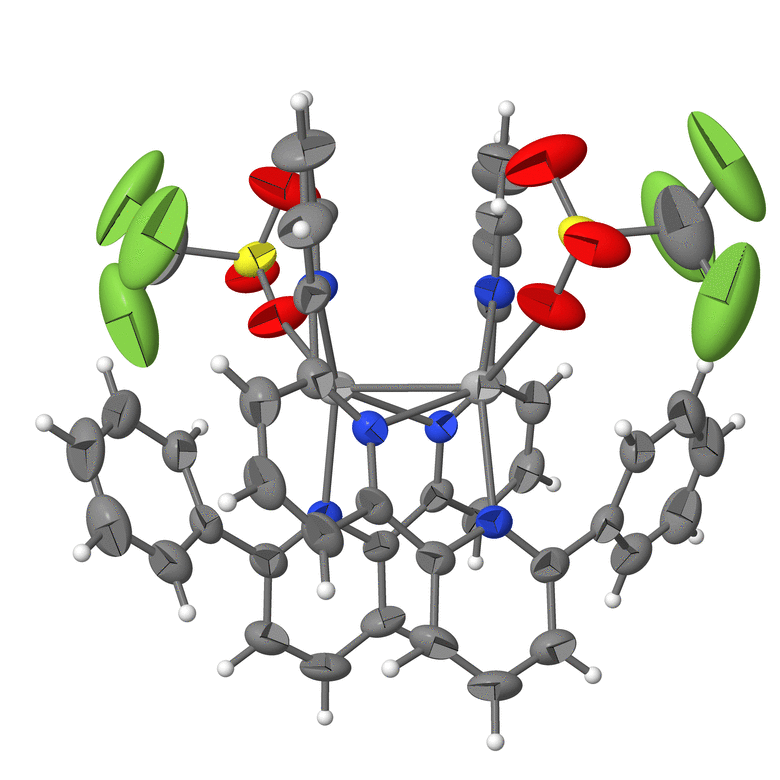
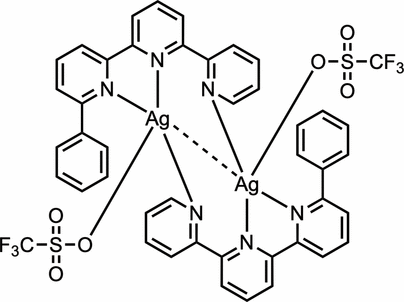
A dinuclear silver(I) complex of 6-phenyl-2,2′:6′,2′′-terpyridine, bis(μ-6-phenyl-2,2′:6′,2′′-terpyridine)bis[(trifluoromethanesulfonato)silver(I)], [Ag2(C21H15N3)(CF3SO3)2], was obtained by crystallization with silver trifluoromethanesulfonate and characterized by single-crystal X-ray diffraction. Two symmetry-related terpyridine ligands bridge two AgI ions. The AgI ion has a highly distorted four-coordinate N3O environment comprising three pyridyl N atoms and one trifluoromethanesulfonate O atom. The intramolecular Ag⋯Ag separation of 2.8501 (8) Å is consistent with an argentophilic interaction. An intramolecular phenyl–pyridyl π–π contact is also present. The structure demonstrates that a single phenyl substituent at the 6-position is compatible with ligand bridging and the formation of a short Ag⋯Ag contact.
Keywords: argentophilic interaction; crystal structure; dinuclear complex; π–π stacking; silver(I); terpyridine.
CCDC reference: 2594042
Structure description
AgI complexes of 2,2′:6′,2′′-terpyridine (tpy) exhibit diverse coordination modes and solvent-dependent nuclearity. Crystallization from acetonitrile (MeCN) affords approximately square-planar [Ag(tpy)(MeCN)]+ units, which associate into dimers through an Ag⋯Ag contact of 3.170 Å (Constable et al., 1998a ,b). Chiral tpy derivatives form mononuclear acetonitrile complexes but favour dinuclear double helicates in less coordinating solvents. These helicates contain intramolecular Ag⋯Ag contacts of 2.914–2.940 Å and associate into tetranuclear aggregates through additional Ag⋯Ag interactions (Baum et al., 1998). Similarly, 6,6′′-dimethyl-tpy forms dinuclear double helicates with Ag⋯Ag distances of 2.930–2.970 Å. Their structures depend on the counter-ion: nitrate and trifluoromethanesulfonate produce asymmetric helicates with one bridging central pyridine N atom, whereas BF4− and ClO4− give more symmetrical structures with both central N atoms bridging the Ag pair (Fik et al., 2014). Dinuclear Ag–tpy units can also form extended chains with gold complexes through Ag⋯Au and Au⋯Au interactions (Gil-Moles et al., 2017). Solution studies support mononuclear [Ag(tpy)2]+ species. Thermodynamic measurements in dimethyl sulfoxide (DMSO) suggest five-coordinate bonds with one unbound pyridine ring (Del Piero et al., 2007), while selective formation of an [Ag(tpy)2]+ unit was demonstrated in an AgI capture–release system (Paul et al., 2019).
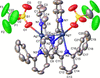
Against this background, we report the crystal structure of the trifluoromethanesulfonate salt of a dinuclear AgI complex containing 6-phenyl-2,2′:6′,2′′-terpyridine (6-Phtpy). The asymmetric unit contains one 6-Phtpy ligand, one AgI ion and one trifluoromethanesulfonate anion. Two symmetry-related 6-Phtpy ligands bridge two central AgI ions in a helical arrangement, forming a chiral dinuclear complex (Fig. 1). A crystallographic twofold rotation axis passes through the midpoint of, and perpendicular to, the Ag⋯Ag vector. Each AgI centre has a highly distorted four-coordinate N3O environment containing one pyridyl N atom from one ligand, two pyridyl N atoms from the other ligand and one trifluoromethanesulfonate O atom. The Ag1—N1, Ag1—N2i and Ag1—N3i distances are 2.240 (3), 2.412 (3) and 2.330 (2) Å, respectively, and Ag1—O1 is 2.578 (4) Å [symmetry code: (i) −x + 1, y, −z +  ]. The intramolecular Ag1⋯Ag1i distance of 2.8500 (6) Å is consistent with an argentophilic interaction (Schmidbaur & Schier, 2015). The ligand adopts a nonplanar conformation. The dihedral angles between the N1- and N2-containing pyridine rings and between the N2- and N3-containing rings are 43.85 (16) and 16.62 (13)°, respectively. The phenyl substituent is inclined by 38.65 (16)° to the adjacent N3-containing pyridine ring. Within the dinuclear complex, the phenyl ring and a symmetry-related N2i-containing pyridine ring form a π–π contact, with a centroid–centroid distance of 3.750 (3) Å and an interplanar angle of 10.58 (15)°.
|
Figure 1
The molecular structure of the dinuclear AgI complex of 6-Phtpy. Displacement ellipsoids are drawn at the 50% probability level. H atoms have been omitted for clarity. [Symmetry code: (i) −x + 1, y, −z + .] |
The dinuclear framework resembles that of Ag2(tpy)2, which contains bridging unsubstituted tpy ligands and weak Ag—O interactions with trifluoromethanesulfonate anions (Gil-Moles et al., 2017). The reported Ag2(tpy)2 complex has an Ag⋯Ag contact of 3.1698 (12) Å. The related [Ag(dptpy)(MeCN)]+ complex, with dptpy = 6,6′′-diphenyl-tpy, is mononuclear and has no short Ag⋯Ag contact; the shortest separation is 5.656 Å (Constable et al., 1998). Thus, a single phenyl substituent at the 6-position is compatible with ligand bridging and a short intramolecular Ag⋯Ag contact.
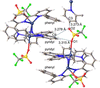
The crystal packing features offset π–π stacking between the central pyridine rings of neighbouring complexes, together with weak C—H⋯O contacts involving the trifluoromethanesulfonate anions (Fig. 2). The central pyridine rings of neighbouring complexes of opposite handedness, related by inversion (symmetry operation: −x, −y + 1, −z + 2), are parallel, with a centroid–centroid distance of 3.879 (3) Å. The C3—H3⋯O2 contact has a C⋯O distance of 3.273 (6) Å and a C—H⋯O angle of 150°. The H9 atom forms a bifurcated contact with O2 and O1, with C9⋯O distances of 3.278 (5) and 3.315 (5) Å, and angles of 132 and 130°, respectively. Details of the weak C—H⋯O contacts are given in Table 1.
|
|||||||||||||||||||||||||||
 ; (ii)
 .
|
Figure 2
The crystal packing of the dinuclear complex, showing phenyl–pyridyl–pyridyl–phenyl π–π stacking and C—H⋯O contacts (labelled distances are C⋯O separations). |
Synthesis and crystallization
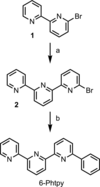
The synthetic route to 6-Phtpy is shown in Fig. 3.
|
Figure 3
Synthetic route to 6-Phtpy. Reagents and conditions: (a) i) hexamethylditin, Pd(PPh3)4, DME, reflux, 18 h; ii) 2,6-dibromopyridine, Pd(PPh3)4, toluene, reflux, 24 h, 45%; (b) phenylboronic acid pinacol ester, Pd(PPh3)4, Na2CO3, H2O, toluene, EtOH, reflux, 24 h, 85%. |
6-Bromo-2,2′:6′,2′′-terpyridine (2). The known compound 2 was prepared according to literature procedures (Derrick et al., 2020; Stefankiewicz et al., 2013) using solvents without prior drying and with the purification procedure modified as follows. The product was purified by column chromatography (SiO2, CHCl3), followed by gel permeation chromatography (GPC), to afford compound 2 in 45% yield.
6-Phenyl-2,2′:6′,2′′-terpyridine (6-Phtpy). 6-Phtpy is a known compound (Constable et al., 1999), but its synthesis from compound 2 has not been reported previously. Compound 2 (168 mg, 0.537 mmol), phenylboronic acid pinacol ester (115 mg, 0.563 mmol), Pd(PPh3)4 (65 mg, 0.056 mmol) and Na2CO3 (286 mg, 2.69 mmol) were added to a mixture of H2O (1.3 ml), toluene (5.0 ml) and EtOH (2.5 ml). The mixture was degassed by three freeze–pump–thaw cycles and refluxed under N2 for 24 h. The solvents were removed under reduced pressure, and the residue was dissolved in CH2Cl2. The solution was washed with water three times, and the organic layer was concentrated under reduced pressure. The crude product was washed with MeOH and collected by filtration. The resulting solid was dissolved in CHCl3, and the solution was filtered. The filtrate was concentrated under reduced pressure to afford 6-Phtpy as a white solid (yield: 142 mg, 0.458 mmol, 85%).
Crystallization. 6-Phtpy and silver(I) trifluoromethanesulfonate (AgOTf) were dissolved in acetone (10 ml) in a 10 ml vial, giving a concentration of 2.5 mM for each component. Slow evaporation at room temperature under ambient conditions afforded colourless needle-shaped crystals after 44 d. A block-shaped specimen was cut from a needle for single-crystal X-ray diffraction.
Refinement
Crystal data, data collection and structure refinement details are summarized in Table 2. Reflections 200 and 110 were omitted because they were considered to be affected by the beamstop. The trifluoromethanesulfonate CF3 group exhibits large anisotropic displacement parameters. Inspection of the difference electron-density map revealed no significant residual features near this group.
|
Structural data
CCDC reference: 2594042
Crystal structure: contains datablock I. DOI: https://doi.org/10.1107/S2414314626010436/vm4086sup1.cif
Structure factors: contains datablock I. DOI: https://doi.org/10.1107/S2414314626010436/vm4086Isup2.hkl
| [Ag2(C21H15N3)(CF3O3S)2] | Dx = 1.735 Mg m−3 |
| Mr = 1132.60 | Mo Kα radiation, λ = 0.71073 Å |
| Orthorhombic, Pbcn | Cell parameters from 5625 reflections |
| a = 21.3041 (10) Å | θ = 2.1–24.4° |
| b = 11.7253 (4) Å | µ = 1.08 mm−1 |
| c = 17.3544 (8) Å | T = 293 K |
| V = 4335.1 (3) Å3 | Block, colourless |
| Z = 4 | 0.35 × 0.1 × 0.06 mm |
| F(000) = 2256 |
| Rigaku XtaLAB Mini II diffractometer | 6431 independent reflections |
| Radiation source: fine-focus sealed X-ray tube, Rigaku (Mo) X-ray Source | 3745 reflections with I > 2σ(I) |
| Graphite monochromator | Rint = 0.038 |
| Detector resolution: 10.0000 pixels mm-1 | θmax = 30.7°, θmin = 2.3° |
| ω scans | h = −30→26 |
| Absorption correction: multi-scan (CrysAlis PRO; Rigaku OD, 2022) | k = −16→16 |
| Tmin = 0.700, Tmax = 1.000 | l = −24→19 |
| 26970 measured reflections |
| Refinement on F2 | Primary atom site location: dual |
| Least-squares matrix: full | Hydrogen site location: inferred from neighbouring sites |
| R[F2 > 2σ(F2)] = 0.047 | H-atom parameters constrained |
| wR(F2) = 0.159 | w = 1/[σ2(Fo2) + (0.1P)2] where P = (Fo2 + 2Fc2)/3 |
| S = 0.92 | (Δ/σ)max = 0.001 |
| 6431 reflections | Δρmax = 0.57 e Å−3 |
| 298 parameters | Δρmin = −0.79 e Å−3 |
| 0 restraints |
Geometry. All esds (except the esd in the dihedral angle between two l.s. planes) are estimated using the full covariance matrix. The cell esds are taken into account individually in the estimation of esds in distances, angles and torsion angles; correlations between esds in cell parameters are only used when they are defined by crystal symmetry. An approximate (isotropic) treatment of cell esds is used for estimating esds involving l.s. planes. |
Refinement. H atoms were placed in calculated positions, with C–H = 0.93 Å, and refined using a riding model, with Uiso(H) = 1.2Ueq(C). |
| x | y | z | Uiso*/Ueq | ||
| Ag1 | 0.55847 (2) | 0.37117 (2) | 0.71012 (2) | 0.04187 (12) | |
| S1 | 0.63201 (6) | 0.16608 (9) | 0.55585 (6) | 0.0504 (3) | |
| O2 | 0.63818 (18) | 0.1843 (3) | 0.47493 (17) | 0.0703 (10) | |
| N2 | 0.52874 (14) | 0.4296 (2) | 0.86920 (16) | 0.0349 (7) | |
| N3 | 0.43146 (14) | 0.5640 (2) | 0.81989 (18) | 0.0366 (7) | |
| N1 | 0.57184 (17) | 0.2271 (3) | 0.79332 (17) | 0.0424 (8) | |
| O1 | 0.6101 (2) | 0.2597 (3) | 0.59889 (19) | 0.0825 (12) | |
| C5 | 0.57356 (19) | 0.2413 (3) | 0.8704 (2) | 0.0428 (9) | |
| C15 | 0.3861 (2) | 0.6287 (3) | 0.7889 (2) | 0.0439 (9) | |
| C16 | 0.33765 (19) | 0.5713 (3) | 0.7428 (3) | 0.0447 (9) | |
| C10 | 0.52524 (18) | 0.5368 (3) | 0.8959 (2) | 0.0378 (8) | |
| O3 | 0.6053 (3) | 0.0596 (3) | 0.5772 (2) | 0.1148 (17) | |
| C11 | 0.47793 (19) | 0.6128 (3) | 0.8607 (2) | 0.0390 (8) | |
| C6 | 0.57040 (18) | 0.3592 (3) | 0.9001 (2) | 0.0401 (9) | |
| C4 | 0.5773 (3) | 0.1487 (4) | 0.9198 (3) | 0.0651 (14) | |
| H4 | 0.578236 | 0.160036 | 0.972827 | 0.078* | |
| C1 | 0.5747 (2) | 0.1201 (3) | 0.7656 (3) | 0.0531 (11) | |
| H1 | 0.573638 | 0.108782 | 0.712619 | 0.064* | |
| C9 | 0.56347 (19) | 0.5729 (4) | 0.9560 (2) | 0.0501 (11) | |
| H9 | 0.560162 | 0.647151 | 0.974331 | 0.060* | |
| C14 | 0.3842 (3) | 0.7457 (4) | 0.8025 (3) | 0.0607 (13) | |
| H14 | 0.351214 | 0.789498 | 0.783776 | 0.073* | |
| C7 | 0.6099 (2) | 0.3925 (4) | 0.9606 (2) | 0.0524 (11) | |
| H7 | 0.638705 | 0.341642 | 0.981709 | 0.063* | |
| C12 | 0.4795 (2) | 0.7297 (3) | 0.8721 (2) | 0.0551 (12) | |
| H12 | 0.512633 | 0.763195 | 0.898656 | 0.066* | |
| C17 | 0.3135 (2) | 0.6216 (4) | 0.6760 (3) | 0.0582 (12) | |
| H17 | 0.327801 | 0.693085 | 0.660634 | 0.070* | |
| C21 | 0.3146 (2) | 0.4648 (4) | 0.7633 (3) | 0.0523 (10) | |
| H21 | 0.328688 | 0.430119 | 0.808279 | 0.063* | |
| C3 | 0.5797 (3) | 0.0418 (4) | 0.8908 (3) | 0.0798 (17) | |
| H3 | 0.581669 | −0.020786 | 0.923677 | 0.096* | |
| C20 | 0.2711 (2) | 0.4099 (5) | 0.7176 (3) | 0.0697 (14) | |
| H20 | 0.256916 | 0.337755 | 0.731366 | 0.084* | |
| C8 | 0.6052 (2) | 0.5010 (4) | 0.9877 (3) | 0.0558 (11) | |
| H8 | 0.630689 | 0.525308 | 1.028020 | 0.067* | |
| C18 | 0.2689 (3) | 0.5661 (6) | 0.6329 (3) | 0.0784 (16) | |
| H18 | 0.252173 | 0.601509 | 0.589576 | 0.094* | |
| C2 | 0.5792 (3) | 0.0269 (4) | 0.8136 (3) | 0.0674 (14) | |
| H2 | 0.581911 | −0.046140 | 0.792846 | 0.081* | |
| C19 | 0.2489 (2) | 0.4599 (6) | 0.6529 (3) | 0.0799 (16) | |
| H19 | 0.220032 | 0.421740 | 0.622141 | 0.096* | |
| C13 | 0.4315 (3) | 0.7954 (4) | 0.8438 (3) | 0.0652 (14) | |
| H13 | 0.431054 | 0.873627 | 0.852724 | 0.078* | |
| F1 | 0.7124 (3) | 0.1423 (6) | 0.6626 (3) | 0.207 (3) | |
| F3 | 0.7404 (3) | 0.0703 (7) | 0.5574 (3) | 0.214 (3) | |
| C22 | 0.7109 (5) | 0.1506 (10) | 0.5893 (5) | 0.129 (3) | |
| F2 | 0.7406 (3) | 0.2552 (8) | 0.5666 (4) | 0.250 (4) |
| U11 | U22 | U33 | U12 | U13 | U23 | |
| Ag1 | 0.0483 (2) | 0.03713 (17) | 0.04016 (18) | 0.00238 (13) | −0.00214 (13) | 0.00872 (11) |
| S1 | 0.0657 (7) | 0.0467 (5) | 0.0389 (6) | 0.0138 (5) | −0.0019 (5) | −0.0025 (4) |
| O2 | 0.115 (3) | 0.0550 (18) | 0.0406 (17) | 0.019 (2) | 0.0045 (18) | −0.0009 (14) |
| N2 | 0.0374 (17) | 0.0374 (15) | 0.0298 (15) | −0.0032 (14) | −0.0029 (13) | −0.0024 (12) |
| N3 | 0.0409 (19) | 0.0332 (15) | 0.0356 (16) | 0.0001 (13) | 0.0039 (14) | −0.0032 (12) |
| N1 | 0.053 (2) | 0.0381 (16) | 0.0358 (17) | 0.0046 (15) | 0.0000 (14) | 0.0043 (13) |
| O1 | 0.131 (4) | 0.062 (2) | 0.054 (2) | 0.034 (2) | 0.011 (2) | −0.0065 (16) |
| C5 | 0.041 (2) | 0.047 (2) | 0.040 (2) | 0.0065 (17) | −0.0031 (17) | 0.0083 (17) |
| C15 | 0.048 (2) | 0.0402 (19) | 0.044 (2) | 0.0071 (18) | 0.0108 (18) | 0.0025 (16) |
| C16 | 0.036 (2) | 0.049 (2) | 0.049 (2) | 0.0111 (18) | 0.0039 (18) | −0.0010 (19) |
| C10 | 0.040 (2) | 0.0407 (19) | 0.0327 (18) | −0.0107 (17) | 0.0041 (16) | −0.0069 (15) |
| O3 | 0.186 (5) | 0.077 (3) | 0.081 (3) | −0.052 (3) | 0.022 (3) | 0.002 (2) |
| C11 | 0.046 (2) | 0.0348 (18) | 0.036 (2) | −0.0051 (16) | 0.0078 (16) | −0.0026 (14) |
| C6 | 0.039 (2) | 0.050 (2) | 0.0320 (19) | −0.0040 (17) | −0.0026 (15) | 0.0033 (15) |
| C4 | 0.086 (4) | 0.062 (3) | 0.047 (3) | 0.015 (3) | −0.008 (2) | 0.017 (2) |
| C1 | 0.070 (3) | 0.040 (2) | 0.050 (2) | 0.010 (2) | 0.002 (2) | 0.0018 (18) |
| C9 | 0.049 (3) | 0.056 (2) | 0.046 (2) | −0.017 (2) | −0.0024 (19) | −0.0128 (19) |
| C14 | 0.066 (3) | 0.040 (2) | 0.077 (3) | 0.011 (2) | 0.003 (3) | −0.002 (2) |
| C7 | 0.046 (2) | 0.071 (3) | 0.041 (2) | −0.001 (2) | −0.0093 (18) | 0.001 (2) |
| C12 | 0.070 (3) | 0.035 (2) | 0.060 (3) | −0.014 (2) | −0.003 (2) | −0.0083 (18) |
| C17 | 0.058 (3) | 0.060 (3) | 0.057 (3) | 0.016 (2) | 0.002 (2) | 0.006 (2) |
| C21 | 0.039 (2) | 0.057 (3) | 0.061 (3) | 0.000 (2) | 0.002 (2) | 0.004 (2) |
| C3 | 0.117 (5) | 0.053 (3) | 0.070 (4) | 0.019 (3) | −0.009 (3) | 0.027 (3) |
| C20 | 0.048 (3) | 0.075 (3) | 0.086 (4) | −0.010 (3) | 0.000 (3) | −0.009 (3) |
| C8 | 0.048 (3) | 0.079 (3) | 0.041 (2) | −0.018 (2) | −0.010 (2) | −0.006 (2) |
| C18 | 0.061 (4) | 0.113 (5) | 0.061 (3) | 0.023 (4) | −0.013 (3) | −0.001 (3) |
| C2 | 0.086 (4) | 0.038 (2) | 0.078 (3) | 0.014 (2) | 0.005 (3) | 0.005 (2) |
| C19 | 0.044 (3) | 0.123 (5) | 0.073 (4) | −0.001 (3) | −0.015 (3) | −0.025 (4) |
| C13 | 0.090 (4) | 0.0279 (19) | 0.078 (3) | 0.002 (2) | 0.003 (3) | −0.006 (2) |
| F1 | 0.163 (5) | 0.365 (9) | 0.092 (4) | 0.131 (5) | −0.056 (3) | −0.014 (4) |
| F3 | 0.167 (5) | 0.332 (8) | 0.144 (5) | 0.182 (6) | 0.015 (4) | −0.002 (5) |
| C22 | 0.102 (7) | 0.201 (10) | 0.084 (6) | 0.045 (7) | −0.001 (5) | 0.003 (6) |
| F2 | 0.129 (5) | 0.393 (12) | 0.228 (7) | −0.107 (7) | −0.015 (5) | 0.004 (7) |
| Ag1—Ag1i | 2.8501 (8) | C1—H1 | 0.9300 |
| Ag1—N2i | 2.412 (3) | C1—C2 | 1.377 (6) |
| Ag1—N3i | 2.330 (3) | C9—H9 | 0.9300 |
| Ag1—N1 | 2.240 (3) | C9—C8 | 1.343 (6) |
| Ag1—O1 | 2.578 (3) | C14—H14 | 0.9300 |
| S1—O2 | 1.427 (3) | C14—C13 | 1.366 (7) |
| S1—O1 | 1.407 (3) | C7—H7 | 0.9300 |
| S1—O3 | 1.421 (4) | C7—C8 | 1.361 (6) |
| S1—C22 | 1.786 (9) | C12—H12 | 0.9300 |
| N2—C10 | 1.342 (4) | C12—C13 | 1.372 (6) |
| N2—C6 | 1.326 (5) | C17—H17 | 0.9300 |
| N3—C15 | 1.342 (5) | C17—C18 | 1.373 (7) |
| N3—C11 | 1.345 (5) | C21—H21 | 0.9300 |
| N1—C5 | 1.349 (5) | C21—C20 | 1.380 (7) |
| N1—C1 | 1.345 (5) | C3—H3 | 0.9300 |
| C5—C6 | 1.476 (5) | C3—C2 | 1.353 (7) |
| C5—C4 | 1.386 (5) | C20—H20 | 0.9300 |
| C15—C16 | 1.468 (6) | C20—C19 | 1.351 (7) |
| C15—C14 | 1.393 (5) | C8—H8 | 0.9300 |
| C16—C17 | 1.399 (6) | C18—H18 | 0.9300 |
| C16—C21 | 1.388 (6) | C18—C19 | 1.362 (8) |
| C10—C11 | 1.478 (5) | C2—H2 | 0.9300 |
| C10—C9 | 1.389 (5) | C19—H19 | 0.9300 |
| C11—C12 | 1.385 (5) | C13—H13 | 0.9300 |
| C6—C7 | 1.402 (5) | F1—C22 | 1.277 (9) |
| C4—H4 | 0.9300 | F3—C22 | 1.260 (9) |
| C4—C3 | 1.351 (7) | C22—F2 | 1.436 (11) |
| N2i—Ag1—Ag1i | 66.66 (7) | N1—C1—C2 | 121.9 (5) |
| N2i—Ag1—O1 | 92.60 (11) | C2—C1—H1 | 119.1 |
| N3i—Ag1—Ag1i | 100.90 (8) | C10—C9—H9 | 119.8 |
| N3i—Ag1—N2i | 70.59 (10) | C8—C9—C10 | 120.4 (4) |
| N3i—Ag1—O1 | 106.58 (11) | C8—C9—H9 | 119.8 |
| N1—Ag1—Ag1i | 78.35 (9) | C15—C14—H14 | 120.3 |
| N1—Ag1—N2i | 132.85 (12) | C13—C14—C15 | 119.3 (5) |
| N1—Ag1—N3i | 149.76 (12) | C13—C14—H14 | 120.3 |
| N1—Ag1—O1 | 92.64 (11) | C6—C7—H7 | 120.8 |
| O1—Ag1—Ag1i | 137.45 (10) | C8—C7—C6 | 118.4 (4) |
| O2—S1—C22 | 104.4 (3) | C8—C7—H7 | 120.8 |
| O1—S1—O2 | 115.9 (2) | C11—C12—H12 | 120.4 |
| O1—S1—O3 | 114.4 (3) | C13—C12—C11 | 119.1 (4) |
| O1—S1—C22 | 102.7 (4) | C13—C12—H12 | 120.4 |
| O3—S1—O2 | 115.2 (2) | C16—C17—H17 | 119.8 |
| O3—S1—C22 | 101.7 (4) | C18—C17—C16 | 120.3 (5) |
| C10—N2—Ag1i | 114.9 (2) | C18—C17—H17 | 119.8 |
| C6—N2—Ag1i | 124.7 (2) | C16—C21—H21 | 119.7 |
| C6—N2—C10 | 118.7 (3) | C20—C21—C16 | 120.6 (5) |
| C15—N3—Ag1i | 121.7 (3) | C20—C21—H21 | 119.7 |
| C15—N3—C11 | 120.1 (3) | C4—C3—H3 | 120.4 |
| C11—N3—Ag1i | 117.6 (2) | C4—C3—C2 | 119.3 (4) |
| C5—N1—Ag1 | 123.3 (3) | C2—C3—H3 | 120.4 |
| C1—N1—Ag1 | 118.6 (3) | C21—C20—H20 | 119.7 |
| C1—N1—C5 | 117.9 (4) | C19—C20—C21 | 120.7 (5) |
| S1—O1—Ag1 | 159.1 (2) | C19—C20—H20 | 119.7 |
| N1—C5—C6 | 117.4 (3) | C9—C8—C7 | 119.6 (4) |
| N1—C5—C4 | 121.2 (4) | C9—C8—H8 | 120.2 |
| C4—C5—C6 | 121.4 (4) | C7—C8—H8 | 120.2 |
| N3—C15—C16 | 117.8 (3) | C17—C18—H18 | 119.6 |
| N3—C15—C14 | 120.5 (4) | C19—C18—C17 | 120.7 (5) |
| C14—C15—C16 | 121.6 (4) | C19—C18—H18 | 119.6 |
| C17—C16—C15 | 121.1 (4) | C1—C2—H2 | 120.1 |
| C21—C16—C15 | 121.4 (4) | C3—C2—C1 | 119.8 (5) |
| C21—C16—C17 | 117.6 (4) | C3—C2—H2 | 120.1 |
| N2—C10—C11 | 117.4 (3) | C20—C19—C18 | 120.0 (5) |
| N2—C10—C9 | 120.8 (4) | C20—C19—H19 | 120.0 |
| C9—C10—C11 | 121.8 (4) | C18—C19—H19 | 120.0 |
| N3—C11—C10 | 117.6 (3) | C14—C13—C12 | 119.8 (4) |
| N3—C11—C12 | 120.9 (4) | C14—C13—H13 | 120.1 |
| C12—C11—C10 | 121.4 (4) | C12—C13—H13 | 120.1 |
| N2—C6—C5 | 118.2 (3) | F1—C22—S1 | 110.9 (6) |
| N2—C6—C7 | 122.1 (4) | F1—C22—F2 | 109.0 (10) |
| C7—C6—C5 | 119.6 (4) | F3—C22—S1 | 113.8 (8) |
| C5—C4—H4 | 120.0 | F3—C22—F1 | 111.6 (8) |
| C3—C4—C5 | 120.0 (5) | F3—C22—F2 | 107.2 (9) |
| C3—C4—H4 | 120.0 | F2—C22—S1 | 103.9 (6) |
| N1—C1—H1 | 119.1 | ||
| Ag1i—N2—C10—C11 | −13.4 (4) | C15—C16—C21—C20 | −177.2 (4) |
| Ag1i—N2—C10—C9 | 164.6 (3) | C15—C14—C13—C12 | −0.9 (8) |
| Ag1i—N2—C6—C5 | 15.1 (5) | C16—C15—C14—C13 | −178.0 (4) |
| Ag1i—N2—C6—C7 | −163.3 (3) | C16—C17—C18—C19 | −2.2 (8) |
| Ag1i—N3—C15—C16 | 7.7 (5) | C16—C21—C20—C19 | −1.6 (7) |
| Ag1i—N3—C15—C14 | −174.5 (3) | C10—N2—C6—C5 | 179.7 (3) |
| Ag1i—N3—C11—C10 | −11.5 (4) | C10—N2—C6—C7 | 1.3 (6) |
| Ag1i—N3—C11—C12 | 171.5 (3) | C10—C11—C12—C13 | −174.3 (4) |
| Ag1—N1—C5—C6 | −4.0 (5) | C10—C9—C8—C7 | 0.1 (7) |
| Ag1—N1—C5—C4 | 175.2 (3) | O3—S1—O1—Ag1 | 18.4 (9) |
| Ag1—N1—C1—C2 | −176.2 (4) | O3—S1—C22—F1 | −64.9 (9) |
| O2—S1—O1—Ag1 | 156.1 (7) | O3—S1—C22—F3 | 61.9 (9) |
| O2—S1—C22—F1 | 175.0 (7) | O3—S1—C22—F2 | 178.1 (6) |
| O2—S1—C22—F3 | −58.2 (9) | C11—N3—C15—C16 | 178.0 (3) |
| O2—S1—C22—F2 | 58.0 (7) | C11—N3—C15—C14 | −4.1 (6) |
| N2—C10—C11—N3 | 17.0 (5) | C11—C10—C9—C8 | 178.7 (4) |
| N2—C10—C11—C12 | −166.0 (4) | C11—C12—C13—C14 | −2.4 (7) |
| N2—C10—C9—C8 | 0.8 (6) | C6—N2—C10—C11 | −179.5 (3) |
| N2—C6—C7—C8 | −0.4 (6) | C6—N2—C10—C9 | −1.4 (5) |
| N3—C15—C16—C17 | −141.8 (4) | C6—C5—C4—C3 | 179.5 (5) |
| N3—C15—C16—C21 | 37.5 (6) | C6—C7—C8—C9 | −0.3 (7) |
| N3—C15—C14—C13 | 4.2 (7) | C4—C5—C6—N2 | −134.9 (4) |
| N3—C11—C12—C13 | 2.6 (6) | C4—C5—C6—C7 | 43.6 (6) |
| N1—C5—C6—N2 | 44.3 (5) | C4—C3—C2—C1 | −1.6 (9) |
| N1—C5—C6—C7 | −137.2 (4) | C1—N1—C5—C6 | 180.0 (4) |
| N1—C5—C4—C3 | 0.4 (8) | C1—N1—C5—C4 | −0.8 (7) |
| N1—C1—C2—C3 | 1.2 (9) | C9—C10—C11—N3 | −161.0 (3) |
| O1—S1—C22—F1 | 53.7 (9) | C9—C10—C11—C12 | 16.0 (6) |
| O1—S1—C22—F3 | −179.5 (8) | C14—C15—C16—C17 | 40.4 (6) |
| O1—S1—C22—F2 | −63.2 (6) | C14—C15—C16—C21 | −140.3 (4) |
| C5—N1—C1—C2 | 0.1 (7) | C17—C16—C21—C20 | 2.1 (6) |
| C5—C6—C7—C8 | −178.8 (4) | C17—C18—C19—C20 | 2.8 (9) |
| C5—C4—C3—C2 | 0.9 (9) | C21—C16—C17—C18 | −0.2 (7) |
| C15—N3—C11—C10 | 177.7 (3) | C21—C20—C19—C18 | −0.9 (8) |
| C15—N3—C11—C12 | 0.7 (6) | C22—S1—O1—Ag1 | −90.8 (8) |
| C15—C16—C17—C18 | 179.1 (4) |
| Symmetry code: (i) −x+1, y, −z+3/2. |
| D—H···A | D—H | H···A | D···A | D—H···A |
| C3—H3···O2ii | 0.93 | 2.43 | 3.273 (6) | 150 |
| C9—H9···O2iii | 0.93 | 2.58 | 3.278 (5) | 132 |
| C9—H9···O1iii | 0.93 | 2.65 | 3.315 (5) | 130 |
| Symmetry codes: (ii) x, −y, z+1/2; (iii) x, −y+1, z+1/2. |
Acknowledgements
Author contributions: Yuto Nakaie: investigation, writing – original draft. Tomoya Abe: investigation. Yosuke Hosoya: supervision. Kosuke Sugawa: supervision. Joe Otsuki: conceptualization, supervision, writing – review and editing.
Funding information
Funding for this research was provided by: Japan Society for the Promotion of Science (grant No. 24K08386).
References
 Constable, E. C., Baum, G., Bill, E., Dyson, R., van Eldik, R., Fenske, D., Kaderli, S., Morris, D., Neubrand, A., Neuburger, M., Smith, D. R., Wieghardt, K., Zehnder, M. & Zuberbühler, A. D. (1999). Chem. Eur. J. 5, 498–508.
CrossRef
CAS
Google Scholar
Baum, G., Constable, E. C., Fenske, D., Housecroft, C. E. & Kulke, T. (1998). Chem. Commun. pp. 2659–2660.
Google Scholar
Constable, E. C., Edwards, A. J., Haire, G. R., Hannon, M. J. & Raithby, P. R. (1998a). Polyhedron 17, 243–253.
CrossRef
CAS
Google Scholar
Constable, E. C., Housecroft, D. F. C. E. & Kulke, T. (1998b). Chem. Commun. pp. 2659–2660.
CrossRef
Google Scholar
Del Piero, S., Fedele, R., Melchior, A., Portanova, R., Tolazzi, M. & Zangrando, E. (2007). Inorg. Chem. 46, 4683–4691.
CrossRef
PubMed
CAS
Google Scholar
Derrick, J. S., Loipersberger, M., Chatterjee, R., Iovan, D. A., Smith, P. T., Chakarawet, K., Yano, J., Long, J. R., Head-Gordon, M. & Chang, C. J. (2020). J. Am. Chem. Soc. 142, 20489–20501.
CrossRef
CAS
PubMed
Google Scholar
Dolomanov, O. V., Bourhis, L. J., Gildea, R. J., Howard, J. A. K. & Puschmann, H. (2009). J. Appl. Cryst. 42, 339–341.
Web of Science
CrossRef
CAS
IUCr Journals
Google Scholar
Fik, M. A., Gorczyński, A., Kubicki, M., Hnatejko, Z., Fedoruk-Wyszomirska, A., Wyszko, E., Giel-Pietraszuk, M. & Patroniak, V. (2014). Eur. J. Med. Chem. 86, 456–468.
CrossRef
CAS
PubMed
Google Scholar
Gil-Moles, M., Gimeno, M. C., López-de-Luzuriaga, J. M., Monge, M., Olmos, M. E. & Pascual, D. (2017). Inorg. Chem. 56, 9281–9290.
CAS
PubMed
Google Scholar
Paul, I., Mittal, N., De, S., Bolte, M. & Schmittel, M. (2019). J. Am. Chem. Soc. 141, 5139–5143.
CrossRef
CAS
PubMed
Google Scholar
Rigaku OD (2022). CrysAlis PRO. Rigaku Oxford Diffraction, Yarnton, England.
Google Scholar
Schmidbaur, H. & Schier, A. (2015). Angew. Chem. Int. Ed. 54, 746–784.
Web of Science
CrossRef
CAS
Google Scholar
Sheldrick, G. M. (2015a). Acta Cryst. A71, 3–8.
Web of Science
CrossRef
IUCr Journals
Google Scholar
Sheldrick, G. M. (2015b). Acta Cryst. C71, 3–8.
Web of Science
CrossRef
IUCr Journals
Google Scholar
Stefankiewicz, A. R., Wałęsa-Chorab, M., Harrowfield, J., Kubicki, M., Hnatejko, Z., Korabik, M. & Patroniak, V. (2013). Dalton Trans. 42, 1743–1751.
CrossRef
CAS
PubMed
Google Scholar
This is an open-access article distributed under the terms of the Creative Commons Attribution (CC-BY) Licence, which permits unrestricted use, distribution, and reproduction in any medium, provided the original authors and source are cited.
| IUCrDATA |