

 menu


metal-organic compounds
 | IUCrDATA |
 access
(η6-1-Isopropyl-4-methylbenzene)bis(η1-pyridin-2-ylethynido-κC)(trimethylphosphane-κP)ruthenium(II)

aThe University of Tennessee at Chattanooga, Department of Chemistry, #2252, 615 McCallie Avenue, Chattanooga, TN 37403, USA, and bClemson University, Department of Chemistry, Clemson, SC 29634, USA
*Correspondence e-mail: [email protected]
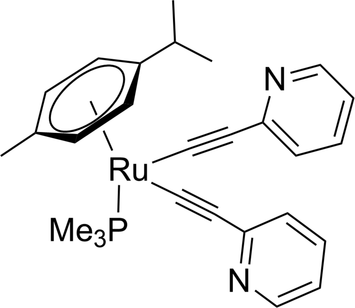
The title complex, [Ru(C7H4N2)2(C10H14)(C3H9P)] or (p-cym)Ru(C2-2py)2(PMe3), where p-cym = η6-1-isopropyl-4-methylbenzene and C2-2py = η1-C-pyridin-2-ylethynide, comprises a pseudo-octahedral RuII atom with p-cym occupying one face of the octahedron and the other face comprised of monodentate PMe3 and two η1-C2-2py ligands. The Ru—Cethynide bond lengths are 2.0248 (16) and 2.0343 (17) Å. The N—C—C—N torsion angle of 151.1 (2)° suggests a near anti-conformation for the two pyridine rings. In the crystal, hydrogen bonding involving one C—H donor and one nitrogen acceptor from each pyridine ring generates dimers propagating along the a-axis direction via supporting C—H⋯π interactions.
Keywords: crystal structure; ruthenium; 2-ethnylpyridine; para-cymene.
CCDC reference: 2594178
Structure description
The title compound (I), where p-cym = η6-1-isopropyl-4-methylbenzene and C2-2py = η1-pyridin-2-ylethynide, represents a newly characterized bisalkynyl species. Alkynyl compounds have a variety of applications (Long & Williams, 2003 ), and our group has been investigating these species as ligands. In a previously reported titanocene, (Cp*)2Ti(C2-2py)2 where Cp* = pentamethylcyclopentadienyl, it was found that the C—Ti—C bond angle was 90.3 (1)° and this metalloligand can coordinate PdII in a trans-bidentate fashion (Vieira et al., 2017). Our initial hypothesis was that other transition-metal compounds with similarly oriented alkynylpyridine ligands could act as trans-bidentate ligands. We therefore focused on cis-alkynylpyridine ligands on square-planar and octahedral metal centers. For instance, we structurally characterized a polymorph of (tbubpy)Pt(C2-2py)2 (where tbubpy = 4,4′-di-tert-butyl-2,2′-bipyridine) that has six unique molecules in the asymmetric unit, with the C—Pt—C bond angles ranging from 88.8 (8) to 91.7 (8)° (Jaques et al., 2020). Although the C—Pt—C angles are like the C—Ti—C angle in the (Cp*)2Ti(C2-2py)2 metalloligand, the PtII alkynylpyridine compound did not act as a trans-bidentate ligand under the conditions tested. Efforts are ongoing to investigate the coordination chemistry of (p-cym)Ru(C2-2py)2(PMe3) (I), and herein we describe structural details of this molecule.
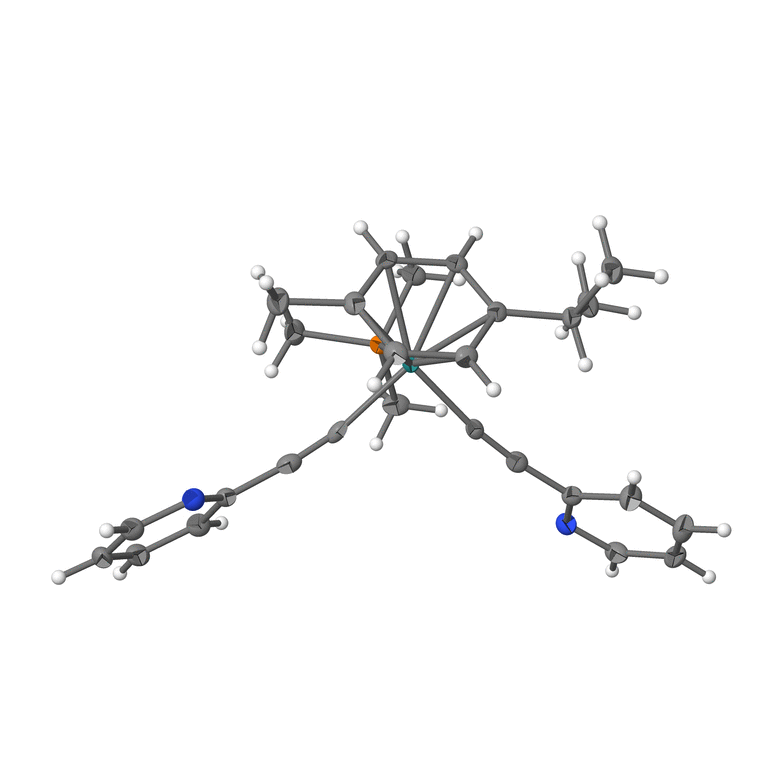
The crystal structure of (p-cym)Ru(C2-2py)2(PMe3) (I) contains a pseudo-octahedral RuII atom with p-cym occupying one face of the octahedron and another face comprised of monodentate PMe3 and two η1-C2-2py ligands (Fig. 1). The angles about the Ru center involving the monodentate ligands are: 91.01 (6)° (C1—Ru1—C4), 87.22 (4)° (C1—Ru—P1), and 83.49 (4)° (C4—Ru1—P)1, which highlight the pseudo-octahedral half-sandwich or ‘piano-stool' coordination of (I) (Lee et al., 2016 and Davis and Muller, 2021). The Ru—Cethynide bond lengths for (I) are 2.0248 (16) Å and 2.0343 (17) Å for Ru1—C1 and Ru1—C4, respectively. The Ru—Cethnyide bond lengths along with the C≡C bond lengths, 1.192 (2) Å and 1.167 (3) Å, are in good agreement with a single resonance structure for (I), showing no evidence of Ru—C multiple-bond character. The similarly structured (p-cym)Ru(C2Ph)2(PMe3) (where C2Ph = η1-phenylethynide) has Ru—C bond lengths of 2.003 (9) and 2.027 (7) Å, and a C—Ru—C bond angle of 91.5 (3)° (Menéndez et al., 2001). In (I), the two pyridine rings appear to be in an anti-conformation upon visual inspection of the nitrogen atoms, and this is quantified by measuring the through space torsion angle between N1—C3—C6—N2 to be 151.1 (2)°. An analogous anti-conformation also occurs in the pyridyl groups in (Cp*)2Ti(C2-2py)2 (Vieira et al., 2017). The Ru—Cp-cym bond lengths show little variation ranging from 2.2436 (15) Å to 2.2698 (16) Å and averaging 2.2601 (16) Å. The aromatic C—C bond distances in the facially coordinating p-cym ligand range from 1.400 (2) to 1.436 (2) Å, which includes three short and three long lengths that alternate. The three short lengths are approximately trans to the three monodentate ligands, which suggests some trans-effect from the PMe3 and C2-py ligands.
 | Figure 1 Displacement ellipsoid perspective view (50% probability) for the title structure showing the atom-numbering scheme. |
In the of (I), Z = 2 and those complexes are related by a center of inversion and are linked by two Cpy—Hpara⋯Npy hydrogen bonds with an average bond angle of 155.9 (2)° (Table 1), which suggests evidence of intermediate hydrogen bonding (Arunan et al., 2011). The hydrogen bonding involves one C—H donor and one nitrogen acceptor from each pyridine of the compound, which generates dimers of the complexes (Fig. 2). These interactions may influence a slight bending of the alkynylpyridine ligands, with Ru1—C1≡C2 of 172.55 (14)°, C1≡C2—C3 of 173.52 (17)°, Ru1—C4≡C5 of 168.85 (14)°, and C4≡C5—C6 of 174.28 (17)°. Translationally equivalent, adjacent dimers propagate in a chain along the a-axis direction (Fig. 3), primarily through C—H⋯π interactions (Table 1).
|
 ; (ii)
 ; (iii)
 ; (iv)
 .
 | Figure 2 Intermolecular hydrogen bonding forming a chain propagating along the a-axis direction where hydrogen bonds are represented by dashed lines. |
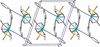 | Figure 3 Extended structure viewed slightly off the b axis. |
Synthesis and crystallization
An oven-dried 50-ml Schlenk flask was brought into the glovebox and charged with a 1.00 M solution of 2-ethynylpyridine in tetrahydrofuran (2.07 ml). After being sealed, the flask was removed from the glovebox and placed on a N2 Schlenk line and diluted with tetrahydrofuran (10 ml) via syringe. After being cooled to −94 °C, the solution was treated with n-BuLi (0.970 ml, 2.09 mmol). The dark brown solution was stirred at −94 °C for 10 min and then brought to room temperature. To this solution, (p-cym)Ru(PMe3)(Cl)2 (0.2010 g, 0.5258 mmol) was added, and the reddish-brown homogenous mixture was allowed to stir at room temperature for 4 h. The solvent was removed on the rotary evaporator leaving a dark brown oil, and the residue was dissolved in dichloromethane and filtered through celite. The volatiles were reduced to dryness leaving a dark brown residue which was then triturated using diethyl ether. The final dark brown powder was collected on a Hirsch funnel dried and in vacuo. (0.254 g, 93.8% yield). 1H-NMR (400 MHz, chloroform-d) δ 8.38 (d, J = 4.4 Hz, 2H), 7.41 (td, J = 7.7, 1.5 Hz, 2H), 7.22 (d, J = 7.9 Hz, 2H), 6.90 (overlapping ddd, J = 7.3, 4.9, and 1.3 Hz 2H), 5.64 (d, J = 6.1 Hz, 2H), 5.58 (d, J = 6.0 Hz, 2H), 2.89–2.86 (sept, J = 6.8 Hz, 1H), 2.29 (s, 3H), 1.69 (d, 2JHP = 10.7 Hz, 9H), 1.29 (d, J = 6.9 Hz, 6H). 13C-NMR (101 MHz, chloroform-d) δ 149.0, 147.2, 135.2, 128.9, 126.7, 118.9, 115.9, 104.3, 94.1 (d, 3JCP = 3.9 Hz), 91.7 (d, 3JCP = 4.3 Hz), 31.7, 22.9, 19.6 (d, 1JCP = 36.6 Hz), 19.3. 31P NMR (161 MHz, chloroform-d) δ −15.3 (s). Analysis calculated (found) for (p-cym)Ru(PMe3)(C2-2-pyridine)2·H2O: C, 60.27 (60.40); H, 6.19 (5.87); N, 5.25 (5.74). IR νC≡C 2086 cm−1.
Crystals were obtained by layering a dichloromethane solution of (I) with hexanes in the dark, yielding yellow plates.
Refinement
Crystal data, data collection, and structure details are summarized in Table 2.
|

Structural data
CCDC reference: 2594178
contains datablock I. DOI: https://doi.org/10.1107/S241431462601045X/bt4209sup1.cif
Structure factors: contains datablock I. DOI: https://doi.org/10.1107/S241431462601045X/bt4209Isup2.hkl
| [Ru(C7H4N2)2(C10H14)(C3H9P)] | Z = 2 |
| Mr = 515.58 | F(000) = 532 |
| Triclinic, P1 | Dx = 1.431 Mg m−3 |
| a = 9.6665 (4) Å | Cu Kα radiation, λ = 1.54178 Å |
| b = 10.7200 (5) Å | Cell parameters from 9272 reflections |
| c = 13.1717 (6) Å | θ = 5.2–74.6° |
| α = 101.9906 (12)° | µ = 6.05 mm−1 |
| β = 103.8890 (12)° | T = 100 K |
| γ = 108.3744 (12)° | Plate, yellow |
| V = 1196.47 (9) Å3 | 0.22 × 0.19 × 0.05 mm |
| Bruker D8 Venture Photon 2 diffractometer | 4770 reflections with I > 2σ(I) |
| Radiation source: Incoatec IµS | Rint = 0.040 |
| φ and ω scans | θmax = 74.7°, θmin = 4.9° |
| Absorption correction: multi-scan (SADABS; Krause et al., 2015) | h = −12→12 |
| Tmin = 0.624, Tmax = 1.000 | k = −13→13 |
| 38204 measured reflections | l = −16→16 |
| 4859 independent reflections |
| Refinement on F2 | Primary atom site location: dual |
| Least-squares matrix: full | Secondary atom site location: difference Fourier map |
| R[F2 > 2σ(F2)] = 0.020 | Hydrogen site location: inferred from neighbouring sites |
| wR(F2) = 0.051 | H-atom parameters constrained |
| S = 1.07 | w = 1/[σ2(Fo2) + (0.021P)2 + 0.8929P] where P = (Fo2 + 2Fc2)/3 |
| 4859 reflections | (Δ/σ)max = 0.002 |
| 286 parameters | Δρmax = 0.52 e Å−3 |
| 0 restraints | Δρmin = −0.31 e Å−3 |
Geometry. All esds (except the esd in the dihedral angle between two l.s. planes) are estimated using the full covariance matrix. The cell esds are taken into account individually in the estimation of esds in distances, angles and torsion angles; correlations between esds in cell parameters are only used when they are defined by crystal symmetry. An approximate (isotropic) treatment of cell esds is used for estimating esds involving l.s. planes. |
Refinement. Hydrogen atoms were located in a difference map and refined as riding on their parent atom with Ctertiary—H=1.00 Å, Cmethyl—H=0.98 Å, Caromatic—H=0.95 Å and with U(H)=1.5Ueq(Cmethyl) and with U(H)=1.2Ueq(C) for the remaining H atoms. The methyl groups were allowed to rotate but not to tip. |
| x | y | z | Uiso*/Ueq | ||
| Ru1 | 0.65563 (2) | 0.57466 (2) | 0.35391 (2) | 0.01282 (5) | |
| P1 | 0.68105 (5) | 0.70169 (4) | 0.23566 (3) | 0.01634 (9) | |
| N1 | 0.04764 (17) | 0.42475 (15) | 0.11000 (12) | 0.0223 (3) | |
| N2 | 0.79917 (16) | 0.99076 (15) | 0.70535 (12) | 0.0218 (3) | |
| C1 | 0.42457 (18) | 0.50340 (15) | 0.27888 (13) | 0.0164 (3) | |
| C2 | 0.2896 (2) | 0.44745 (17) | 0.22983 (14) | 0.0209 (3) | |
| C3 | 0.12987 (19) | 0.36582 (17) | 0.16778 (13) | 0.0191 (3) | |
| C4 | 0.65350 (17) | 0.74745 (17) | 0.45178 (13) | 0.0178 (3) | |
| C5 | 0.67684 (19) | 0.85009 (18) | 0.51729 (14) | 0.0222 (3) | |
| C6 | 0.72193 (18) | 0.97960 (17) | 0.60112 (14) | 0.0191 (3) | |
| C7 | 0.0635 (2) | 0.22850 (18) | 0.16713 (15) | 0.0255 (4) | |
| H7 | 0.122521 | 0.189822 | 0.209549 | 0.031* | |
| C8 | −0.0891 (2) | 0.15055 (19) | 0.10384 (16) | 0.0295 (4) | |
| H8 | −0.135719 | 0.057181 | 0.101568 | 0.035* | |
| C9 | −0.1732 (2) | 0.2098 (2) | 0.04383 (15) | 0.0277 (4) | |
| H9 | −0.278201 | 0.158431 | −0.000273 | 0.033* | |
| C10 | −0.0996 (2) | 0.34637 (19) | 0.05004 (14) | 0.0253 (4) | |
| H10 | −0.157649 | 0.386918 | 0.008953 | 0.030* | |
| C11 | 0.6894 (2) | 1.09009 (18) | 0.57537 (15) | 0.0241 (3) | |
| H11 | 0.634210 | 1.079933 | 0.502009 | 0.029* | |
| C12 | 0.7381 (2) | 1.21395 (18) | 0.65723 (16) | 0.0272 (4) | |
| H12 | 0.715797 | 1.289192 | 0.640898 | 0.033* | |
| C13 | 0.8195 (2) | 1.22657 (18) | 0.76312 (16) | 0.0269 (4) | |
| H13 | 0.856097 | 1.310705 | 0.820917 | 0.032* | |
| C14 | 0.8461 (2) | 1.11201 (19) | 0.78222 (15) | 0.0253 (4) | |
| H14 | 0.901539 | 1.120657 | 0.855123 | 0.030* | |
| C15 | 0.88305 (18) | 0.55396 (17) | 0.36949 (14) | 0.0188 (3) | |
| H15 | 0.965175 | 0.604791 | 0.348262 | 0.023* | |
| C16 | 0.88120 (19) | 0.60241 (17) | 0.47651 (14) | 0.0201 (3) | |
| C17 | 0.75568 (19) | 0.52310 (17) | 0.50552 (13) | 0.0201 (3) | |
| H17 | 0.751468 | 0.553678 | 0.577356 | 0.024* | |
| C18 | 0.63897 (19) | 0.40128 (16) | 0.43001 (13) | 0.0182 (3) | |
| H18 | 0.558205 | 0.349378 | 0.451854 | 0.022* | |
| C19 | 0.63979 (18) | 0.35378 (16) | 0.31992 (13) | 0.0163 (3) | |
| C20 | 0.76420 (18) | 0.42991 (16) | 0.29173 (13) | 0.0175 (3) | |
| H20 | 0.769427 | 0.398682 | 0.220300 | 0.021* | |
| C21 | 1.0031 (2) | 0.73548 (19) | 0.55802 (15) | 0.0275 (4) | |
| H21A | 1.068749 | 0.714880 | 0.615974 | 0.041* | |
| H21B | 0.953339 | 0.792175 | 0.590703 | 0.041* | |
| H21C | 1.066314 | 0.785909 | 0.520383 | 0.041* | |
| C22 | 0.51048 (19) | 0.22202 (16) | 0.24052 (14) | 0.0198 (3) | |
| H22 | 0.417857 | 0.209447 | 0.264708 | 0.024* | |
| C23 | 0.5567 (2) | 0.09907 (17) | 0.24827 (16) | 0.0272 (4) | |
| H23A | 0.646335 | 0.107754 | 0.223677 | 0.041* | |
| H23B | 0.470309 | 0.012939 | 0.201463 | 0.041* | |
| H23C | 0.583068 | 0.097968 | 0.324629 | 0.041* | |
| C24 | 0.4643 (2) | 0.22366 (18) | 0.12171 (14) | 0.0261 (4) | |
| H24A | 0.438572 | 0.304471 | 0.118535 | 0.039* | |
| H24B | 0.374345 | 0.139320 | 0.076537 | 0.039* | |
| H24C | 0.550501 | 0.228240 | 0.093759 | 0.039* | |
| C25 | 0.7288 (2) | 0.62688 (18) | 0.11774 (14) | 0.0237 (3) | |
| H25A | 0.646330 | 0.536955 | 0.074119 | 0.036* | |
| H25B | 0.826224 | 0.614828 | 0.143528 | 0.036* | |
| H25C | 0.739483 | 0.688679 | 0.072233 | 0.036* | |
| C26 | 0.5155 (2) | 0.7375 (2) | 0.17165 (16) | 0.0275 (4) | |
| H26A | 0.485104 | 0.785860 | 0.228718 | 0.041* | |
| H26B | 0.429445 | 0.650470 | 0.126320 | 0.041* | |
| H26C | 0.542677 | 0.795633 | 0.125343 | 0.041* | |
| C27 | 0.8338 (2) | 0.87270 (18) | 0.29789 (16) | 0.0284 (4) | |
| H27A | 0.844269 | 0.918281 | 0.241322 | 0.043* | |
| H27B | 0.931295 | 0.864499 | 0.331484 | 0.043* | |
| H27C | 0.808136 | 0.927576 | 0.354418 | 0.043* |
| U11 | U22 | U33 | U12 | U13 | U23 | |
| Ru1 | 0.01285 (7) | 0.01244 (7) | 0.01278 (7) | 0.00485 (5) | 0.00363 (5) | 0.00378 (4) |
| P1 | 0.01931 (19) | 0.01539 (18) | 0.01715 (18) | 0.00801 (15) | 0.00732 (15) | 0.00705 (15) |
| N1 | 0.0222 (7) | 0.0218 (7) | 0.0207 (7) | 0.0100 (6) | 0.0030 (6) | 0.0044 (5) |
| N2 | 0.0206 (7) | 0.0223 (7) | 0.0220 (7) | 0.0077 (6) | 0.0073 (6) | 0.0064 (6) |
| C1 | 0.0215 (8) | 0.0130 (7) | 0.0158 (7) | 0.0063 (6) | 0.0075 (6) | 0.0054 (6) |
| C2 | 0.0241 (9) | 0.0201 (8) | 0.0215 (8) | 0.0109 (7) | 0.0081 (7) | 0.0082 (6) |
| C3 | 0.0189 (8) | 0.0216 (8) | 0.0168 (7) | 0.0086 (6) | 0.0055 (6) | 0.0052 (6) |
| C4 | 0.0114 (7) | 0.0229 (8) | 0.0162 (7) | 0.0015 (6) | 0.0024 (6) | 0.0107 (6) |
| C5 | 0.0183 (8) | 0.0279 (9) | 0.0260 (8) | 0.0104 (7) | 0.0105 (7) | 0.0138 (7) |
| C6 | 0.0182 (7) | 0.0192 (8) | 0.0205 (8) | 0.0061 (6) | 0.0095 (6) | 0.0053 (6) |
| C7 | 0.0244 (9) | 0.0247 (9) | 0.0245 (8) | 0.0071 (7) | 0.0044 (7) | 0.0096 (7) |
| C8 | 0.0271 (9) | 0.0244 (9) | 0.0290 (9) | 0.0013 (7) | 0.0068 (8) | 0.0084 (7) |
| C9 | 0.0172 (8) | 0.0337 (10) | 0.0224 (8) | 0.0050 (7) | 0.0026 (7) | 0.0008 (7) |
| C10 | 0.0237 (8) | 0.0310 (9) | 0.0194 (8) | 0.0148 (7) | 0.0020 (7) | 0.0032 (7) |
| C11 | 0.0258 (9) | 0.0253 (8) | 0.0238 (8) | 0.0105 (7) | 0.0097 (7) | 0.0100 (7) |
| C12 | 0.0298 (9) | 0.0208 (8) | 0.0367 (10) | 0.0118 (7) | 0.0167 (8) | 0.0104 (7) |
| C13 | 0.0253 (9) | 0.0218 (8) | 0.0291 (9) | 0.0053 (7) | 0.0136 (7) | −0.0010 (7) |
| C14 | 0.0228 (8) | 0.0289 (9) | 0.0208 (8) | 0.0079 (7) | 0.0082 (7) | 0.0029 (7) |
| C15 | 0.0149 (7) | 0.0195 (8) | 0.0259 (8) | 0.0092 (6) | 0.0076 (6) | 0.0096 (6) |
| C16 | 0.0176 (8) | 0.0201 (8) | 0.0208 (8) | 0.0093 (6) | 0.0004 (6) | 0.0065 (6) |
| C17 | 0.0237 (8) | 0.0242 (8) | 0.0150 (7) | 0.0129 (7) | 0.0037 (6) | 0.0083 (6) |
| C18 | 0.0205 (8) | 0.0188 (7) | 0.0201 (8) | 0.0096 (6) | 0.0070 (6) | 0.0117 (6) |
| C19 | 0.0181 (7) | 0.0144 (7) | 0.0185 (7) | 0.0088 (6) | 0.0048 (6) | 0.0067 (6) |
| C20 | 0.0196 (8) | 0.0182 (7) | 0.0197 (7) | 0.0120 (6) | 0.0074 (6) | 0.0074 (6) |
| C21 | 0.0218 (8) | 0.0255 (9) | 0.0257 (9) | 0.0075 (7) | −0.0021 (7) | 0.0026 (7) |
| C22 | 0.0191 (8) | 0.0158 (7) | 0.0221 (8) | 0.0059 (6) | 0.0052 (6) | 0.0042 (6) |
| C23 | 0.0284 (9) | 0.0171 (8) | 0.0325 (9) | 0.0094 (7) | 0.0047 (8) | 0.0054 (7) |
| C24 | 0.0275 (9) | 0.0226 (8) | 0.0206 (8) | 0.0093 (7) | 0.0002 (7) | 0.0007 (7) |
| C25 | 0.0309 (9) | 0.0268 (9) | 0.0201 (8) | 0.0150 (7) | 0.0125 (7) | 0.0100 (7) |
| C26 | 0.0307 (9) | 0.0316 (9) | 0.0337 (10) | 0.0199 (8) | 0.0146 (8) | 0.0202 (8) |
| C27 | 0.0339 (10) | 0.0194 (8) | 0.0293 (9) | 0.0028 (7) | 0.0156 (8) | 0.0081 (7) |
| Ru1—C1 | 2.0248 (16) | C14—H14 | 0.9500 |
| Ru1—C4 | 2.0343 (17) | C15—C16 | 1.404 (2) |
| Ru1—C15 | 2.2436 (15) | C15—C20 | 1.429 (2) |
| Ru1—C20 | 2.2563 (15) | C15—H15 | 0.9500 |
| Ru1—C17 | 2.2577 (15) | C16—C17 | 1.431 (2) |
| Ru1—C19 | 2.2646 (15) | C16—C21 | 1.507 (2) |
| Ru1—C18 | 2.2688 (15) | C17—C18 | 1.400 (2) |
| Ru1—C16 | 2.2698 (16) | C17—H17 | 0.9500 |
| Ru1—P1 | 2.2792 (4) | C18—C19 | 1.436 (2) |
| P1—C26 | 1.8146 (18) | C18—H18 | 0.9500 |
| P1—C27 | 1.8167 (18) | C19—C20 | 1.404 (2) |
| P1—C25 | 1.8244 (17) | C19—C22 | 1.516 (2) |
| N1—C10 | 1.336 (2) | C20—H20 | 0.9500 |
| N1—C3 | 1.355 (2) | C21—H21A | 0.9800 |
| N2—C14 | 1.335 (2) | C21—H21B | 0.9800 |
| N2—C6 | 1.356 (2) | C21—H21C | 0.9800 |
| C1—C2 | 1.192 (2) | C22—C24 | 1.526 (2) |
| C2—C3 | 1.436 (2) | C22—C23 | 1.534 (2) |
| C3—C7 | 1.406 (2) | C22—H22 | 1.0000 |
| C4—C5 | 1.167 (3) | C23—H23A | 0.9800 |
| C5—C6 | 1.445 (2) | C23—H23B | 0.9800 |
| C6—C11 | 1.403 (2) | C23—H23C | 0.9800 |
| C7—C8 | 1.382 (3) | C24—H24A | 0.9800 |
| C7—H7 | 0.9500 | C24—H24B | 0.9800 |
| C8—C9 | 1.384 (3) | C24—H24C | 0.9800 |
| C8—H8 | 0.9500 | C25—H25A | 0.9800 |
| C9—C10 | 1.387 (3) | C25—H25B | 0.9800 |
| C9—H9 | 0.9500 | C25—H25C | 0.9800 |
| C10—H10 | 0.9500 | C26—H26A | 0.9800 |
| C11—C12 | 1.384 (3) | C26—H26B | 0.9800 |
| C11—H11 | 0.9500 | C26—H26C | 0.9800 |
| C12—C13 | 1.382 (3) | C27—H27A | 0.9800 |
| C12—H12 | 0.9500 | C27—H27B | 0.9800 |
| C13—C14 | 1.391 (3) | C27—H27C | 0.9800 |
| C13—H13 | 0.9500 | ||
| C1—Ru1—C4 | 91.01 (6) | C16—C15—C20 | 121.52 (15) |
| C1—Ru1—C15 | 150.44 (6) | C16—C15—Ru1 | 72.89 (9) |
| C4—Ru1—C15 | 118.47 (6) | C20—C15—Ru1 | 71.96 (9) |
| C1—Ru1—C20 | 113.58 (6) | C16—C15—H15 | 119.2 |
| C4—Ru1—C20 | 155.38 (6) | C20—C15—H15 | 119.2 |
| C15—Ru1—C20 | 37.04 (6) | Ru1—C15—H15 | 128.2 |
| C1—Ru1—C17 | 121.14 (6) | C15—C16—C17 | 117.65 (15) |
| C4—Ru1—C17 | 89.35 (6) | C15—C16—C21 | 121.98 (16) |
| C15—Ru1—C17 | 65.22 (6) | C17—C16—C21 | 120.34 (16) |
| C20—Ru1—C17 | 77.19 (6) | C15—C16—Ru1 | 70.87 (9) |
| C1—Ru1—C19 | 89.31 (6) | C17—C16—Ru1 | 71.11 (9) |
| C4—Ru1—C19 | 151.13 (6) | C21—C16—Ru1 | 127.27 (11) |
| C15—Ru1—C19 | 66.19 (6) | C18—C17—C16 | 121.24 (15) |
| C20—Ru1—C19 | 36.19 (6) | C18—C17—Ru1 | 72.42 (9) |
| C17—Ru1—C19 | 66.12 (6) | C16—C17—Ru1 | 72.03 (9) |
| C1—Ru1—C18 | 93.52 (6) | C18—C17—H17 | 119.4 |
| C4—Ru1—C18 | 114.29 (6) | C16—C17—H17 | 119.4 |
| C15—Ru1—C18 | 77.00 (6) | Ru1—C17—H17 | 128.5 |
| C20—Ru1—C18 | 65.13 (6) | C17—C18—C19 | 120.84 (15) |
| C17—Ru1—C18 | 36.03 (6) | C17—C18—Ru1 | 71.55 (9) |
| C19—Ru1—C18 | 36.94 (6) | C19—C18—Ru1 | 71.37 (8) |
| C1—Ru1—C16 | 157.91 (6) | C17—C18—H18 | 119.6 |
| C4—Ru1—C16 | 90.64 (6) | C19—C18—H18 | 119.6 |
| C15—Ru1—C16 | 36.24 (6) | Ru1—C18—H18 | 130.1 |
| C20—Ru1—C16 | 66.22 (6) | C20—C19—C18 | 118.07 (14) |
| C17—Ru1—C16 | 36.85 (6) | C20—C19—C22 | 122.77 (14) |
| C19—Ru1—C16 | 78.82 (6) | C18—C19—C22 | 119.12 (14) |
| C18—Ru1—C16 | 65.85 (6) | C20—C19—Ru1 | 71.58 (9) |
| C1—Ru1—P1 | 87.22 (4) | C18—C19—Ru1 | 71.69 (9) |
| C4—Ru1—P1 | 83.49 (4) | C22—C19—Ru1 | 129.53 (10) |
| C15—Ru1—P1 | 93.68 (4) | C19—C20—C15 | 120.63 (15) |
| C20—Ru1—P1 | 98.27 (4) | C19—C20—Ru1 | 72.23 (9) |
| C17—Ru1—P1 | 150.93 (5) | C15—C20—Ru1 | 71.00 (9) |
| C19—Ru1—P1 | 125.35 (4) | C19—C20—H20 | 119.7 |
| C18—Ru1—P1 | 162.17 (4) | C15—C20—H20 | 119.7 |
| C16—Ru1—P1 | 114.85 (4) | Ru1—C20—H20 | 129.6 |
| C26—P1—C27 | 102.86 (9) | C16—C21—H21A | 109.5 |
| C26—P1—C25 | 102.51 (9) | C16—C21—H21B | 109.5 |
| C27—P1—C25 | 103.39 (9) | H21A—C21—H21B | 109.5 |
| C26—P1—Ru1 | 117.58 (6) | C16—C21—H21C | 109.5 |
| C27—P1—Ru1 | 113.81 (6) | H21A—C21—H21C | 109.5 |
| C25—P1—Ru1 | 114.87 (6) | H21B—C21—H21C | 109.5 |
| C10—N1—C3 | 117.44 (15) | C19—C22—C24 | 114.00 (14) |
| C14—N2—C6 | 117.44 (15) | C19—C22—C23 | 109.14 (13) |
| C2—C1—Ru1 | 172.55 (14) | C24—C22—C23 | 110.50 (14) |
| C1—C2—C3 | 173.52 (17) | C19—C22—H22 | 107.7 |
| N1—C3—C7 | 121.84 (15) | C24—C22—H22 | 107.7 |
| N1—C3—C2 | 118.06 (15) | C23—C22—H22 | 107.7 |
| C7—C3—C2 | 120.10 (15) | C22—C23—H23A | 109.5 |
| C5—C4—Ru1 | 168.85 (14) | C22—C23—H23B | 109.5 |
| C4—C5—C6 | 174.28 (17) | H23A—C23—H23B | 109.5 |
| N2—C6—C11 | 121.38 (15) | C22—C23—H23C | 109.5 |
| N2—C6—C5 | 117.32 (15) | H23A—C23—H23C | 109.5 |
| C11—C6—C5 | 121.30 (15) | H23B—C23—H23C | 109.5 |
| C8—C7—C3 | 119.03 (16) | C22—C24—H24A | 109.5 |
| C8—C7—H7 | 120.5 | C22—C24—H24B | 109.5 |
| C3—C7—H7 | 120.5 | H24A—C24—H24B | 109.5 |
| C7—C8—C9 | 119.38 (17) | C22—C24—H24C | 109.5 |
| C7—C8—H8 | 120.3 | H24A—C24—H24C | 109.5 |
| C9—C8—H8 | 120.3 | H24B—C24—H24C | 109.5 |
| C8—C9—C10 | 117.98 (16) | P1—C25—H25A | 109.5 |
| C8—C9—H9 | 121.0 | P1—C25—H25B | 109.5 |
| C10—C9—H9 | 121.0 | H25A—C25—H25B | 109.5 |
| N1—C10—C9 | 124.33 (16) | P1—C25—H25C | 109.5 |
| N1—C10—H10 | 117.8 | H25A—C25—H25C | 109.5 |
| C9—C10—H10 | 117.8 | H25B—C25—H25C | 109.5 |
| C12—C11—C6 | 119.75 (16) | P1—C26—H26A | 109.5 |
| C12—C11—H11 | 120.1 | P1—C26—H26B | 109.5 |
| C6—C11—H11 | 120.1 | H26A—C26—H26B | 109.5 |
| C13—C12—C11 | 119.02 (17) | P1—C26—H26C | 109.5 |
| C13—C12—H12 | 120.5 | H26A—C26—H26C | 109.5 |
| C11—C12—H12 | 120.5 | H26B—C26—H26C | 109.5 |
| C12—C13—C14 | 117.79 (16) | P1—C27—H27A | 109.5 |
| C12—C13—H13 | 121.1 | P1—C27—H27B | 109.5 |
| C14—C13—H13 | 121.1 | H27A—C27—H27B | 109.5 |
| N2—C14—C13 | 124.60 (17) | P1—C27—H27C | 109.5 |
| N2—C14—H14 | 117.7 | H27A—C27—H27C | 109.5 |
| C13—C14—H14 | 117.7 | H27B—C27—H27C | 109.5 |
| C10—N1—C3—C7 | −1.2 (2) | C15—C16—C17—Ru1 | −55.22 (13) |
| C10—N1—C3—C2 | 178.07 (15) | C21—C16—C17—Ru1 | 122.78 (15) |
| C14—N2—C6—C11 | −1.4 (2) | C16—C17—C18—C19 | −1.5 (2) |
| C14—N2—C6—C5 | 177.52 (15) | Ru1—C17—C18—C19 | 53.73 (13) |
| N1—C3—C7—C8 | 1.4 (3) | C16—C17—C18—Ru1 | −55.21 (14) |
| C2—C3—C7—C8 | −177.84 (17) | C17—C18—C19—C20 | 2.6 (2) |
| C3—C7—C8—C9 | −0.8 (3) | Ru1—C18—C19—C20 | 56.38 (12) |
| C7—C8—C9—C10 | 0.0 (3) | C17—C18—C19—C22 | −179.48 (14) |
| C3—N1—C10—C9 | 0.4 (3) | Ru1—C18—C19—C22 | −125.66 (13) |
| C8—C9—C10—N1 | 0.2 (3) | C17—C18—C19—Ru1 | −53.82 (13) |
| N2—C6—C11—C12 | 0.7 (3) | C18—C19—C20—C15 | −2.4 (2) |
| C5—C6—C11—C12 | −178.22 (16) | C22—C19—C20—C15 | 179.73 (14) |
| C6—C11—C12—C13 | 0.6 (3) | Ru1—C19—C20—C15 | 54.04 (13) |
| C11—C12—C13—C14 | −1.1 (3) | C18—C19—C20—Ru1 | −56.44 (12) |
| C6—N2—C14—C13 | 0.9 (3) | C22—C19—C20—Ru1 | 125.69 (14) |
| C12—C13—C14—N2 | 0.4 (3) | C16—C15—C20—C19 | 1.2 (2) |
| C20—C15—C16—C17 | 0.0 (2) | Ru1—C15—C20—C19 | −54.61 (13) |
| Ru1—C15—C16—C17 | 55.35 (13) | C16—C15—C20—Ru1 | 55.77 (13) |
| C20—C15—C16—C21 | −177.96 (15) | C20—C19—C22—C24 | −36.8 (2) |
| Ru1—C15—C16—C21 | −122.62 (15) | C18—C19—C22—C24 | 145.31 (15) |
| C20—C15—C16—Ru1 | −55.34 (13) | Ru1—C19—C22—C24 | 55.7 (2) |
| C15—C16—C17—C18 | 0.2 (2) | C20—C19—C22—C23 | 87.25 (18) |
| C21—C16—C17—C18 | 178.17 (15) | C18—C19—C22—C23 | −90.61 (18) |
| Ru1—C16—C17—C18 | 55.39 (14) | Ru1—C19—C22—C23 | 179.77 (12) |
| Cg1 and Cg2 are the centroids of the C3/C7–C10/N1 and C6/C11–C14/N2 rings, respectively. |
| D—H···A | D—H | H···A | D···A | D—H···A |
| C7—H7···N2i | 0.95 | 2.64 | 3.556 (2) | 161 |
| C13—H13···N1ii | 0.95 | 2.57 | 3.430 (2) | 151 |
| C20—H20···Cg1iii | 0.95 | 3.17 | 3.94 | 139 |
| C27—H27B···Cg2iv | 0.98 | 2.85 | 3.70 | 145 |
| Symmetry codes: (i) −x+1, −y+1, −z+1; (ii) −x+1, −y+2, −z+1; (iii) x+1, y, z; (iv) −x+2, −y+2, −z+1. |
Acknowledgements
Acknowledgements are made to the University of Tennessee at Chattanooga, and the Grote Chemistry Fund at UTC.
Funding information
Funding for this research was provided by: ACS Petroleum Research Fund Undergraduate New Investigator (grant No. 61868-UNI3).
References
 Arunan, E., Desiraju, G. R., Klein, R. A., Sadlej, J., Scheiner, S., Alkorta, I., Clary, D. C., Crabtree, R. H., Dannenberg, J. J., Hobza, P., Kjaergaard, H. G., Legon, A. C., Mennucci, B. & Nesbitt, D. J. (2011). Pure Appl. Chem. 83, 1637–1641. Web of Science CrossRef CAS Google Scholar
Bruker (2017). APEX3 and SAINT. Bruker AXS Inc., Madison, Wisconsin, USA. Google Scholar
Davis, W. L. & Muller, A. (2021). IUCrData 6, x211259. Google Scholar
Jaques, L. D., McDarmont, S. L., Smart, M. M., McMillen, C. D., Neglia, S. E., Lee, J. P. & Pienkos, J. A. (2020). Inorg. Chem. Commun. 112, 107722. CrossRef Google Scholar
Krause, L., Herbst-Irmer, R., Sheldrick, G. M. & Stalke, D. (2015). J. Appl. Cryst. 48, 3–10. Web of Science CSD CrossRef ICSD CAS IUCr Journals Google Scholar
Lee, J. P., Hankins, M. J., Riner, A. D. & Albu, T. V. (2016). J. Coord. Chem. 69, 20–38. CrossRef Google Scholar
Long, N. J. & Williams, C. K. (2003). Angew. Chem. Int. Ed. 42, 2586–2617. Web of Science CrossRef CAS Google Scholar
Macrae, C. F., Sovago, I., Cottrell, S. J., Galek, P. T. A., McCabe, P., Pidcock, E., Platings, M., Shields, G. P., Stevens, J. S., Towler, M. & Wood, P. A. (2020). J. Appl. Cryst. 53, 226–235. Web of Science CrossRef CAS IUCr Journals Google Scholar
Menéndez, C., Morales, D., Pérez, J., Riera, V. & Miguel, D. (2001). Organometallics 20, 2775–2781. Google Scholar
Sheldrick, G. M. (2015a). Acta Cryst. A71, 3–8. Web of Science CrossRef IUCr Journals Google Scholar
Sheldrick, G. M. (2015b). Acta Cryst. C71, 3–8. Web of Science CrossRef IUCr Journals Google Scholar
Vieira, N. C., Pienkos, J. A., McMillen, C. D., Myers, A. R., Clay, A. P. & Wagenknecht, P. S. (2017). Dalton Trans. 46, 15195–15199. CrossRef PubMed Google Scholar
Westrip, S. P. (2010). J. Appl. Cryst. 43, 920–925. Web of Science CrossRef CAS IUCr Journals Google Scholar
This is an open-access article distributed under the terms of the Creative Commons Attribution (CC-BY) Licence, which permits unrestricted use, distribution, and reproduction in any medium, provided the original authors and source are cited.
| IUCrDATA |