

 menu


organic compounds
 | IUCrDATA |
 access
2-Azido-N-(o-tolyl)acetamide

aLaboratory of Medicinal Chemistry, Drug Sciences Research Center, Faculty of Medicine and Pharmacy, Mohammed V University in Rabat, Morocco, bDepartment of Chemistry, Faculty of Science, Islamic University of Madinah, Madinah, 42351, Saudi Arabia, cInstitut fur Chemie und Biochemie, Anorganische Chemie, Freie Universität Berlin, Fabeckstrasse 34-36, 14195 Berlin, Germany, dLaboratory of Medicinal Chemistry, Faculty of Clinical Pharmacy, 21 September University for Medical and Applied Sciences, Yemen, and eDepartment of Chemistry, Tulane University, New Orleans, LA 70118, USA
*Correspondence e-mail: [email protected], [email protected]
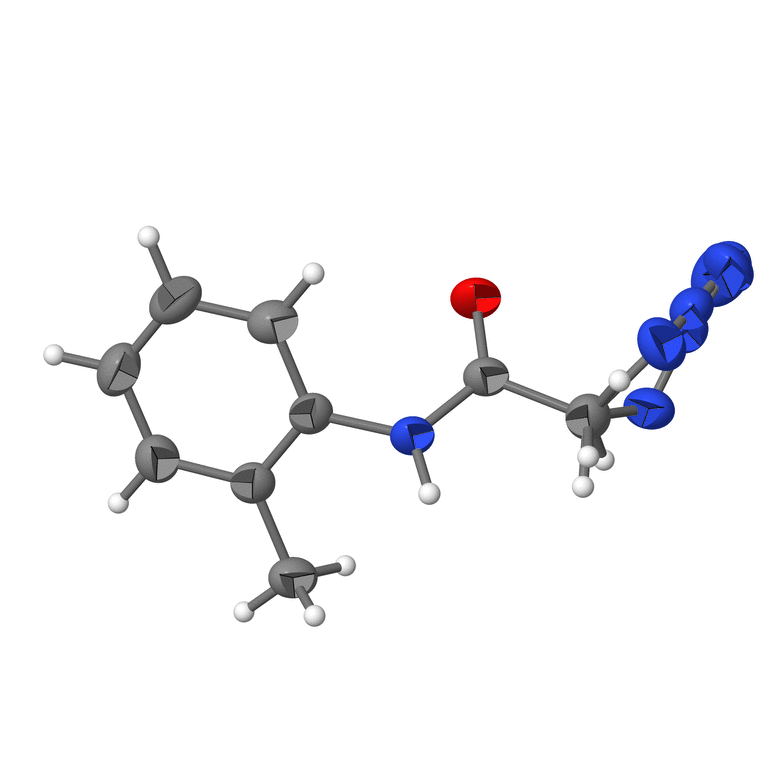
In the title molecule, C9H9N3O, the inner C—N—C—C portion is almost planar and the phenyl ring and azide group are rotated to be well out of this plane. In the crystal, N—H⋯O and C—H⋯O hydrogen bonds plus C—H⋯π(ring) interactions form chains of molecules extending along the a-axis direction, which pack with normal van der Waals interactions.
Keywords: crystal structure; azide; hydrogen bond; acetamide; C—H⋯π(ring) interaction; Hirshfeld surface.
CCDC reference: 2594679
Structure description
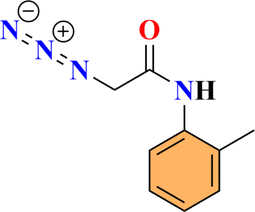
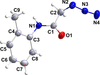
A main target in medicinal chemistry is heo synthesis of compounds or libraries of compounds through a variety of chemical reactions during the drug discovery process (Patrick, 2023 ). Among the numerous synthetic methodologies available, the 1,3-dipolar cycloaddition, also known as the Huisgen cycloaddition, is widely employed for the construction of bioactive molecules (Huisgen et al., 1967). This reaction involves the cycloaddition of an organic azide with a terminal alkyne, leading to the formation of 1,4- or 1,5-disubstituted 1,2,3-triazoles, depending on the catalyst and reaction conditions employed (Johansson et al., 2016). Alkyl azides are regarded as key synthetic intermediates in medicinal chemistry because they provide efficient access to 1,2,3-triazole derivatives, a privileged heterocyclic scaffold that has been extensively exploited in the development of therapeutic agents for the treatment of a wide range of diseases (Zhou & Wang, 2012). With this objective in mind, and as a continuation of our ongoing research (e.g. Guerrab et al., 2025), we report herein the synthesis and structural characterization of the title compound, C9H9N3O (2), prepared via nucleophilic substitution of the corresponding N-aryl chloroacetamide precursor with sodium azide. The molecular structure of 2 is shown in Fig. 1.
|
Figure 1
Perspective view of the title molecule with labeling scheme and 50% probability ellipsoids. Only the major orientation of the azide group is shown. |
The C3—N1—C1—C2 portion is planar within experimental error [torsion angle C3—N1—C1—C2 is −179.52 (14)°]. Both the azide and phenyl moieties are rotated out of this plane as indicated by the C1—N1—C3—C4 torsion angle of 131.37 (16)° and the dihedral angle between the amide group (O1/C1/N1) and benzene ring (C3–C8) of 48.4 (2)°. Bond lengths and interbond angles are as expected for the formulation given.
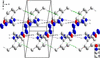
In the crystal, N1—H1⋯O1i and C2—H2AB⋯O1i hydrogen bonds plus C9—H9C⋯Cg1i interactions (Cg1 is the centroid of the C3–C8 ring; Table 1) form chains of molecules extending along the a-axis direction (Fig. 2). The chains pack with normal van der Waals interactions.
|
|||||||||||||||||||||||||||
 .
|
Figure 2
Packing projected onto (011) with N —H⋯O and C—H⋯O hydrogen bonds depicted, respectively, by violet and black dashed lines. The C—H⋯π(ring) interactions are depicted by green dashed lines and non-interacting hydrogen atoms are omitted for clarity. |
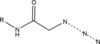
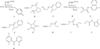
A search of the Cambridge Structural Database (CSD, version 6.01, updated to June 2026; Groom et al., 2016) with the fragment shown in Fig. 3 (R = C) yielded 85 hits. Many of these contained the N3 fragment as part of a triazole or a tetrazole ring, which left 20 that are comparable to the title molecule. These are listed in Table 2 with the more complex R groups pictured in Fig. 4. Inspection of the torsion angles corresponding to the N1—C1—C2—N2 and C1—N1—C3—C4 torsion angles in the title molecule (Table 2) shows that in the similar molecules, the conformations vary widely. Since the R groups vary greatly in size and shape, this is not surprising and likely can be attributed to packing considerations.
|
|
Figure 3
The search fragment used for the CSD database survey (R = C). |
|
Figure 4
The substituents (R) referred to in Table 2 . The wide dashed bond indicates the point of attachment. |
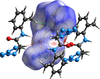
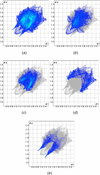
The dnorm Hirshfeld surface of the title molecule was calculated with CrystalExplorer (Spackman et al., 2021) and is shown in Fig. 5. Descriptions of the plots obtained by this method and their interpretations have been published (Tan et al., 2019). In Fig. 5, the intense red spots indicate the locations of the N—H⋯O hydrogen bonds to the neighboring molecules while the C—H⋯O hydrogen bonds are indicated by lighter red spots and the C—H⋯π(ring) interaction by the green line. The two-dimensional fingerprint plots are shown in Fig. 6 with all interactions in Fig. 6a, and the H⋯H interactions in Fig. 6b. The latter contribute 32.6% of the total intermolecular contacts which is often the case for organic molecules whose periphery consists largely of hydrogen atoms. It might be surprising that the N⋯H/H⋯N contacts (Fig. 6c) comprise 33.3% of the total since there are no directed hydrogen bonds to nitrogen. However, with the considerable nitrogen content due to the azide group, there are six N⋯H contacts at or close to the sum of the respective van der Waals radii. The other significant contributions come from the C⋯H/H⋯C (Fig. 6d, 17.3%) and the O⋯H/H⋯O (Fig. 6e, 10.5%) contacts. The former are due primarily to the C—H⋯π(ring) interactions and appear as a pair of rather blunt peaks. The latter appear as a pair of sharp peaks attributed to the N—H⋯O hydrogen bonds with broader shoulders which correspond to the C—H⋯O hydrogen bonds.
|
Figure 5
The dnorm Hirshfeld surface of the title molecule together with neighboring molecules and indicating the hydrogen bonds (red dashed lines) and C—H⋯π(ring) interactions (green line). |
|
Figure 6
Two-dimensional fingerprint plots showing all intermolecular interactions (a), the H⋯H interactions (b), the N⋯H/H⋯N interactions (c), the C⋯H/H⋯C interactions (d) and the O⋯H/H⋯O interactions (e). |
Synthesis and crystallization
The precursor 2-chloro-N-(o-tolyl)acetamide (1) was prepared according to the procedure described in our previous work (e.g. El Moutaouakil Ala Allah et al., 2024). A mixture of 2.73 mmol of compound 1 and 3.52 mmol of sodium azide was dissolved in an ethanol/water mixture and refluxed at 80 °C for 24 h. Upon completion of the reaction, as monitored by thin-layer chromatography (TLC), the precipitated 2-azido-N-(o-tolyl)acetamide (2) was collected by filtration and washed with cold water. The resulting solid was subsequently recrystallized from ethanol. Single crystals suitable for X-ray diffraction analysis were obtained by slow evaporation from ethanol solution.
Yield 82%, white solid, m.p. = 455–457 K. FT–IR (ATR, cm−1): 3218 (NH), 2110 (N3), 1640 (C=O); 1H NMR (500 MHz, DMSO-d6): δ p.p.m. 4.18 (s, 2H, CH2), 4.32 (s, 3H, CH3), 6.72–7.30 (m, 4H, Ar—H), 10.82 (s, 1H, NH); 13C NMR: 44.25 (CH2), 48.23 (CH3), 118.62, 121.25, 134.62, 148.59 (C—Ar); 169.23 (C=O).
Refinement
Crystal data, data collection and structure refinement details are summarized in Table 3. The azide group is disordered over two sites related by a 22.4 (3)° rotation about the C1—C2 bond in a 0.740 (4)/0.260 (4) ratio. The two components were refined with restraints that their geometries be comparable.
|

Structural data
CCDC reference: 2594679
Crystal structure: contains datablock I. DOI: https://doi.org/10.1107/S2414314626010503/vm4085sup1.cif
Structure factors: contains datablock I. DOI: https://doi.org/10.1107/S2414314626010503/vm4085Isup2.hkl
Supporting information file. DOI: https://doi.org/10.1107/S2414314626010503/vm4085Isup3.cml
| C9H10N4O | Z = 2 |
| Mr = 190.21 | F(000) = 200 |
| Triclinic, P1 | Dx = 1.341 Mg m−3 |
| a = 4.8642 (6) Å | Cu Kα radiation, λ = 1.54184 Å |
| b = 9.9359 (13) Å | Cell parameters from 1534 reflections |
| c = 10.4042 (9) Å | θ = 4.5–72.6° |
| α = 70.153 (10)° | µ = 0.77 mm−1 |
| β = 87.279 (8)° | T = 250 K |
| γ = 84.833 (10)° | Plank, colourless |
| V = 470.97 (10) Å3 | 0.46 × 0.16 × 0.13 mm |
| SuperNova, Dual, Cu at home/near, Atlas diffractometer | 1787 independent reflections |
| Radiation source: micro-focus sealed X-ray tube, SuperNova (Cu) X-ray Source | 1446 reflections with I > 2σ(I) |
| Mirror monochromator | Rint = 0.018 |
| Detector resolution: 10.5082 pixels mm-1 | θmax = 72.8°, θmin = 4.5° |
| ω scans | h = −5→5 |
| Absorption correction: gaussian (CrysAlisPro; Rigaku OD, 2026) | k = −11→12 |
| Tmin = 0.474, Tmax = 1.000 | l = −7→12 |
| 2964 measured reflections |
| Refinement on F2 | Primary atom site location: dual |
| Least-squares matrix: full | Hydrogen site location: mixed |
| R[F2 > 2σ(F2)] = 0.039 | H atoms treated by a mixture of independent and constrained refinement |
| wR(F2) = 0.116 | w = 1/[σ2(Fo2) + (0.0606P)2 + 0.0544P] where P = (Fo2 + 2Fc2)/3 |
| S = 1.05 | (Δ/σ)max < 0.001 |
| 1787 reflections | Δρmax = 0.22 e Å−3 |
| 159 parameters | Δρmin = −0.16 e Å−3 |
| 48 restraints |
Geometry. All esds (except the esd in the dihedral angle between two l.s. planes) are estimated using the full covariance matrix. The cell esds are taken into account individually in the estimation of esds in distances, angles and torsion angles; correlations between esds in cell parameters are only used when they are defined by crystal symmetry. An approximate (isotropic) treatment of cell esds is used for estimating esds involving l.s. planes. |
Refinement. The crystals contain a disordered azide moiety. The azide consist of N atoms N2-4 (Part 1) and N2A-4A (Part 2) The distances of the disordered groups were restrained to be similar (SADI) and the thermal parameters were also restrained (SIMU, RIGU. The occupancies were allowed to freely refine to sum unity, with a ratio of Part1:part2 of 0.74 (1):0.26 (1). All hydrogen atoms except H1 were observed in the electron density map before placing and refining using a riding model. Hydrogen atom H1 was refined and the N-H distance restrained to a target value of 0.88 %A (DFIX). The isotropic dispalcement parameters of hydrogen atom H1 was fixed at a value of 1.2 Ueq of the parent nitrogen atom N1. |
| x | y | z | Uiso*/Ueq | Occ. (<1) | |
| O1 | 0.04695 (19) | 0.74648 (14) | 0.48779 (12) | 0.0551 (3) | |
| N1 | 0.4802 (2) | 0.72303 (14) | 0.40158 (12) | 0.0400 (3) | |
| N3 | 0.0729 (8) | 0.9021 (4) | 0.6931 (5) | 0.0494 (9) | 0.740 (4) |
| C3 | 0.4099 (3) | 0.68309 (16) | 0.28864 (14) | 0.0374 (3) | |
| C1 | 0.2968 (3) | 0.75172 (17) | 0.49098 (14) | 0.0400 (3) | |
| C4 | 0.5213 (3) | 0.75306 (16) | 0.15991 (15) | 0.0395 (3) | |
| C8 | 0.2337 (3) | 0.57458 (17) | 0.30866 (16) | 0.0458 (4) | |
| H8 | 0.163675 | 0.526827 | 0.396628 | 0.055* | |
| C5 | 0.4474 (3) | 0.71126 (19) | 0.05240 (17) | 0.0493 (4) | |
| H5 | 0.520754 | 0.756276 | −0.035484 | 0.059* | |
| C9 | 0.7116 (3) | 0.87048 (18) | 0.13746 (16) | 0.0475 (4) | |
| H9A | 0.619476 | 0.946175 | 0.166719 | 0.071* | |
| H9B | 0.760659 | 0.909159 | 0.041157 | 0.071* | |
| H9C | 0.877472 | 0.831851 | 0.190031 | 0.071* | |
| N4 | −0.1164 (15) | 0.9030 (10) | 0.7588 (10) | 0.081 (2) | 0.740 (4) |
| C7 | 0.1620 (3) | 0.53715 (19) | 0.19932 (19) | 0.0548 (4) | |
| H7 | 0.040316 | 0.465146 | 0.212335 | 0.066* | |
| C2 | 0.4226 (3) | 0.7929 (2) | 0.60148 (17) | 0.0516 (4) | |
| H2AA | 0.417820 | 0.712307 | 0.687708 | 0.062* | 0.740 (4) |
| H2AB | 0.616616 | 0.810274 | 0.577377 | 0.062* | 0.740 (4) |
| H2BC | 0.603671 | 0.739849 | 0.623958 | 0.062* | 0.260 (4) |
| H2BD | 0.452032 | 0.895441 | 0.565423 | 0.062* | 0.260 (4) |
| C6 | 0.2689 (3) | 0.6053 (2) | 0.07137 (18) | 0.0557 (4) | |
| H6 | 0.220633 | 0.579867 | −0.003277 | 0.067* | |
| N2 | 0.2826 (4) | 0.9194 (2) | 0.6216 (2) | 0.0573 (7) | 0.740 (4) |
| N2A | 0.2616 (11) | 0.7659 (7) | 0.7216 (5) | 0.0549 (17) | 0.260 (4) |
| N3A | 0.065 (2) | 0.8486 (12) | 0.7275 (15) | 0.053 (3) | 0.260 (4) |
| N4A | −0.121 (5) | 0.921 (3) | 0.740 (3) | 0.087 (6) | 0.260 (4) |
| H1 | 0.651 (4) | 0.737 (3) | 0.412 (2) | 0.104* |
| U11 | U22 | U33 | U12 | U13 | U23 | |
| O1 | 0.0242 (5) | 0.0869 (9) | 0.0647 (7) | −0.0092 (5) | 0.0024 (5) | −0.0385 (7) |
| N1 | 0.0240 (6) | 0.0584 (8) | 0.0420 (7) | −0.0063 (5) | −0.0007 (5) | −0.0219 (6) |
| N3 | 0.0376 (14) | 0.067 (2) | 0.057 (2) | −0.0111 (16) | 0.0033 (12) | −0.0374 (19) |
| C3 | 0.0257 (6) | 0.0461 (8) | 0.0435 (8) | −0.0003 (5) | −0.0042 (5) | −0.0194 (6) |
| C1 | 0.0279 (7) | 0.0510 (8) | 0.0430 (8) | −0.0059 (6) | 0.0001 (5) | −0.0177 (6) |
| C4 | 0.0283 (7) | 0.0478 (8) | 0.0449 (8) | −0.0012 (6) | −0.0014 (5) | −0.0190 (6) |
| C8 | 0.0394 (8) | 0.0478 (9) | 0.0509 (9) | −0.0082 (6) | −0.0004 (6) | −0.0162 (7) |
| C5 | 0.0450 (9) | 0.0629 (10) | 0.0441 (8) | −0.0051 (7) | −0.0003 (6) | −0.0231 (7) |
| C9 | 0.0380 (8) | 0.0573 (10) | 0.0479 (8) | −0.0112 (7) | 0.0014 (6) | −0.0168 (7) |
| N4 | 0.052 (3) | 0.131 (5) | 0.083 (3) | −0.024 (2) | 0.029 (2) | −0.067 (3) |
| C7 | 0.0497 (9) | 0.0538 (10) | 0.0700 (11) | −0.0138 (7) | −0.0051 (8) | −0.0296 (8) |
| C2 | 0.0357 (8) | 0.0760 (12) | 0.0540 (9) | −0.0089 (7) | 0.0023 (6) | −0.0356 (9) |
| C6 | 0.0528 (10) | 0.0685 (11) | 0.0591 (10) | −0.0068 (8) | −0.0072 (8) | −0.0375 (9) |
| N2 | 0.0442 (11) | 0.0663 (14) | 0.0723 (14) | −0.0169 (9) | 0.0196 (9) | −0.0370 (11) |
| N2A | 0.051 (3) | 0.073 (4) | 0.042 (3) | −0.003 (3) | 0.002 (2) | −0.021 (3) |
| N3A | 0.045 (4) | 0.071 (6) | 0.058 (7) | −0.021 (4) | 0.006 (4) | −0.037 (5) |
| N4A | 0.070 (10) | 0.083 (8) | 0.130 (16) | 0.008 (6) | −0.010 (8) | −0.068 (9) |
| O1—C1 | 1.2234 (16) | C9—H9A | 0.9700 |
| N1—C3 | 1.4263 (17) | C9—H9B | 0.9700 |
| N1—C1 | 1.3408 (18) | C9—H9C | 0.9700 |
| N1—H1 | 0.873 (16) | C7—H7 | 0.9400 |
| N3—N4 | 1.122 (6) | C7—C6 | 1.374 (3) |
| N3—N2 | 1.223 (4) | C2—H2AA | 0.9800 |
| C3—C4 | 1.392 (2) | C2—H2AB | 0.9800 |
| C3—C8 | 1.392 (2) | C2—H2BC | 0.9800 |
| C1—C2 | 1.515 (2) | C2—H2BD | 0.9800 |
| C4—C5 | 1.391 (2) | C2—N2 | 1.449 (3) |
| C4—C9 | 1.504 (2) | C2—N2A | 1.402 (5) |
| C8—H8 | 0.9400 | C6—H6 | 0.9400 |
| C8—C7 | 1.379 (2) | N2A—N3A | 1.217 (11) |
| C5—H5 | 0.9400 | N3A—N4A | 1.136 (14) |
| C5—C6 | 1.381 (2) | ||
| C3—N1—H1 | 120.0 (17) | H9A—C9—H9C | 109.5 |
| C1—N1—C3 | 124.46 (11) | H9B—C9—H9C | 109.5 |
| C1—N1—H1 | 115.4 (17) | C8—C7—H7 | 120.1 |
| N4—N3—N2 | 171.4 (6) | C6—C7—C8 | 119.85 (15) |
| C4—C3—N1 | 119.13 (12) | C6—C7—H7 | 120.1 |
| C8—C3—N1 | 119.80 (13) | C1—C2—H2AA | 108.9 |
| C8—C3—C4 | 121.07 (13) | C1—C2—H2AB | 108.9 |
| O1—C1—N1 | 124.94 (13) | C1—C2—H2BC | 108.7 |
| O1—C1—C2 | 120.59 (13) | C1—C2—H2BD | 108.7 |
| N1—C1—C2 | 114.47 (11) | H2AA—C2—H2AB | 107.7 |
| C3—C4—C9 | 121.38 (13) | H2BC—C2—H2BD | 107.6 |
| C5—C4—C3 | 117.40 (14) | N2—C2—C1 | 113.38 (15) |
| C5—C4—C9 | 121.22 (14) | N2—C2—H2AA | 108.9 |
| C3—C8—H8 | 120.0 | N2—C2—H2AB | 108.9 |
| C7—C8—C3 | 119.95 (15) | N2A—C2—C1 | 114.1 (2) |
| C7—C8—H8 | 120.0 | N2A—C2—H2BC | 108.7 |
| C4—C5—H5 | 119.1 | N2A—C2—H2BD | 108.7 |
| C6—C5—C4 | 121.72 (15) | C5—C6—H6 | 120.0 |
| C6—C5—H5 | 119.1 | C7—C6—C5 | 119.99 (15) |
| C4—C9—H9A | 109.5 | C7—C6—H6 | 120.0 |
| C4—C9—H9B | 109.5 | N3—N2—C2 | 116.9 (2) |
| C4—C9—H9C | 109.5 | N3A—N2A—C2 | 120.0 (7) |
| H9A—C9—H9B | 109.5 | N4A—N3A—N2A | 176 (2) |
| O1—C1—C2—N2 | −47.3 (2) | C1—N1—C3—C4 | 131.37 (16) |
| O1—C1—C2—N2A | 24.8 (4) | C1—N1—C3—C8 | −49.2 (2) |
| N1—C3—C4—C5 | −179.88 (13) | C1—C2—N2—N3 | 81.8 (4) |
| N1—C3—C4—C9 | −0.6 (2) | C1—C2—N2A—N3A | −79.6 (10) |
| N1—C3—C8—C7 | 179.04 (14) | C4—C3—C8—C7 | −1.5 (2) |
| N1—C1—C2—N2 | 132.74 (16) | C4—C5—C6—C7 | −0.7 (3) |
| N1—C1—C2—N2A | −155.1 (3) | C8—C3—C4—C5 | 0.6 (2) |
| C3—N1—C1—O1 | 0.5 (3) | C8—C3—C4—C9 | 179.96 (14) |
| C3—N1—C1—C2 | −179.52 (14) | C8—C7—C6—C5 | −0.1 (3) |
| C3—C4—C5—C6 | 0.5 (2) | C9—C4—C5—C6 | −178.84 (15) |
| C3—C8—C7—C6 | 1.2 (3) |
| Cg1 is the centroid of the C3–C8 benzene ring. |
| D—H···A | D—H | H···A | D···A | D—H···A |
| N1—H1···O1i | 0.87 (2) | 2.14 (2) | 2.9918 (15) | 166 (2) |
| C2—H2AB···O1i | 0.98 | 2.37 | 3.2576 (19) | 150 |
| C9—H9C···Cg1i | 0.97 | 2.81 | 3.5817 (18) | 137 |
| Symmetry code: (i) x+1, y, z. |
| Compound | Ra | Torsion 1b (°) | Torsion 2c (°) | Reference |
| Title molecule | o-tolyl | 132.74 (16) | 131.37 (16) | This work |
| ASEDIO | phenyl | 169.90 (18), 160.9 (2) | 151,3(3), 161.5 (2) | Guerrab et al. (2021) |
| BEBPIJ | A | -17.4 (13) | -164.4 (10) | Cecioni et al. (2012) |
| BEKRES | p-tolyl | -177.75 (18), -176.64 (18), -179.23 (18) | -156.8 (2), -160.2 (2), -158.8 (2) | Missioui et al. (2022a) |
| BEKRIW | 4-FC6H4 | 167.98 (18), -156.64 (18) | -158.4 (2), -158.8 (2) | Missioui et al. (2022b) |
| CUVVEY | 2,6-Me2C6H3 | -137.3 (5), 136.6((4) | -116.5 (6), 114.9 (5) | El Moutaouakil Ala Allah et al. (2025) |
| DAPYOU | 4-HC2C6H4 | -160.0 (4), -175.4 (3) | -176.2 (4), 168.4 (3) | Madhusudhanan et al. (2021) |
| GUYCUC | B | 103.7 (9) | -78.2 (6) | Rai et al. (2025) |
| HIQKIF | C | -145.6 (4) | -126.0 (3) | Khazeber & Sureshan (2022) |
| KEPKOG | D | 6.5 (2) | 126.8 (4) | Petsalakis et al. (2006) |
| LETTIR | E | 5.7 (3) | 1.6 (4) | Guirado-Moreno et al. (2023) |
| PADGEK | F | 166.5 (7) | 118.6 (6) | Hema & Sureshan (2020) |
| QAGNOF | 4-O2NC6H4 | 142.68 (13) | 15.99 (19) | Missioui et al. (2020) |
| QIMYOE | G | 123.53 (9) | 68.76 (12) | Kumar et al. (2023) |
| TARHIH | 4-MeOC6H4 | 125.25 (14) | 156.34 (15) | Missioui et al. (2022c) |
| TODFIZ | H | -161.8 (8) | -173.9 (8) | Athiyarath & Sureshan (2019) |
| TODVAM | I | 161.9 (4) | 178.0 (4) | Athiyarath & Sureshan (2019) |
| TUZPEJ | J | 10.0 (3), 176.0 (2) | 146.9 (3), 37.3 (4) | Li et al. (2003) |
| VIFVOX | K | -170.3 (3), -3.8 (4) | 161.9 (2), 174.7 (2) | Sandra et al. (2012) |
| WOQBOX | PhCH2CH2 | 177.98 (13) | 84.67 (17) | Cedillo-Cruz et al. (2024) |
| Notes: (a) Letters refer to the drawings in Fig. 4; (b) corresponds to the N1—C1—C2—N2 torsion in the title molecule; (c) corresponds to the C1—N1—C3—C4 torsion in the title molecule. |
Acknowledgements
YR is thankful to the National Center for Scientific and Technical Research of Morocco (CNRST) for its continuous support. Author contributions are as follows. Conceptualization, YR; methodology, AA and MAS; investigation, AEMA.; writing (review and editing of the manuscript), YR; formal analysis, JTM and VL; supervision, YR; crystal structure determination, BS.
References
 Athiyarath, V. & Sureshan, K. M. (2019). Angew. Chem. Int. Ed. 58, 612–617.
CrossRef
CAS
Google Scholar
Cecioni, S., Praly, J.-P., Matthews, S. E., Wimmerová, M., Imberty, A. & Vidal, S. (2012). Chem. Eur. J. 18, 6250–6263.
Web of Science
CSD
CrossRef
CAS
PubMed
Google Scholar
Cedillo–Cruz, A., Villalobos–López, D. C., Zavala–Segovia, N., Aguilar, M. I. & Cuevas–Yañez, E. (2024). J. Mol. Struct. 1309, 138178.
Google Scholar
Dolomanov, O. V., Bourhis, L. J., Gildea, R. J., Howard, J. A. K. & Puschmann, H. (2009). J. Appl. Cryst. 42, 339–341.
Web of Science
CrossRef
CAS
IUCr Journals
Google Scholar
El Moutaouakil Ala Allah, A., Kariuki, B. M., Al-Sulami, A. I., Basha, M. T., Allehyani, B. H., Alsubari, A., Mague, J. T. & Ramli, Y. (2025). Acta Cryst. E81, 627–631.
CrossRef
IUCr Journals
Google Scholar
El Moutaouakil Ala Allah, A., Kariuki, B. M., Ameziane El Hassani, I., Alsubari, A., Guerrab, W., Said, M. & Ramli, Y. (2024). IUCrData 9, x241015.
Google Scholar
Groom, C. R., Bruno, I. J., Lightfoot, M. P. & Ward, S. C. (2016). Acta Cryst. B72, 171–179.
Web of Science
CrossRef
IUCr Journals
Google Scholar
Guerrab, W., Missioui, M., Zaoui, Y., Mague, J. T. & Ramli, Y. (2021). Z. Kristallogr. New Cryst. Struct. 236, 133–134.
Web of Science
CSD
CrossRef
CAS
Google Scholar
Guerrab, W., Mortada, S., El Moutaouakil Ala Allah, A., Demirtaş, G., Mague, J. T., Alzahrani, A. Y. A., AL Mughram, M. H., Faouzi, M. E. A. & Ramli, Y. (2025). J. Mol. Struct. 1333, 141802.
Web of Science
CSD
CrossRef
Google Scholar
Guirado-Moreno, J. C., González-Ceballos, L., Carreira-Barral, I., Ibeas, S., Fernández-Muiño, M. A., Teresa Sancho, M., García, J. M. & Vallejos, S. (2023). Spectrochim. Acta A Mol. Biomol. Spectrosc. 284, 121820.
PubMed
Google Scholar
Hema, K. & Sureshan, K. M. (2020). Angew. Chem. Int. Ed. 59, 8854–8859.
CrossRef
CAS
Google Scholar
Huisgen, R., Szeimies, G. & Möbius, L. (1967). Chem. Ber. 100, 2494–2507.
CrossRef
CAS
Google Scholar
Johansson, J. R., Beke-Somfai, T., Said Stålsmeden, A. & Kann, N. (2016). Chem. Rev. 116, 14726–14768.
CrossRef
CAS
PubMed
Google Scholar
Khazeber, R. & Sureshan, K. M. (2022). Proc. Natl Acad. Sci. USA 119, e2205320119.
CrossRef
PubMed
Google Scholar
Kumar, S., Lal, B., Tittal, R. K., Singh, G., Singh, J., Sharma, R. & Sabane, J. K. (2023). Sens. Diagn. 2, 1267–1276.
CrossRef
CAS
Google Scholar
Li, Z.-X., Tang, S.-Q., Liu, J.-T. & Sun, J. (2003). Jiegou Huaxue(Chin.)(Chin. J. Struct. Chem.) 2, 25.
Google Scholar
Madhusudhanan, M. C., Balan, H., Werz, D. B. & Sureshan, K. M. (2021). Angew. Chem. Int. Ed. 60, 22797–22803.
Web of Science
CSD
CrossRef
CAS
Google Scholar
Missioui, M., Guerrab, W., Alsubari, A., Mague, J. T. & Ramli, Y. (2022a). IUCrData 7, x220621.
Google Scholar
Missioui, M., Guerrab, W., Alsubari, A., Mague, J. T. & Ramli, Y. (2022b). Acta Cryst. E78, 855–859.
Web of Science
CSD
CrossRef
IUCr Journals
Google Scholar
Missioui, M., Guerrab, W., Mague, J. T. & Ramli, Y. (2020). Z. Kristallogr. New Cryst. Struct. 235, 1429–1430.
Web of Science
CSD
CrossRef
CAS
Google Scholar
Missioui, M., Lgaz, H., Guerrab, W., Lee, H.-S., Warad, I., Mague, J. T., Ali, I. H., <Essassi, El, M. & Ramli, Y. (2022c). J. Mol. Struct. 1253, 132132.
CrossRef
Google Scholar
Patrick, G. L. (2023). An introduction to medicinal chemistry. Oxford University Press.
Google Scholar
Petsalakis, E. I., Chrysina, E. D., Tiraidis, C., Hadjiloi, T., Leonidas, D. D., Oikonomakos, N. G., Aich, U., Varghese, B. & Loganathan, D. (2006). Bioorg. Med. Chem. 14, 5316–5324.
CrossRef
PubMed
CAS
Google Scholar
Rai, R., Xavier, D., Pathak, S., Fernandez, F. B., Komath, M. & Sureshan, K. M. (2025). Angew. Chem. Int. Ed. 64, e202422593.
CrossRef
Google Scholar
Rigaku OD (2026). CrysAlis PRO. Rigaku Oxford Diffraction, Yarnton, England.
Google Scholar
Sandra, C.-M., Eduardo, C. C., Simon, H.-O., Teresa, R. A., Antonio, N. C., Lijanova, I. V. & Marcos, M.-G. (2012). Anticancer Agents Med. Chem. 12, 611–618.
CAS
PubMed
Google Scholar
Sheldrick, G. M. (2015a). Acta Cryst. A71, 3–8.
Web of Science
CrossRef
IUCr Journals
Google Scholar
Sheldrick, G. M. (2015b). Acta Cryst. C71, 3–8.
Web of Science
CrossRef
IUCr Journals
Google Scholar
Spackman, P. R., Turner, M. J., McKinnon, J. J., Wolff, S. K., Grimwood, D. J., Jayatilaka, D. & Spackman, M. A. (2021). J. Appl. Cryst. 54, 1006–1011.
Web of Science
CrossRef
CAS
IUCr Journals
Google Scholar
Tan, S. L., Jotani, M. M. & Tiekink, E. R. T. (2019). Acta Cryst. E75, 308–318.
Web of Science
CrossRef
IUCr Journals
Google Scholar
Zhou, C.-H. & Wang, Y. (2012). Curr. Med. Chem. 19, 239–280.
Web of Science
CAS
PubMed
Google Scholar
This is an open-access article distributed under the terms of the Creative Commons Attribution (CC-BY) Licence, which permits unrestricted use, distribution, and reproduction in any medium, provided the original authors and source are cited.
| IUCrDATA |