

 menu


organic compounds
 | IUCrDATA |
 access
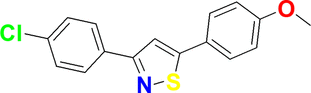
5-(4-Chlorophenyl)-3-(4-methoxyphenyl)isothiazole

aDepartment of Chemistry, BMS Institute of Technology & Management, Autonomous under Visvesvaraya Technological University, Avalahalli, Yelahanka, Bengaluru 560064, Karnataka, India, bDepartment of Physics, Government First Grade College, Pandavapura, Mandya, Karnataka 571434, India, and cResearch Center, Department of Physics, Government Engineering College, Bedarapura, Chamarajanagara 571313, Karnataka, India
*Correspondence e-mail: [email protected], [email protected]
In the title compound, C16H12ClNOS, the dihedral angles between the central isothiazole ring and pendant p-methoxyphenyl and p-chlorophenyl rings are 19.30 (19) and 13.8 (2)°, respectively. The molecule exhibits short intramolecular C—H⋯S and C—H⋯N contacts, each generating an S(5) ring motif.
CCDC reference: 2158969
Structure description
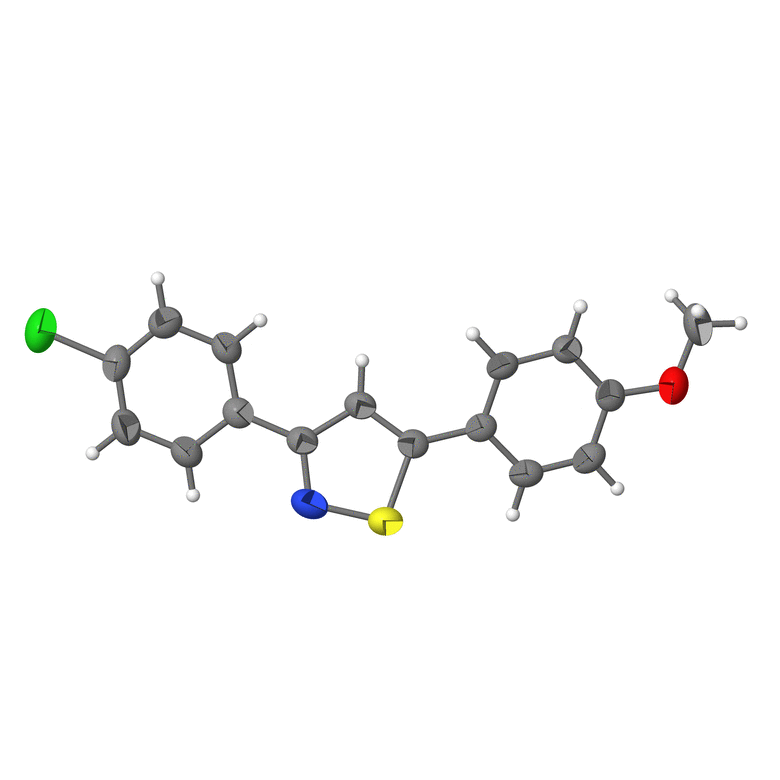
The title compound, C16H12ClNOS (2), crystallizes with one molecule in the asymmetric unit (Fig. 1 ) in space group Cc. The dihedral angles between the central C1/C2/C3/S1/N1 isothiazole ring and pendant C4–C9 p-methoxyphenyl and C11–C16 p-chlorophenyl rings are 19.30 (19) and 13.8 (2)°, respectively. The dihedral angle between the pendant rings is 15.9 (2)°. The inter-ring bond distances of C1—C11 = 1.472 (6) Å and C3—C4 = 1.461 (5) Å are very similar. Otherwise, all the bond distances in 2 are consistent with those in related structures (Chakravarthy et al., 2026; Sreenatha et al., 2020; Sreenatha et al., 2018). The molecular conformation of 2 is supported by short intramolecular C9—H9⋯S1 and C12—H12⋯N1 contacts (Table 1): both of these enclose an S(5) ring. The packing of the molecules is shown in Fig. 2.
|
||||||||||||||||||||||
|
Figure 1
The molecular structure of 2 drawn at 50% probability with short intramolecular contacts represented by dashed lines. |
|
Figure 2
The packing for 2 viewed along the crystallographic c axis. |
Synthesis and crystallization
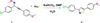
Compound 2 was synthesized by following a literature procedure (Zhang et al., 2021) (Fig. 3). A vessel was charged with 1 (0.20 mmol), Na2S (0.30 mmol, 23.4 mg), NaHCO3 (0.40 mmol, 33.6 mg) and H2O (1.20 mmol, 21.6 mg) in N,N-dimethylformamide (DMF) (2 ml). The reaction mixture was stirred at 90°C in an oil bath for 13–15 h until the starting material was consumed completely as monitored by TLC. After the completion of the reaction the mixture was poured into ethyl acetate and washed with brine (2 × 15 ml). The combined organic layers were dried over anhydrous MgSO4 and evaporated under vacuum. The residue was purified by flash column chromatography using petroleum ether/ethyl acetate as the eluent to afford the desired product 2 in 87% yield. Then, 0.5 g of 2 was dissolved in 5 ml of DMF and was allowed to undergo slow evaporation to form colorless blocks.
|
Figure 3
Synthesis scheme for 2. |
Refinement
Crystal data and structure refinement details are summarized in Table 2.
|
Structural data
CCDC reference: 2158969
Crystal structure: contains datablock I. DOI: https://doi.org/10.1107/S2414314626010989/hb4577sup1.cif
Structure factors: contains datablock I. DOI: https://doi.org/10.1107/S2414314626010989/hb4577Isup2.hkl
Supporting information file. DOI: https://doi.org/10.1107/S2414314626010989/hb4577Isup3.cml
| C16H12ClNOS | F(000) = 624.0 |
| Mr = 301.78 | Dx = 1.420 Mg m−3 |
| Monoclinic, Cc | Mo Kα radiation, λ = 0.71073 Å |
| a = 32.054 (3) Å | Cell parameters from 4353 reflections |
| b = 7.2423 (7) Å | θ = 2.6–30.5° |
| c = 6.0942 (5) Å | µ = 0.41 mm−1 |
| β = 93.607 (3)° | T = 301 K |
| V = 1411.9 (2) Å3 | Block, colorless |
| Z = 4 | 0.30 × 0.27 × 0.21 mm |
| Bruker APEX diffractometer | Rint = 0.094 |
| Radiation source: graphite | θmax = 30.5°, θmin = 2.6° |
| SAINT (Bruker, 2012) scans | h = −45→45 |
| Absorption correction: multi-scan (Krause et al., 2015) | k = −10→10 |
| Tmin = 0.677, Tmax = 0.739 | l = −8→8 |
| 43343 measured reflections | 4353 standard reflections every 200 reflections |
| 4353 independent reflections | intensity decay: none |
| 2555 reflections with I > 2σ(I) |
| Refinement on F2 | Hydrogen site location: inferred from neighbouring sites |
| Least-squares matrix: full | H-atom parameters constrained |
| R[F2 > 2σ(F2)] = 0.048 | w = 1/[σ2(Fo2) + (0.0482P)2 + 0.4728P] where P = (Fo2 + 2Fc2)/3 |
| wR(F2) = 0.121 | (Δ/σ)max = 0.018 |
| S = 1.01 | Δρmax = 0.21 e Å−3 |
| 4353 reflections | Δρmin = −0.25 e Å−3 |
| 182 parameters | Absolute structure: Flack x determined using 978 quotients [(I+)-(I-)]/[(I+)+(I-)] (Parsons et al., 2013) |
| 2 restraints | Absolute structure parameter: 0.05 (3) |
| Primary atom site location: dual |
Geometry. All esds (except the esd in the dihedral angle between two l.s. planes) are estimated using the full covariance matrix. The cell esds are taken into account individually in the estimation of esds in distances, angles and torsion angles; correlations between esds in cell parameters are only used when they are defined by crystal symmetry. An approximate (isotropic) treatment of cell esds is used for estimating esds involving l.s. planes. |
Refinement. The methyl H atoms were placed in calculated positions and refined as riding atoms with Uiso(H) = 1.5Ueq(C). All other H atoms were positioned geometrically and refined using a riding model with Uiso(H) = 1.2Ueq(C). |
| x | y | z | Uiso*/Ueq | ||
| N1 | 0.47015 (14) | 0.7064 (5) | 0.7742 (6) | 0.0591 (11) | |
| S1 | 0.52016 (4) | 0.70064 (18) | 0.83327 (15) | 0.0599 (3) | |
| O1 | 0.70313 (10) | 0.7362 (5) | 0.3621 (6) | 0.0636 (9) | |
| Cl1 | 0.28598 (4) | 0.7711 (2) | 0.1759 (2) | 0.0833 (5) | |
| C1 | 0.46277 (13) | 0.7425 (5) | 0.5613 (7) | 0.0400 (9) | |
| C2 | 0.49908 (13) | 0.7689 (5) | 0.4444 (6) | 0.0418 (9) | |
| C3 | 0.53505 (13) | 0.7466 (5) | 0.5741 (6) | 0.0395 (8) | |
| C4 | 0.57864 (12) | 0.7502 (5) | 0.5173 (6) | 0.0382 (8) | |
| C5 | 0.59000 (12) | 0.8323 (6) | 0.3257 (6) | 0.0434 (9) | |
| C6 | 0.63132 (12) | 0.8324 (6) | 0.2661 (7) | 0.0446 (9) | |
| C7 | 0.66182 (13) | 0.7482 (6) | 0.4015 (7) | 0.0433 (9) | |
| C8 | 0.65076 (13) | 0.6660 (6) | 0.5985 (7) | 0.0488 (10) | |
| C9 | 0.61006 (13) | 0.6673 (6) | 0.6540 (6) | 0.0463 (10) | |
| C10 | 0.71611 (17) | 0.8111 (10) | 0.1694 (10) | 0.0847 (18) | |
| C11 | 0.41961 (14) | 0.7482 (5) | 0.4638 (7) | 0.0423 (9) | |
| C12 | 0.38673 (14) | 0.6809 (6) | 0.5819 (7) | 0.0523 (11) | |
| C13 | 0.34575 (14) | 0.6873 (6) | 0.4948 (8) | 0.0586 (12) | |
| C14 | 0.33749 (13) | 0.7612 (7) | 0.2906 (8) | 0.0504 (11) | |
| C15 | 0.36868 (13) | 0.8283 (7) | 0.1691 (7) | 0.0547 (11) | |
| C16 | 0.40983 (13) | 0.8195 (6) | 0.2572 (7) | 0.0492 (10) | |
| H2 | 0.498508 | 0.798179 | 0.295664 | 0.050* | |
| H5 | 0.569576 | 0.889094 | 0.233849 | 0.052* | |
| H6 | 0.638274 | 0.888710 | 0.136228 | 0.054* | |
| H8 | 0.671192 | 0.610591 | 0.691597 | 0.059* | |
| H9 | 0.603131 | 0.612082 | 0.784607 | 0.056* | |
| H10A | 0.699173 | 0.763190 | 0.046890 | 0.127* | |
| H10B | 0.744828 | 0.779184 | 0.153505 | 0.127* | |
| H10C | 0.713348 | 0.943035 | 0.173878 | 0.127* | |
| H12 | 0.392495 | 0.630994 | 0.721126 | 0.063* | |
| H13 | 0.324164 | 0.641881 | 0.574405 | 0.070* | |
| H15 | 0.362514 | 0.878733 | 0.030485 | 0.066* | |
| H16 | 0.431213 | 0.862731 | 0.174619 | 0.059* |
| U11 | U22 | U33 | U12 | U13 | U23 | |
| N1 | 0.065 (3) | 0.068 (3) | 0.045 (2) | −0.0046 (19) | 0.0129 (18) | 0.0084 (18) |
| S1 | 0.0563 (7) | 0.0828 (8) | 0.0403 (5) | −0.0031 (7) | 0.0017 (4) | 0.0113 (6) |
| O1 | 0.0416 (15) | 0.081 (2) | 0.068 (2) | 0.0024 (16) | 0.0012 (14) | 0.0022 (19) |
| Cl1 | 0.0460 (7) | 0.1072 (12) | 0.0954 (11) | −0.0022 (7) | −0.0064 (6) | 0.0041 (9) |
| C1 | 0.047 (2) | 0.035 (2) | 0.039 (2) | 0.0026 (16) | 0.0063 (16) | 0.0020 (15) |
| C2 | 0.048 (2) | 0.043 (2) | 0.0353 (19) | 0.0012 (17) | 0.0060 (16) | −0.0001 (15) |
| C3 | 0.045 (2) | 0.032 (2) | 0.041 (2) | −0.0021 (17) | 0.0032 (16) | 0.0017 (15) |
| C4 | 0.045 (2) | 0.031 (2) | 0.038 (2) | −0.0013 (15) | −0.0020 (15) | −0.0016 (14) |
| C5 | 0.046 (2) | 0.044 (2) | 0.039 (2) | −0.0006 (17) | −0.0050 (17) | 0.0050 (17) |
| C6 | 0.042 (2) | 0.050 (2) | 0.041 (2) | −0.0063 (18) | 0.0013 (16) | 0.0064 (17) |
| C7 | 0.041 (2) | 0.042 (2) | 0.047 (2) | −0.0055 (18) | 0.0005 (16) | −0.0048 (17) |
| C8 | 0.051 (3) | 0.046 (3) | 0.048 (2) | 0.0055 (18) | −0.0084 (18) | 0.0032 (18) |
| C9 | 0.055 (2) | 0.045 (2) | 0.038 (2) | 0.0001 (18) | −0.0005 (17) | 0.0036 (16) |
| C10 | 0.041 (3) | 0.130 (5) | 0.084 (4) | −0.012 (3) | 0.013 (3) | 0.006 (4) |
| C11 | 0.046 (2) | 0.036 (2) | 0.045 (2) | 0.0000 (17) | 0.0069 (17) | −0.0023 (17) |
| C12 | 0.049 (3) | 0.060 (3) | 0.049 (2) | −0.001 (2) | 0.0104 (19) | 0.006 (2) |
| C13 | 0.043 (2) | 0.063 (3) | 0.071 (3) | −0.006 (2) | 0.012 (2) | 0.009 (2) |
| C14 | 0.037 (2) | 0.049 (3) | 0.064 (3) | 0.0015 (18) | −0.0004 (19) | −0.003 (2) |
| C15 | 0.054 (3) | 0.059 (3) | 0.050 (3) | −0.001 (2) | −0.002 (2) | 0.0057 (19) |
| C16 | 0.043 (2) | 0.056 (3) | 0.049 (2) | −0.0029 (19) | 0.0094 (18) | 0.0049 (19) |
| S1—N1 | 1.621 (5) | C9—H9 | 0.9300 |
| S1—C3 | 1.711 (4) | C11—C16 | 1.378 (6) |
| Cl1—C14 | 1.754 (4) | C11—C12 | 1.401 (6) |
| C4—C5 | 1.380 (5) | C16—C15 | 1.394 (6) |
| C4—C9 | 1.401 (5) | C16—H16 | 0.9300 |
| C4—C3 | 1.461 (5) | C6—H6 | 0.9300 |
| C1—N1 | 1.330 (5) | C14—C13 | 1.365 (7) |
| C1—C2 | 1.415 (6) | C14—C15 | 1.370 (6) |
| C1—C11 | 1.472 (6) | C15—H15 | 0.9300 |
| C7—O1 | 1.363 (5) | C2—H2 | 0.9300 |
| C7—C6 | 1.381 (6) | C12—C13 | 1.386 (6) |
| C7—C8 | 1.405 (6) | C12—H12 | 0.9300 |
| C8—C9 | 1.368 (6) | C13—H13 | 0.9300 |
| C8—H8 | 0.9300 | C10—O1 | 1.381 (6) |
| C5—C6 | 1.395 (5) | C10—H10A | 0.9600 |
| C5—H5 | 0.9300 | C10—H10B | 0.9600 |
| C3—C2 | 1.366 (5) | C10—H10C | 0.9600 |
| N1—S1—C3 | 96.9 (2) | C11—C16—H16 | 119.2 |
| C5—C4—C9 | 118.0 (4) | C15—C16—H16 | 119.2 |
| C5—C4—C3 | 121.0 (3) | C7—C6—C5 | 119.5 (4) |
| C9—C4—C3 | 120.9 (4) | C7—C6—H6 | 120.3 |
| N1—C1—C2 | 114.6 (4) | C5—C6—H6 | 120.3 |
| N1—C1—C11 | 120.3 (4) | C13—C14—C15 | 121.7 (4) |
| C2—C1—C11 | 125.1 (3) | C13—C14—Cl1 | 120.2 (4) |
| C1—N1—S1 | 109.5 (3) | C15—C14—Cl1 | 118.1 (4) |
| O1—C7—C6 | 125.6 (4) | C14—C15—C16 | 118.7 (4) |
| O1—C7—C8 | 115.1 (4) | C14—C15—H15 | 120.6 |
| C6—C7—C8 | 119.4 (4) | C16—C15—H15 | 120.6 |
| C9—C8—C7 | 120.3 (4) | C3—C2—C1 | 112.6 (3) |
| C9—C8—H8 | 119.9 | C3—C2—H2 | 123.7 |
| C7—C8—H8 | 119.9 | C1—C2—H2 | 123.7 |
| C4—C5—C6 | 121.7 (4) | C13—C12—C11 | 121.1 (4) |
| C4—C5—H5 | 119.1 | C13—C12—H12 | 119.4 |
| C6—C5—H5 | 119.1 | C11—C12—H12 | 119.4 |
| C2—C3—C4 | 130.2 (4) | C14—C13—C12 | 119.1 (4) |
| C2—C3—S1 | 106.4 (3) | C14—C13—H13 | 120.4 |
| C4—C3—S1 | 123.3 (3) | C12—C13—H13 | 120.4 |
| C8—C9—C4 | 121.1 (4) | O1—C10—H10A | 109.5 |
| C8—C9—H9 | 119.4 | O1—C10—H10B | 109.5 |
| C4—C9—H9 | 119.4 | H10A—C10—H10B | 109.5 |
| C16—C11—C12 | 117.7 (4) | O1—C10—H10C | 109.5 |
| C16—C11—C1 | 122.2 (4) | H10A—C10—H10C | 109.5 |
| C12—C11—C1 | 120.1 (4) | H10B—C10—H10C | 109.5 |
| C11—C16—C15 | 121.6 (4) | C7—O1—C10 | 118.2 (4) |
| C2—C1—N1—S1 | −0.9 (5) | C12—C11—C16—C15 | 1.3 (6) |
| C11—C1—N1—S1 | 177.7 (3) | C1—C11—C16—C15 | −178.4 (4) |
| C3—S1—N1—C1 | 0.0 (3) | O1—C7—C6—C5 | 179.2 (4) |
| O1—C7—C8—C9 | −179.1 (4) | C8—C7—C6—C5 | −0.9 (6) |
| C6—C7—C8—C9 | 0.9 (6) | C4—C5—C6—C7 | 0.1 (6) |
| C9—C4—C5—C6 | 0.6 (6) | C13—C14—C15—C16 | 0.3 (7) |
| C3—C4—C5—C6 | −178.2 (4) | Cl1—C14—C15—C16 | −179.3 (4) |
| C5—C4—C3—C2 | 19.7 (6) | C11—C16—C15—C14 | −1.1 (7) |
| C9—C4—C3—C2 | −159.1 (4) | C4—C3—C2—C1 | 175.8 (4) |
| C5—C4—C3—S1 | −163.3 (3) | S1—C3—C2—C1 | −1.6 (4) |
| C9—C4—C3—S1 | 17.9 (5) | N1—C1—C2—C3 | 1.7 (5) |
| N1—S1—C3—C2 | 1.0 (3) | C11—C1—C2—C3 | −176.8 (4) |
| N1—S1—C3—C4 | −176.6 (3) | C16—C11—C12—C13 | −0.6 (6) |
| C7—C8—C9—C4 | −0.2 (6) | C1—C11—C12—C13 | 179.0 (4) |
| C5—C4—C9—C8 | −0.6 (6) | C15—C14—C13—C12 | 0.3 (8) |
| C3—C4—C9—C8 | 178.3 (4) | Cl1—C14—C13—C12 | 179.9 (4) |
| N1—C1—C11—C16 | 167.0 (4) | C11—C12—C13—C14 | −0.2 (7) |
| C2—C1—C11—C16 | −14.5 (6) | C6—C7—O1—C10 | −1.2 (6) |
| N1—C1—C11—C12 | −12.6 (6) | C8—C7—O1—C10 | 178.9 (5) |
| C2—C1—C11—C12 | 165.9 (4) |
| D—H···A | D—H | H···A | D···A | D—H···A |
| C9—H9···S1 | 0.93 | 2.77 | 3.155 (4) | 106 |
| C12—H12···N1 | 0.93 | 2.55 | 2.857 (6) | 100 |
Acknowledgements
The authors are thankful to the BMSIT&M, Bengaluru, and the GEC, Chamarajanagara for support.
References
 Bruker (2012). APEX2 and SAINT. Bruker AXS Inc., Madison, Wisconsin, USA.
Google Scholar
Chakravarthy, A. S. J. & Sreenatha, N. R. (2026). IUCrData 11. x206821.
Google Scholar
Krause, L., Herbst-Irmer, R., Sheldrick, G. M. & Stalke, D. (2015). J. Appl. Cryst. 48, 3–10.
Web of Science
CSD
CrossRef
ICSD
CAS
IUCr Journals
Google Scholar
Parsons, S., Flack, H. D. & Wagner, T. (2013). Acta Cryst. B69, 249–259.
Web of Science
CSD
CrossRef
CAS
IUCr Journals
Google Scholar
Sheldrick, G. M. (2015a). Acta Cryst. A71, 3–8.
Web of Science
CrossRef
IUCr Journals
Google Scholar
Sheldrick, G. M. (2015b). Acta Cryst. C71, 3–8.
Web of Science
CrossRef
IUCr Journals
Google Scholar
Spek, A. L. (2020). Acta Cryst. E76, 1–11.
Web of Science
CrossRef
IUCr Journals
Google Scholar
Sreenatha, N. R., Jeevan Chakravarthy, A. S., Suchithra, B., Lakshminarayana, B. N., Hariprasad, S. & Ganesha, D. P. (2020). J. Mol. Struct. 1210, 127979.
Web of Science
CSD
CrossRef
Google Scholar
Sreenatha, N. R., Lakshminarayana, B. N., Ganesha, D. P. & Gnanendra, C. R. (2018). Acta Cryst. E74, 1451–1454.
Web of Science
CSD
CrossRef
IUCr Journals
Google Scholar
Zhang, Z.-Z., Chen, R., Zhang, X.-H. & Zhang, X.-G. (2021). J. Org. Chem. 86, 636–642.
Google Scholar
This is an open-access article distributed under the terms of the Creative Commons Attribution (CC-BY) Licence, which permits unrestricted use, distribution, and reproduction in any medium, provided the original authors and source are cited.
| IUCrDATA |