

 menu


organic compounds
 | IUCrDATA |
 access
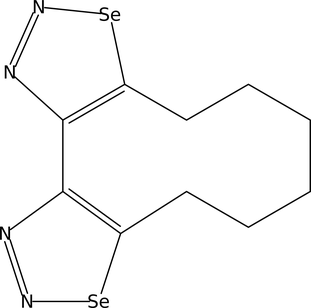
5,14-Diselena-3,4,15,16-tetraazatricyclo[11.3.0.02,6]hexadeca-1(13),2(6),3,15-tetraene

aUniversity of Mainz, Department of Chemistry, Duesbergweg 10-14, 55099 Mainz, Germany
*Correspondence e-mail: [email protected]
The complete molecule of the title compound, C8H8N4Se2, is generated by a crystallographic twofold axis: the almost planar 1,2,3-selenadiazole ring and its symmetry-generated partner are annulated to a cyclodeca-1,3-diene ring. Their dihedral angle amounts to 88.4 (2)° and the conformation of the hexamethylene chain is mostly staggered (gauche) except for a near-anti arrangement in the middle.
Keywords: crystal structure.
CCDC reference: 2596883
Structure description
The title compound,C8H8N4Se2 (I), was prepared in a project focusing on medium-sized cycloalkynes with additional sterically demanding groups (Bissinger et al. 1988 ; Detert et al. 1994; Detert & Meier, 1997). Bis-1,2,3-selanadiazoles are important sources for medium-sized cycloalkadiynes (Gleiter et al. 1988) and the structures of three bisselenadiazolo-cyclooctadienes have recently been reported (Detert & Schollmeyer, 2020, 2026, Schollmeyer & Detert, 2025). Compound (I) is thermally unstable and in the presence of tetraphenyl cyclopentadienone, the formal mono-trapping product of cyclodeca-1,3-diyne is formed (42%, m.p. 529 K).
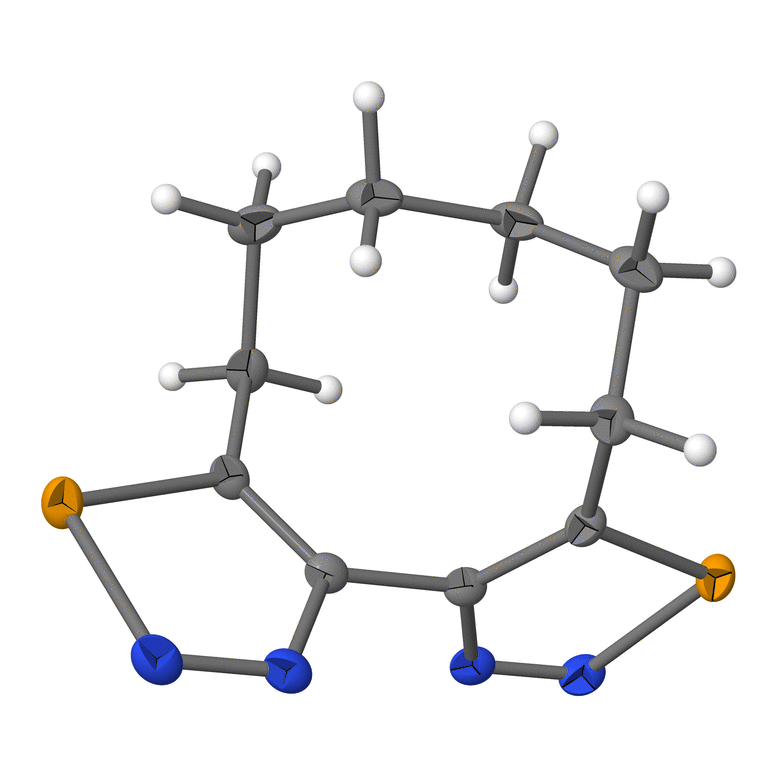
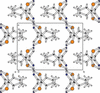
The complete molecule of (I) (Fig. 1) is generated by crystallographic twofold symmetry with the rotation axis passing through the mid-points of the C1—C1i and C8—C8i bonds [symmetry code: (i) 1 − x, y,  − z] with a dihedral angle between the 1,2,3-selenadiazole ring and its symmetry-generated partner of 88.4 (2)°. This angle is more than twice as large as in the smaller eight-ring homologue (43.6°, Detert & Schollmeyer, 2020). The C1/N2/N3/Se4/C5 selenadiazole ring is planar to within 0.05 (4) Å and the N2—C1—C1i—N2i torsion angle is 91.8 (4)°. The hexamethylene tether shows a nearly perfect staggered conformation with torsion angles of ca 60°; only the central C7—C8—C8i—C7i torsion angle of −149.8 (4)° indicates some Pitzer strain. Within the orthorhombic crystal, the twofold symmetry axis parallel to the b-axis and a twofold screw axis along the c-axis pack the molecules effectively (Fig. 2).
|
Figure 1
The molecular structure of (I) with displacement ellipsoids drawn at the 50% probability level. Atoms with suffix _a are generated by the symmetry operation 1 − x, y, − z. |
|
Figure 2
Part of the packing diagram of (I) viewed along the a-axis direction. |
Synthesis and crystallization
The title compound was prepared from sebacoic acid via esterification with ethanol, an acyloin condensation according to a combination of the Prelog and Rühlmann procedures (Prelog et al. 1947; Rühlmann 1971), oxidation with copper acetate (Blomquist & Goldstein 1956), formation of the semicarbazone and reaction with selenium dioxide. The semicarbazone (8.5 g, m.p. 556 K) was suspended in dioxane (70 ml), and selenium dioxide (26.4 g) and water (15 ml) were added and the mixture was stirred at 318 K for 4 days. Filtration, removal of 50 ml dioxane, addition of 50 ml of ethyl acetate, washing of the organic layer with brine, sodium bicarbonate solution, and brine was followed by drying over sodium sulfate and chromatography on silica gel with toluene/ethyl acetate 7/3 yielded 3.5 g (34%) of hexagonal, pinkish crystals with m.p. 398–400 K (dec.). Single crystals of (I) were grown by slow evaporation of a solution in toluene. Spectroscopic data: (assignment of signals follows IUPAC nomenclature): 1H-NMR (400 MHz, CDCl3): δ = 3.15, 2.90 (2 × dt, 2 × 2H, J = 15 Hz; J′= 5 Hz, fast exchange of H—CH'-7,12 and HC—H′-7,12), 1.65 (m, 4 H, H2C-8, 12), 1.35, 0.75 (2 × bs, 2 × 2 H, fast exchange of H—CH'-9,10 and HC—H′-9,10); 13C-NMR (100 MHz, CDCl3): δ = 168.5, 152.3 (C-1,2,6,13), 30.0 (C-7, 12,), 24.8, 20.0 (C-8,9,10,11); 77Se-NMR (73 MHz, CDCl3, SeO2/D2O as reference): δ = 213.4; UV(EtOH): λ (log ɛ) = 210 (4.10), 228 (4.16), 286 nm (3.42), MS (FD): 348 (M+., Se2-isotope pattern), 320 (M+.—N2, Se2-isotope pattern), 240 (M+.—N2—Se, Se-isotope pattern); MS (EI): 292 (8%, M+. − 2 N2, Se2-isotope pattern), 212 (5%, M+.-2 N2– Se) 183 (50%), 129 (77%), 91 (100%); IR (KBr): ν = 2920, 2840, 1502, 1448, 1101, 1055, 860, 842 cm−1
Refinement
Crystal data, data collection and structure refinement details are summarized in Table 1.
|
Structural data
CCDC reference: 2596883
Crystal structure: contains datablocks I, global. DOI: https://doi.org/10.1107/S2414314626010953/hb4574sup1.cif
Structure factors: contains datablock I. DOI: https://doi.org/10.1107/S2414314626010953/hb4574Isup2.hkl
Supporting information file. DOI: https://doi.org/10.1107/S2414314626010953/hb4574Isup3.cml
| C10H12N4Se2 | Dx = 1.926 Mg m−3 |
| Mr = 346.16 | Mo Kα radiation, λ = 0.71073 Å |
| Orthorhombic, C2221 | Cell parameters from 3676 reflections |
| a = 8.4957 (7) Å | θ = 2.8–28.3° |
| b = 14.0651 (10) Å | µ = 6.17 mm−1 |
| c = 9.9897 (6) Å | T = 120 K |
| V = 1193.70 (15) Å3 | Block, colorless |
| Z = 4 | 0.37 × 0.26 × 0.23 mm |
| F(000) = 672 |
| Stoe IPDS 2T diffractometer | 1254 independent reflections |
| Radiation source: sealed tube | 1224 reflections with I > 2σ(I) |
| Detector resolution: 6.67 pixels mm-1 | Rint = 0.014 |
| rotation method, ω scans | θmax = 27.9°, θmin = 2.8° |
| Absorption correction: integration | h = −11→10 |
| Tmin = 0.230, Tmax = 0.329 | k = −12→18 |
| 1663 measured reflections | l = −13→11 |
| Refinement on F2 | Hydrogen site location: inferred from neighbouring sites |
| Least-squares matrix: full | H-atom parameters constrained |
| R[F2 > 2σ(F2)] = 0.024 | w = 1/[σ2(Fo2) + (0.0323P)2 + 2.4527P] where P = (Fo2 + 2Fc2)/3 |
| wR(F2) = 0.060 | (Δ/σ)max < 0.001 |
| S = 1.15 | Δρmax = 0.48 e Å−3 |
| 1254 reflections | Δρmin = −0.31 e Å−3 |
| 73 parameters | Absolute structure: Classical Flack method preferred over Parsons because s.u. lower |
| 0 restraints | Absolute structure parameter: 0.08 (3) |
| Primary atom site location: dual |
Geometry. All esds (except the esd in the dihedral angle between two l.s. planes) are estimated using the full covariance matrix. The cell esds are taken into account individually in the estimation of esds in distances, angles and torsion angles; correlations between esds in cell parameters are only used when they are defined by crystal symmetry. An approximate (isotropic) treatment of cell esds is used for estimating esds involving l.s. planes. |
Refinement. The H atoms were placed at calculated positions with C—H = 0.99 Å and were refined in the riding-model approximation with Uiso(H) = 1.2 Ueq(C). |
| x | y | z | Uiso*/Ueq | ||
| C1 | 0.4277 (4) | 0.1859 (3) | 0.2089 (4) | 0.0163 (8) | |
| N2 | 0.4228 (4) | 0.2468 (2) | 0.0997 (4) | 0.0186 (6) | |
| N3 | 0.2985 (5) | 0.2466 (3) | 0.0296 (4) | 0.0206 (7) | |
| Se4 | 0.15092 (4) | 0.15946 (3) | 0.09906 (4) | 0.02012 (13) | |
| C5 | 0.2978 (5) | 0.1314 (3) | 0.2288 (4) | 0.0174 (8) | |
| C6 | 0.2739 (5) | 0.0574 (3) | 0.3352 (4) | 0.0202 (8) | |
| H6A | 0.171981 | 0.069125 | 0.380357 | 0.024* | |
| H6B | 0.358169 | 0.063595 | 0.403035 | 0.024* | |
| C7 | 0.2750 (6) | −0.0446 (3) | 0.2791 (5) | 0.0250 (9) | |
| H7A | 0.259725 | −0.089763 | 0.353998 | 0.030* | |
| H7B | 0.185083 | −0.052100 | 0.216997 | 0.030* | |
| C8 | 0.4257 (6) | −0.0702 (3) | 0.2058 (5) | 0.0244 (9) | |
| H8A | 0.441258 | −0.024463 | 0.131619 | 0.029* | |
| H8B | 0.413158 | −0.134127 | 0.165772 | 0.029* |
| U11 | U22 | U33 | U12 | U13 | U23 | |
| C1 | 0.0180 (18) | 0.0161 (18) | 0.0147 (16) | 0.0009 (14) | 0.0040 (15) | 0.0011 (14) |
| N2 | 0.0211 (16) | 0.0173 (15) | 0.0173 (14) | 0.0024 (12) | 0.0037 (15) | 0.0004 (16) |
| N3 | 0.0230 (16) | 0.0207 (17) | 0.0182 (17) | 0.0031 (14) | 0.0039 (14) | 0.0054 (15) |
| Se4 | 0.01690 (17) | 0.02506 (19) | 0.01841 (18) | 0.00027 (17) | −0.00221 (16) | 0.00498 (17) |
| C5 | 0.0170 (16) | 0.0195 (18) | 0.0158 (16) | 0.0028 (15) | −0.0010 (14) | 0.0023 (15) |
| C6 | 0.0187 (19) | 0.024 (2) | 0.0176 (19) | −0.0023 (16) | 0.0015 (16) | 0.0071 (16) |
| C7 | 0.032 (2) | 0.019 (2) | 0.024 (2) | −0.0069 (18) | −0.006 (2) | 0.0067 (18) |
| C8 | 0.035 (3) | 0.0148 (18) | 0.023 (2) | −0.0014 (17) | −0.010 (2) | −0.0013 (17) |
| C1—C5 | 1.358 (6) | C6—H6A | 0.9900 |
| C1—N2 | 1.388 (5) | C6—H6B | 0.9900 |
| C1—C1i | 1.477 (8) | C7—C8 | 1.518 (7) |
| N2—N3 | 1.267 (5) | C7—H7A | 0.9900 |
| N3—Se4 | 1.885 (4) | C7—H7B | 0.9900 |
| Se4—C5 | 1.842 (4) | C8—C8i | 1.541 (8) |
| C5—C6 | 1.501 (5) | C8—H8A | 0.9900 |
| C6—C7 | 1.540 (6) | C8—H8B | 0.9900 |
| C5—C1—N2 | 116.0 (4) | H6A—C6—H6B | 107.8 |
| C5—C1—C1i | 126.5 (4) | C8—C7—C6 | 113.7 (4) |
| N2—C1—C1i | 117.5 (3) | C8—C7—H7A | 108.8 |
| N3—N2—C1 | 117.3 (3) | C6—C7—H7A | 108.8 |
| N2—N3—Se4 | 110.7 (3) | C8—C7—H7B | 108.8 |
| C5—Se4—N3 | 86.99 (17) | C6—C7—H7B | 108.8 |
| C1—C5—C6 | 127.2 (4) | H7A—C7—H7B | 107.7 |
| C1—C5—Se4 | 109.1 (3) | C7—C8—C8i | 114.5 (5) |
| C6—C5—Se4 | 123.7 (3) | C7—C8—H8A | 108.6 |
| C5—C6—C7 | 112.8 (4) | C8i—C8—H8A | 108.6 |
| C5—C6—H6A | 109.0 | C7—C8—H8B | 108.6 |
| C7—C6—H6A | 109.0 | C8i—C8—H8B | 108.6 |
| C5—C6—H6B | 109.0 | H8A—C8—H8B | 107.6 |
| C7—C6—H6B | 109.0 | ||
| C5—C1—N2—N3 | 0.5 (5) | C1i—C1—C5—Se4 | 179.6 (3) |
| C1i—C1—N2—N3 | −179.9 (3) | N3—Se4—C5—C1 | 0.7 (3) |
| C1—N2—N3—Se4 | 0.1 (4) | N3—Se4—C5—C6 | −177.7 (4) |
| N2—N3—Se4—C5 | −0.5 (3) | C1—C5—C6—C7 | −108.5 (5) |
| N2—C1—C5—C6 | 177.5 (4) | Se4—C5—C6—C7 | 69.6 (5) |
| C1i—C1—C5—C6 | −2.0 (7) | C5—C6—C7—C8 | 58.0 (5) |
| N2—C1—C5—Se4 | −0.9 (5) | C6—C7—C8—C8i | 63.7 (4) |
| Symmetry code: (i) −x+1, y, −z+1/2. |
References
 Bissinger, H. J., Detert, H. & Meier, H. (1988). Liebigs Ann. Chem. pp. 221–224.
CrossRef
Google Scholar
Blomquist, A. T. & Goldstein, A. (1956). Org. Synth. 36, 77–79.
CAS
Google Scholar
Detert, H. & Meier, H. (1997). Liebigs Ann. Recl pp. 1557–1563.
CrossRef
Google Scholar
Detert, H., Rose, B., Mayer, W. & Meier, H. (1994). Chem. Ber. 127, 1529–1532.
CrossRef
CAS
Web of Science
Google Scholar
Detert, H. & Schollmeyer, D. (2020). IUCr Data 5 x201585.
Google Scholar
Detert, H. & Schollmeyer, D. (2026). IUCr Data 11, x260063.
Google Scholar
Gleiter, R., Karcher, M., Jahn, R. & Irngartinger, H. (1988). Chem. Ber. 121, 735–740.
CSD
CrossRef
CAS
Web of Science
Google Scholar
Prelog, V., Frenkiel, L., Kobelt, M. & Barman, P. (1947). Helv. Chim. Acta 30, 1741–1749.
CrossRef
CAS
Web of Science
Google Scholar
Rühlmann, K. (1971). Synthesis pp. 236–253.
Google Scholar
Schollmeyer, D. & Detert, H. (2025). IUCr Data 10, x250324.
Google Scholar
Sheldrick, G. M. (2015a). Acta Cryst. A71, 3–8.
Web of Science
CrossRef
IUCr Journals
Google Scholar
Sheldrick, G. M. (2015b). Acta Cryst. C71, 3–8.
Web of Science
CrossRef
IUCr Journals
Google Scholar
Spek, A. L. (2009). Acta Cryst. D65, 148–155.
Web of Science
CrossRef
CAS
IUCr Journals
Google Scholar
Stoe & Cie (2020). X-AREA WinXpose, X-AREA Recipe and X-AREA Integrate. Stoe & Cie, Darmstadt, Germany.
Google Scholar
This is an open-access article distributed under the terms of the Creative Commons Attribution (CC-BY) Licence, which permits unrestricted use, distribution, and reproduction in any medium, provided the original authors and source are cited.
| IUCrDATA |