

 menu


metal-organic compounds
 | IUCrDATA |
 access
catena-Poly[[bis(2-methylpyrazine-κN4)copper(II)]-di-μ-bromido]

aCarlson School of Chemistry and Biochemistry, Clark University, 950 Main St., Worcester, MA 01610, USA, and bDept. of Chemistry, Trinity College Dublin, The University of Dublin, College Green, Dublin 2, Ireland
*Correspondence e-mail: [email protected]
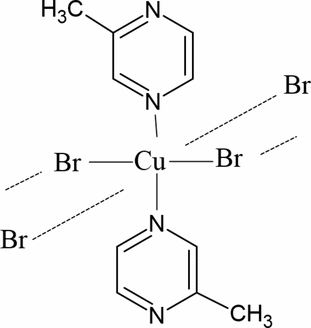
The reaction of 2-methylpyrazine with copper(II) bromide via gel diffusion yielded crystals of the title compound, [CuBr2(C5H6N2)2]n. The compound crystallizes in the monoclinic P21/n space group and the metal atom (site symmetry 1) adopts a square-planar CuBr2N2 coordination geometry. Short Cu⋯Br contacts, nearly perpendicular to the Cu coordination plane, link the molecules into chains propagating parallel to the a-axis direction, which are well separated by the bulk of the methylpyrazine ligands.
Keywords: crystal structure; copper(II); bihalide bridged chain; methylpyrazine.
CCDC reference: 2595817
Structure description
Pyrazine has been used ubiquitously in coordination chemistry, in particular with CuII (Landee & Turnbull, 2013 ). The two nitrogen atoms provide a linear coordination bridge for good control of geometry in coordination polymers. Substituted pyrazine ligands have also been used frequently, but may introduce a change in local geometry depending upon the number and position of the substituents. In cases where the substituted pyrazine is monodentate, coordination occurs uniformly to the distal nitrogen atom, except in cases where the substituent may coordinate in which case chelation is observed to the proximal nitrogen atom, as in the case of pyrazine-2-carboxylate (Klein et al., 1981, 1982; Konar et al., 2014).
2-Methylpyrazine is one of the most commonly employed monosubstituted pyrazine ligands with more than eighty complexes of first row transition metals alone; fifty of those involve copper (Groom et al., 2016). CuII coordinates to methylpyrazine in both bridging (Otieno et al., 1993; Abu-Youssef et al., 2008) and terminal (Maekawa et al., 1992; Navas et al., 1993; Amaral et al., 2001; Otieno et al., 2002; Manson et al., 2008; Barquín et al., 2010; Araujo-Martinez et al., 2023) modes, again with the terminal methylpyrazine molecules coordinated through the distal nitrogen atom. We find only three examples in the literature of terminal methylpyrazine molecules coordinated through the proximal nitrogen atom, namely bis(μ-iodo)bis(2-methylpyrazine)bis(triphenylphosphine)dicopper(I) and its triphenylarsine equivalent (Kikuchi et al., 2026), plus the silver(I) complex catena-[(μ2-methylpyrazine)bis(μ2-tricyanomethanide)bis(methylpyrazine)disilver(I)] (Abrahams et al., 2003).
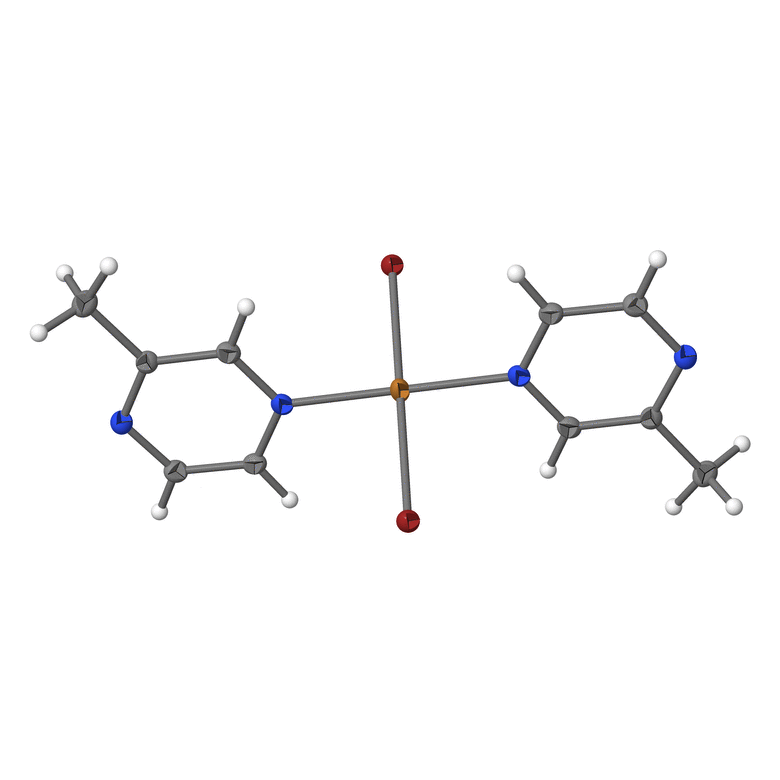
In the course of our investigations of complexes of substituted pyrazines with CuII, we prepared the title compound, which crystallizes in the monoclinic space group P21/n with the CuII ion located on an inversion centre. The molecular unit is shown in Fig. 1. The Cu1—N14 bond length is 2.021 (2) Å (Table 1) and comparable to known compounds with methylpyrazine coordinated to the distal nitrogen atom (Otieno et al., 2002; Araujo-Martinez et al., 2023) but somewhat shorter (∼0.05 Å) than the equivalent bond in compounds where the methylpyrazine is bridging (Otieno et al., 1993). When bridging, it is common for the position of the methyl group to be disordered (Amaral et al., 2001; Liu et al., 2017; Kikuchi et al., 2023), rendering the distal and proximal nitrogen atoms equivalent and the bond length moot. The Br1—Cu1—N14 bond angle is 90° within error and all trans bond angles are 180° as required by symmetry. The pyrazine ring is virtually planar, as expected (mean deviation of constituent atoms = 0.006 Å) and the ring is canted 60.6 (2)° relative to the Cu coordination plane.
|
||||||||||||||||||
|
Figure 1
The molecular unit drawn as 50% probability ellipsoids. Hydrogen atoms are shown as spheres of arbitrary size. Only the asymmetric unit and copper coordination sphere are labelled. Atoms with suffix A are generated by the symmetry operation −x + 1, −y, −z + 1. |
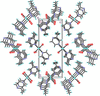
In the extended structure, the molecular units are linked into chains parallel to the a-axis direction via short Cu⋯Br contacts forming bihalide bridges (see Fig. 2). The Cu1⋯Br1i distance is 3.1912 (3) Å [symmetry code: (i) 2 − x, −y, 1 − z) and the Br1—Cu1—Br1i angle is 92.141 (10)°. The Cu1—Br1⋯Cu1ii angle supplementary [87.859 (10)°; symmetry code: (ii) 1 + x, y, z] as required by symmetry. The long Cu⋯Br contact lies only 2.2 (1)° from the normal to the CuII coordination plane. The chains are well separated by the bulk of the methylpyrazine ligands (see Fig. 3), suggesting that the chains would be well isolated magnetically. The structure of the bihalide bridges within the chains suggests weak antiferromagnetic interactions. Sadly, insufficient material was isolated to measure the magnetic properties.
|
Figure 2
The chain structure of the compound shown as arbitrary spheres (a axis horizontal). |
|
Figure 3
Packing of the chains viewed down the a axis. Atoms are shown as arbitrary spheres. |
Synthesis and crystallization
Single crystals suitable for single-crystal X-ray diffraction were made by a gel diffusion technique. The bottom gel layer was prepared by dissolving copper(II) bromide (1.001 g, 4.49 mmol) and 1 ml of tetramethyl orthosilicate (TMOS) in 9 ml of H2O. The mixture was stirred for 5 min. and allowed to harden overnight. The second layer was made by adjusting the pH of 18 ml H2O and 2 ml TMOS with 20 drops of 2% ammonium hydroxide. This mixture was carefully poured over the top of the first layer, and also allowed to harden overnight. The third layer was prepared by dissolving 2-methylpyrazine (375.8 mg, 3.99 mmol) and 1 ml of TMOS in 10 ml of H2O, stirring for 5 minutes, and pouring the solution over the top of the previous two layers. The layered gels were allowed to sit for 8 months yielding green needles approximately 1.10 × 0.06 × 0.04 mm in size on the surface of the gel. The crystals were harvested by filtration and washed with 30 ml of diethyl ether. IR (KBr) ν: 3083w, 1595w, 1482w, 1443m, 1400m, 1302m, 1259w, 1164m, 1081s, 1026m, 981w, 909w, 830s, 737m, 668s, 567w, 503w cm−1.
Refinement
Crystal data, data collection and structure refinement details are summarized in Table 2. A very large crystal was used (1 mm long) due to the braided nature of the sample. Once cut, the de-braided end was kept out of the beam path. No decomposition was observed during data collection.
|
Structural data
CCDC reference: 2595817
Crystal structure: contains datablock I. DOI: https://doi.org/10.1107/S2414314626010758/bh4105sup1.cif
Structure factors: contains datablock I. DOI: https://doi.org/10.1107/S2414314626010758/bh4105Isup2.hkl
| [CuBr2(C5H6N2)2] | F(000) = 398 |
| Mr = 411.60 | Dx = 2.103 Mg m−3 |
| Monoclinic, P21/n | Mo Kα radiation, λ = 0.71073 Å |
| a = 3.9321 (4) Å | Cell parameters from 6357 reflections |
| b = 20.274 (2) Å | θ = 2.9–30.0° |
| c = 8.2685 (9) Å | µ = 7.81 mm−1 |
| β = 99.602 (2)° | T = 90 K |
| V = 649.93 (12) Å3 | Rod, green |
| Z = 2 | 1.10 × 0.06 × 0.04 mm |
| Bruker SMART APEX diffractometer | 1674 reflections with I > 2σ(I) |
| ω scans | Rint = 0.042 |
| Absorption correction: multi-scan (SADABS; Krause et al., 2015) | θmax = 30.0°, θmin = 2.0° |
| Tmin = 0.042, Tmax = 0.730 | h = −5→5 |
| 8934 measured reflections | k = −28→28 |
| 1837 independent reflections | l = −11→11 |
| Refinement on F2 | Primary atom site location: structure-invariant direct methods |
| Least-squares matrix: full | Secondary atom site location: difference Fourier map |
| R[F2 > 2σ(F2)] = 0.029 | Hydrogen site location: inferred from neighbouring sites |
| wR(F2) = 0.074 | H-atom parameters constrained |
| S = 1.08 | w = 1/[σ2(Fo2) + (0.0428P)2 + 0.3P] where P = (Fo2 + 2Fc2)/3 |
| 1837 reflections | (Δ/σ)max < 0.001 |
| 80 parameters | Δρmax = 1.68 e Å−3 |
| 0 restraints | Δρmin = −0.62 e Å−3 |
Refinement. Data were measured using omega scans (0.3 ° per frame for 15 s). All non-hydrogen atoms were refined anisotropically. |
| x | y | z | Uiso*/Ueq | ||
| Cu1 | 0.500000 | 0.000000 | 0.500000 | 0.01973 (12) | |
| Br1 | 0.92174 (5) | 0.06601 (2) | 0.67603 (3) | 0.01551 (9) | |
| N11 | 0.3718 (5) | 0.17387 (10) | 0.0988 (2) | 0.0173 (4) | |
| C12 | 0.2992 (6) | 0.18368 (11) | 0.2500 (3) | 0.0159 (4) | |
| C13 | 0.3393 (6) | 0.13326 (11) | 0.3659 (3) | 0.0173 (4) | |
| H13 | 0.291403 | 0.141949 | 0.472767 | 0.021* | |
| N14 | 0.4438 (6) | 0.07281 (9) | 0.3308 (2) | 0.0167 (4) | |
| C15 | 0.5144 (7) | 0.06290 (11) | 0.1796 (3) | 0.0178 (4) | |
| H15 | 0.587954 | 0.020597 | 0.150055 | 0.021* | |
| C16 | 0.4813 (6) | 0.11378 (12) | 0.0659 (3) | 0.0182 (4) | |
| H16 | 0.538781 | 0.105545 | −0.039345 | 0.022* | |
| C17 | 0.1775 (7) | 0.25094 (12) | 0.2889 (3) | 0.0224 (5) | |
| H17A | 0.369251 | 0.282275 | 0.296126 | 0.034* | |
| H17B | 0.093376 | 0.249652 | 0.393945 | 0.034* | |
| H17C | −0.009587 | 0.264898 | 0.202115 | 0.034* |
| U11 | U22 | U33 | U12 | U13 | U23 | |
| Cu1 | 0.0253 (2) | 0.0148 (2) | 0.0164 (2) | −0.00535 (15) | −0.00449 (16) | 0.00416 (15) |
| Br1 | 0.01469 (13) | 0.01564 (13) | 0.01582 (14) | −0.00124 (7) | 0.00148 (9) | −0.00008 (7) |
| N11 | 0.0192 (9) | 0.0164 (9) | 0.0164 (10) | −0.0007 (7) | 0.0035 (8) | 0.0013 (7) |
| C12 | 0.0153 (10) | 0.0153 (10) | 0.0168 (11) | −0.0015 (8) | 0.0018 (8) | 0.0004 (8) |
| C13 | 0.0181 (11) | 0.0186 (10) | 0.0150 (10) | −0.0032 (8) | 0.0024 (8) | −0.0007 (8) |
| N14 | 0.0183 (10) | 0.0161 (9) | 0.0144 (10) | −0.0035 (7) | −0.0015 (7) | 0.0003 (7) |
| C15 | 0.0184 (11) | 0.0166 (11) | 0.0173 (11) | 0.0008 (8) | −0.0003 (8) | −0.0023 (8) |
| C16 | 0.0202 (11) | 0.0185 (11) | 0.0162 (11) | −0.0007 (8) | 0.0043 (9) | −0.0008 (8) |
| C17 | 0.0267 (12) | 0.0175 (11) | 0.0238 (13) | 0.0025 (9) | 0.0062 (10) | −0.0007 (9) |
| Cu1—N14i | 2.020 (2) | C13—H13 | 0.9500 |
| Cu1—N14 | 2.021 (2) | N14—C15 | 1.340 (3) |
| Cu1—Br1i | 2.4196 (3) | C15—C16 | 1.387 (3) |
| Cu1—Br1 | 2.4196 (3) | C15—H15 | 0.9500 |
| N11—C16 | 1.335 (3) | C16—H16 | 0.9500 |
| N11—C12 | 1.343 (3) | C17—H17A | 0.9800 |
| C12—C13 | 1.392 (3) | C17—H17B | 0.9800 |
| C12—C17 | 1.498 (3) | C17—H17C | 0.9800 |
| C13—N14 | 1.340 (3) | ||
| N14i—Cu1—N14 | 180.0 | C15—N14—Cu1 | 121.37 (16) |
| N14i—Cu1—Br1i | 89.85 (6) | C13—N14—Cu1 | 121.34 (16) |
| N14—Cu1—Br1i | 90.15 (6) | N14—C15—C16 | 120.7 (2) |
| N14i—Cu1—Br1 | 90.15 (6) | N14—C15—H15 | 119.7 |
| N14—Cu1—Br1 | 89.84 (6) | C16—C15—H15 | 119.7 |
| Br1i—Cu1—Br1 | 180.0 | N11—C16—C15 | 122.5 (2) |
| C16—N11—C12 | 116.8 (2) | N11—C16—H16 | 118.7 |
| N11—C12—C13 | 121.0 (2) | C15—C16—H16 | 118.7 |
| N11—C12—C17 | 117.4 (2) | C12—C17—H17A | 109.5 |
| C13—C12—C17 | 121.6 (2) | C12—C17—H17B | 109.5 |
| N14—C13—C12 | 121.7 (2) | H17A—C17—H17B | 109.5 |
| N14—C13—H13 | 119.1 | C12—C17—H17C | 109.5 |
| C12—C13—H13 | 119.1 | H17A—C17—H17C | 109.5 |
| C15—N14—C13 | 117.3 (2) | H17B—C17—H17C | 109.5 |
| Symmetry code: (i) −x+1, −y, −z+1. |
Acknowledgements
The Bruker (Siemens) SMART APEX diffraction facility was established at the University of Idaho with the assistance of the NSF-EPSCoR program and the M. J. Murdock Charitable Trust, Vancouver, WA, USA.
Funding information
Funding for this research was provided by: National Science Foundation-EPSCoR (grant to B. Twamley); M.J. Murdock Charitable Trust (grant to B. Twamley).
References
 Abrahams, B. F., Batten, S. R., Hoskins, B. F. & Robson, R. (2003). Inorg. Chem. 42, 2654–2664.
Web of Science
CrossRef
PubMed
CAS
Google Scholar
Abu-Youssef, M. A. M., Escuer, A., Mautner, F. A. & Öhrström, L. (2008). Dalton Trans. pp. 2553–2558.
Google Scholar
Amaral, S., Jensen, W. E., Landee, C. P., Turnbull, M. M. & Woodward, F. M. (2001). Polyhedron 20, 1317–1322.
CrossRef
CAS
Google Scholar
Araujo-Martinez, A. P., Faber, K., Huynh, N., Dickie, D. A., Landee, C. P., Turnbull, M. M., Twamley, B. & Wikaira, J. L. (2023). J. Coord. Chem. 76, 632–647.
CAS
Google Scholar
Barquín, M., González Garmendia, M. J., Larrínaga, L., Pinilla, E., Seco, J. M. & Torres, M. R. (2010). J. Coord. Chem. 63, 1652–1665.
Google Scholar
Bruker (2004). XP. Bruker AXS Inc., Madison, Wisconsin, USA.
Google Scholar
Bruker (2006). SMART and SAINT-Plus. Bruker AXS Inc., Madison, Wisconsin, USA.
Google Scholar
Groom, C. R., Bruno, I. J., Lightfoot, M. P. & Ward, S. C. (2016). Acta Cryst. B72, 171–179.
Web of Science
CrossRef
IUCr Journals
Google Scholar
Kikuchi, K., Imoto, H. & Naka, K. (2023). Dalton Trans. 52, 11168–11175.
CrossRef
CAS
PubMed
Google Scholar
Kikuchi, K., Nagata, S., Yumura, T., Iwamoto, T., Naka, K. & Imoto, H. (2026). Inorg. Chem. Front. 13, 3740–3749.
CrossRef
CAS
Google Scholar
Klein, C. L., Majeste, R. J., Trefonas, L. M. & O'Connor, C. J. (1982). Inorg. Chem. 21, 1891–1897.
CrossRef
CAS
Web of Science
Google Scholar
Klein, C. L., Trefonas, L. M., O'Connor, C. J. & Majeste, R. J. (1981). Cryst. Struct. Commun. 10, 891–894.
CAS
Google Scholar
Konar, S., Saha, U., Dolai, M. & Chatterjee, S. (2014). J. Mol. Struct. 1075, 286–291.
CrossRef
CAS
Google Scholar
Krause, L., Herbst-Irmer, R., Sheldrick, G. M. & Stalke, D. (2015). J. Appl. Cryst. 48, 3–10.
Web of Science
CSD
CrossRef
ICSD
CAS
IUCr Journals
Google Scholar
Landee, C. P. & Turnbull, M. M. (2013). Eur. J. Inorg. Chem. pp. 2266–2285.
Web of Science
CrossRef
Google Scholar
Liu, W., Zhu, K., Teat, S. J., Deibert, B. J., Yuan, W. & Li, J. (2017). J. Mater. Chem. C. 5, 5962–5969.
CrossRef
CAS
Google Scholar
Maekawa, M., Kitagawa, S., Tanimura, T., Munakata, M. & Yonezawa, T. (1992). Anal. Sci. 8, 899–900.
CrossRef
CAS
Google Scholar
Manson, J. L., Donovan, J. & Twamley, B. (2008). Polyhedron 27, 2650–2654.
CrossRef
CAS
Google Scholar
Navas, C., Turnbull, M. M., Giogas, C., Landee, C. P., Zhang, W., Pon, G. & Willett, R. D. (1993). Polyhedron 12, 1019–1026.
CrossRef
CAS
Google Scholar
Otieno, T., Pinkston, A. T., Johnson, N. C. & Parkin, S. (2002). Acta Cryst. E58, m328–m330.
CrossRef
IUCr Journals
Google Scholar
Otieno, T., Rettig, S. J., Thompson, R. C. & Trotter, J. (1993). Inorg. Chem. 32, 4384–4390.
CrossRef
CAS
Web of Science
Google Scholar
Sheldrick, G. M. (2008). Acta Cryst. A64, 112–122.
Web of Science
CrossRef
CAS
IUCr Journals
Google Scholar
Sheldrick, G. M. (2015). Acta Cryst. C71, 3–8.
Web of Science
CrossRef
IUCr Journals
Google Scholar
Westrip, S. P. (2010). J. Appl. Cryst. 43, 920–925.
Web of Science
CrossRef
CAS
IUCr Journals
Google Scholar
This is an open-access article distributed under the terms of the Creative Commons Attribution (CC-BY) Licence, which permits unrestricted use, distribution, and reproduction in any medium, provided the original authors and source are cited.
| IUCrDATA |