

 menu


metal-organic compounds
 | IUCrDATA |
 access
trans-Diaquabis(pyridin-2-yl thiophen-2-yl ketone-κ2N,O)zinc(II) bis(tetrafluoridoborate)

aDepartment of Chemsitry and Biochemistry, Central Connecticut State University, 1615 Stanley St., New Brtiain, CT 06050, USA, and bMolecular Structure Facility, 149 Stepan Chemistry Hall, Department of Chemistry and Biochemistry, University of Notre Dame, Notre Dame, IN 46556, USA
*Correspondence e-mail: [email protected]
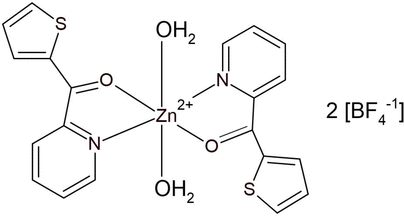
The title salt, [Zn(C10H7NOS)2(H2O)2](BF4)2, crystallizes isotypically with the CoII analog in the monoclinic space group P21/n. In the complex cation, the central ZnII atom (site symmetry 1) has a pseudo-octahedral coordination environment with bonding to pyridyl N [2.0624 (18) Å] and carbonyl O [2.1030 (13) Å] atoms from the 2-thienyl 2-pyridyl ketone ligands. The remaining bonds are to water molecules [2.1598 (16) Å], which form an O—H⋯F hydrogen-bonded layer with BF4− counter-ions.
Keywords: crystal structure; zinc; pyridyl ketone; thiophene; isotypism.
CCDC reference: 2593362
Structure description
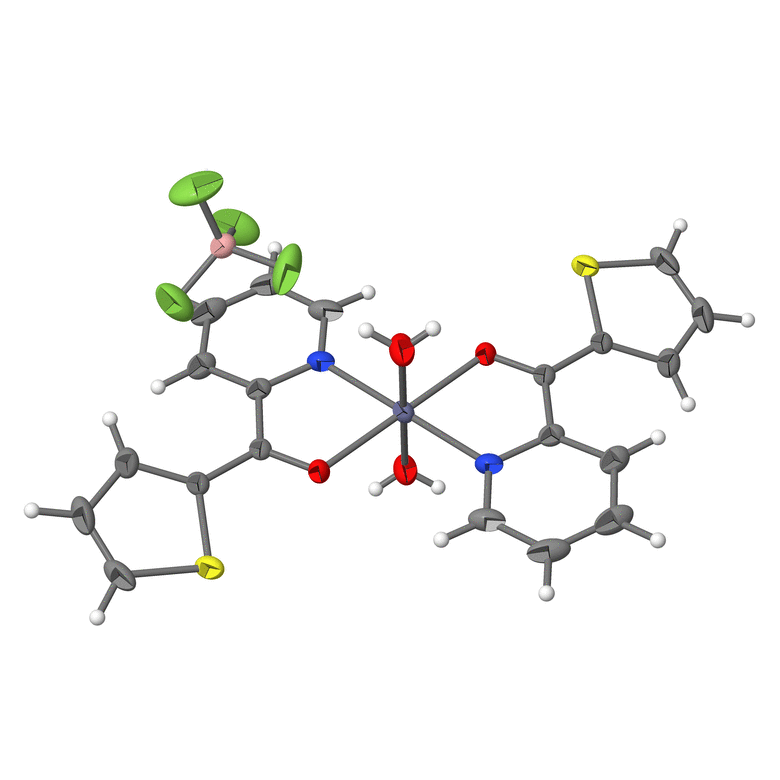
The complex title salt (Fig. 1 ) is structurally similar to the previously reported CuII (Sommerer et al., 1998) and NiII (Westcott & Nichol, 2026) analogs. It is isotypic with the CoII complex (Westcott, 2026), but unlike that crystal structure, it has an ordered arrangement of the thiophene units. The title salt also resembles other ZnII complexes with related ligands, such as di-2-pyridyl ketone (Kanaras et al., 2004) and di-2-pyridyl ketone oxime (Westcott et al., 2016).
|
Figure 1
The molecular entities in the asymmetric unit of the title salt shown with displacement ellipsoids at the 50% probability level. O—H⋯F hydrogen bonding is shown by a dashed line. Atoms of the asymmetric unit are labeled and non-labeled atoms are generated by the symmetry code (−x + 1, −y + 1, −z + 1). |
The zinc atom in the title compound is located at an inversion center with pseudo-octahedral coordination. The 2-thienyl 2-pyridyl ketone (tpk) ligands coordinate through the pyridyl N [2.0624 (18) Å] and carbonyl O [2.1030 (13) Å] atoms in the equatorial plane, and the O atoms from water molecules coordinate in the axial positions, leading to an [O4N2] coordination set. The Zn—O distance with the aqua ligands [2.1598 (16) Å] is within the distances seen for the previous three complexes, as are all other bond lengths and angles. The thienyl ring in the title complex is 20.78 (8)° out of the plane defined by the ZnII site and the pyridyl ring, consistent with what is seen for CoII [21.22 (8)°] (Westcott, 2026) and NiII [19.01 (7)°] (Westcott & Nichol, 2026).
The coordinating water molecules are hydrogen bonded to the BF4− anion (Table 1), forming layers extending parallel to (10 ) (Fig. 2).
|
||||||||||||||||||||||
 .
|
Figure 2
The crystal structure of the title salt viewed along the a-axis direction. O—H⋯F hydrogen bonding is shown by dashed lines. |
Synthesis and crystallization
Zn(BF4)2·H2O and acetonitrile were used as received from Thermo Fisher, and di-2-pyridyl ketone (tpk) was used as received from Rieke Metals. The title complex was synthesized following a literature procedure (Sommerer et al., 1998). Excess Zn(BF4)2·6H2O (0.2318 g, 0.9019 mmol) was combined with tpk (0.3237 g, 1.711 mmol) in 40 ml of acetonitrile at room temperature, affording a colorless solution, which was allowed to evaporate slowly to facilitate the formation of yellow crystals suitable for X-ray diffraction (18 d).
Refinement
Crystal data, data collection, and structure refinement details are summarized in Table 2. Water H-atom positions were refined maintaining a tetrahedral Zn—O—H angle and allowing O—H distances to obtain the best fit to the observed electron density.
|
Structural data
CCDC reference: 2593362
Crystal structure: contains datablock I. DOI: https://doi.org/10.1107/S2414314626010369/wm4262sup1.cif
Structure factors: contains datablock I. DOI: https://doi.org/10.1107/S2414314626010369/wm4262Isup2.hkl
| [Zn(C10H7BF4NOS)2(H2O)2](BF4)2 | F(000) = 656 |
| Mr = 653.47 | Dx = 1.712 Mg m−3 |
| Monoclinic, P21/n | Cu Kα radiation, λ = 1.54178 Å |
| a = 7.1601 (3) Å | Cell parameters from 9706 reflections |
| b = 11.9574 (4) Å | θ = 4.8–74.6° |
| c = 15.2293 (5) Å | µ = 3.73 mm−1 |
| β = 103.519 (2)° | T = 120 K |
| V = 1267.75 (8) Å3 | Block, colourless |
| Z = 2 | 0.16 × 0.15 × 0.06 mm |
| Bruker Venture diffractometer | 2591 independent reflections |
| Radiation source: micro-focus, Incoatec Diamond | 2426 reflections with I > 2σ(I) |
| HELIOS Multi-layer monochromator | Rint = 0.040 |
| Detector resolution: 7.41 pixels mm-1 | θmax = 74.6°, θmin = 4.8° |
| combination of ω and φ–scans | h = −8→8 |
| Absorption correction: numerical (SADABS; Krause et al., 2015) | k = −14→14 |
| Tmin = 0.632, Tmax = 0.792 | l = −18→19 |
| 50901 measured reflections |
| Refinement on F2 | 0 restraints |
| Least-squares matrix: full | Hydrogen site location: inferred from neighbouring sites |
| R[F2 > 2σ(F2)] = 0.033 | H atoms treated by a mixture of independent and constrained refinement |
| wR(F2) = 0.085 | w = 1/[σ2(Fo2) + (0.0365P)2 + 1.6051P] where P = (Fo2 + 2Fc2)/3 |
| S = 1.05 | (Δ/σ)max < 0.001 |
| 2591 reflections | Δρmax = 0.90 e Å−3 |
| 182 parameters | Δρmin = −0.44 e Å−3 |
Geometry. All esds (except the esd in the dihedral angle between two l.s. planes) are estimated using the full covariance matrix. The cell esds are taken into account individually in the estimation of esds in distances, angles and torsion angles; correlations between esds in cell parameters are only used when they are defined by crystal symmetry. An approximate (isotropic) treatment of cell esds is used for estimating esds involving l.s. planes. |
| x | y | z | Uiso*/Ueq | ||
| Zn1 | 0.500000 | 0.500000 | 0.500000 | 0.02437 (12) | |
| S1 | 0.18759 (8) | 0.72375 (5) | 0.69959 (3) | 0.03012 (14) | |
| F1 | 0.8022 (3) | 0.24775 (13) | 0.67903 (14) | 0.0624 (5) | |
| F2 | 0.8089 (3) | 0.07751 (18) | 0.73899 (13) | 0.0714 (6) | |
| F3 | 0.5264 (2) | 0.15039 (18) | 0.66175 (11) | 0.0608 (5) | |
| F4 | 0.7480 (3) | 0.09858 (16) | 0.58875 (11) | 0.0579 (5) | |
| C1 | 0.7890 (3) | 0.6652 (2) | 0.45821 (15) | 0.0344 (5) | |
| H1 | 0.826771 | 0.605726 | 0.424795 | 0.041* | |
| O1 | 0.3691 (2) | 0.60322 (11) | 0.58006 (9) | 0.0244 (3) | |
| O2 | 0.7274 (3) | 0.45695 (15) | 0.61534 (11) | 0.0389 (4) | |
| H2A | 0.725 (2) | 0.395 (2) | 0.6240 (11) | 0.052 (10)* | |
| H2B | 0.724 (2) | 0.4932 (17) | 0.6516 (13) | 0.068 (13)* | |
| N1 | 0.6421 (2) | 0.64948 (15) | 0.49702 (11) | 0.0252 (4) | |
| C2 | 0.8881 (3) | 0.7654 (2) | 0.46508 (16) | 0.0397 (6) | |
| H2 | 0.989151 | 0.775495 | 0.435059 | 0.048* | |
| C3 | 0.8378 (3) | 0.8496 (2) | 0.51593 (17) | 0.0395 (6) | |
| H3 | 0.904055 | 0.919023 | 0.521513 | 0.047* | |
| C4 | 0.6892 (3) | 0.83319 (19) | 0.55943 (15) | 0.0310 (5) | |
| H4 | 0.656277 | 0.889617 | 0.597064 | 0.037* | |
| C5 | 0.5907 (3) | 0.73282 (17) | 0.54654 (13) | 0.0232 (4) | |
| C6 | 0.4250 (3) | 0.70198 (16) | 0.58704 (12) | 0.0207 (4) | |
| C7 | 0.3300 (3) | 0.78074 (16) | 0.63380 (13) | 0.0230 (4) | |
| C8 | 0.3224 (3) | 0.89730 (18) | 0.63450 (15) | 0.0315 (5) | |
| H8 | 0.390280 | 0.944439 | 0.602466 | 0.038* | |
| C9 | 0.2018 (4) | 0.9361 (2) | 0.68855 (17) | 0.0418 (6) | |
| H9 | 0.178309 | 1.013201 | 0.696706 | 0.050* | |
| C10 | 0.1221 (4) | 0.8528 (2) | 0.72797 (15) | 0.0400 (6) | |
| H10 | 0.038714 | 0.865221 | 0.767203 | 0.048* | |
| B1 | 0.7191 (3) | 0.14287 (19) | 0.66790 (16) | 0.0245 (5) |
| U11 | U22 | U33 | U12 | U13 | U23 | |
| Zn1 | 0.0334 (2) | 0.0206 (2) | 0.0211 (2) | 0.00279 (15) | 0.01042 (15) | −0.00211 (14) |
| S1 | 0.0370 (3) | 0.0322 (3) | 0.0241 (3) | 0.0106 (2) | 0.0131 (2) | 0.00448 (19) |
| F1 | 0.0648 (11) | 0.0253 (7) | 0.0870 (13) | −0.0074 (7) | −0.0029 (9) | −0.0029 (8) |
| F2 | 0.0715 (12) | 0.0805 (14) | 0.0575 (11) | 0.0102 (10) | 0.0054 (9) | 0.0448 (10) |
| F3 | 0.0303 (8) | 0.1036 (15) | 0.0507 (9) | 0.0004 (8) | 0.0138 (7) | −0.0034 (9) |
| F4 | 0.0630 (10) | 0.0683 (11) | 0.0479 (9) | −0.0027 (9) | 0.0242 (8) | −0.0216 (8) |
| C1 | 0.0295 (11) | 0.0502 (14) | 0.0257 (10) | 0.0037 (10) | 0.0110 (9) | 0.0086 (10) |
| O1 | 0.0304 (7) | 0.0194 (7) | 0.0265 (7) | −0.0024 (5) | 0.0131 (6) | −0.0030 (5) |
| O2 | 0.0571 (11) | 0.0268 (9) | 0.0273 (8) | 0.0076 (8) | −0.0009 (7) | −0.0034 (7) |
| N1 | 0.0262 (8) | 0.0301 (9) | 0.0205 (8) | 0.0013 (7) | 0.0083 (7) | 0.0042 (7) |
| C2 | 0.0251 (11) | 0.0616 (16) | 0.0326 (12) | −0.0038 (11) | 0.0071 (9) | 0.0184 (11) |
| C3 | 0.0273 (11) | 0.0456 (14) | 0.0408 (13) | −0.0125 (10) | −0.0018 (10) | 0.0167 (11) |
| C4 | 0.0277 (11) | 0.0302 (11) | 0.0317 (11) | −0.0055 (9) | 0.0004 (8) | 0.0057 (9) |
| C5 | 0.0237 (9) | 0.0245 (10) | 0.0199 (9) | −0.0003 (8) | 0.0017 (7) | 0.0047 (7) |
| C6 | 0.0238 (9) | 0.0203 (9) | 0.0162 (8) | 0.0008 (7) | 0.0012 (7) | 0.0003 (7) |
| C7 | 0.0280 (10) | 0.0215 (10) | 0.0180 (9) | 0.0019 (7) | 0.0026 (7) | −0.0001 (7) |
| C8 | 0.0376 (12) | 0.0233 (10) | 0.0304 (11) | 0.0049 (9) | 0.0019 (9) | −0.0013 (8) |
| C9 | 0.0525 (15) | 0.0299 (12) | 0.0383 (13) | 0.0132 (11) | 0.0013 (11) | −0.0125 (10) |
| C10 | 0.0493 (14) | 0.0466 (14) | 0.0244 (11) | 0.0210 (11) | 0.0092 (10) | −0.0058 (10) |
| B1 | 0.0264 (11) | 0.0221 (11) | 0.0249 (11) | 0.0003 (9) | 0.0059 (9) | 0.0031 (9) |
| Zn1—N1i | 2.0624 (18) | O2—H2B | 0.71 (2) |
| Zn1—N1 | 2.0624 (18) | N1—C5 | 1.352 (3) |
| Zn1—O1i | 2.1030 (13) | C2—C3 | 1.369 (4) |
| Zn1—O1 | 2.1030 (13) | C2—H2 | 0.9500 |
| Zn1—O2 | 2.1598 (16) | C3—C4 | 1.392 (3) |
| Zn1—O2i | 2.1598 (16) | C3—H3 | 0.9500 |
| S1—C10 | 1.697 (2) | C4—C5 | 1.383 (3) |
| S1—C7 | 1.728 (2) | C4—H4 | 0.9500 |
| F1—B1 | 1.381 (3) | C5—C6 | 1.506 (3) |
| F2—B1 | 1.368 (3) | C6—C7 | 1.443 (3) |
| F3—B1 | 1.364 (3) | C7—C8 | 1.395 (3) |
| F4—B1 | 1.376 (3) | C8—C9 | 1.404 (3) |
| C1—N1 | 1.335 (3) | C8—H8 | 0.9500 |
| C1—C2 | 1.383 (4) | C9—C10 | 1.357 (4) |
| C1—H1 | 0.9500 | C9—H9 | 0.9500 |
| O1—C6 | 1.243 (2) | C10—H10 | 0.9500 |
| O2—H2A | 0.76 (2) | ||
| N1i—Zn1—N1 | 180.0 | C2—C3—H3 | 120.1 |
| N1i—Zn1—O1i | 78.06 (6) | C4—C3—H3 | 120.1 |
| N1—Zn1—O1i | 101.94 (6) | C5—C4—C3 | 118.4 (2) |
| N1i—Zn1—O1 | 101.94 (6) | C5—C4—H4 | 120.8 |
| N1—Zn1—O1 | 78.06 (6) | C3—C4—H4 | 120.8 |
| O1i—Zn1—O1 | 180.00 (6) | N1—C5—C4 | 121.54 (19) |
| N1i—Zn1—O2 | 93.30 (7) | N1—C5—C6 | 113.04 (17) |
| N1—Zn1—O2 | 86.70 (7) | C4—C5—C6 | 125.39 (19) |
| O1i—Zn1—O2 | 88.75 (6) | O1—C6—C7 | 118.84 (18) |
| O1—Zn1—O2 | 91.25 (6) | O1—C6—C5 | 117.80 (17) |
| N1i—Zn1—O2i | 86.70 (7) | C7—C6—C5 | 123.35 (17) |
| N1—Zn1—O2i | 93.30 (7) | C8—C7—C6 | 132.8 (2) |
| O1i—Zn1—O2i | 91.25 (6) | C8—C7—S1 | 111.11 (16) |
| O1—Zn1—O2i | 88.75 (6) | C6—C7—S1 | 116.03 (15) |
| O2—Zn1—O2i | 180.0 | C7—C8—C9 | 111.4 (2) |
| C10—S1—C7 | 91.42 (12) | C7—C8—H8 | 124.3 |
| N1—C1—C2 | 122.1 (2) | C9—C8—H8 | 124.3 |
| N1—C1—H1 | 118.9 | C10—C9—C8 | 113.4 (2) |
| C2—C1—H1 | 118.9 | C10—C9—H9 | 123.3 |
| C6—O1—Zn1 | 115.38 (12) | C8—C9—H9 | 123.3 |
| Zn1—O2—H2A | 109.5 | C9—C10—S1 | 112.67 (18) |
| Zn1—O2—H2B | 109.5 | C9—C10—H10 | 123.7 |
| H2A—O2—H2B | 117.4 | S1—C10—H10 | 123.7 |
| C1—N1—C5 | 119.2 (2) | F3—B1—F2 | 111.9 (2) |
| C1—N1—Zn1 | 125.16 (16) | F3—B1—F4 | 108.78 (19) |
| C5—N1—Zn1 | 115.26 (13) | F2—B1—F4 | 109.5 (2) |
| C3—C2—C1 | 118.8 (2) | F3—B1—F1 | 110.4 (2) |
| C3—C2—H2 | 120.6 | F2—B1—F1 | 108.2 (2) |
| C1—C2—H2 | 120.6 | F4—B1—F1 | 108.0 (2) |
| C2—C3—C4 | 119.8 (2) |
| Symmetry code: (i) −x+1, −y+1, −z+1. |
| D—H···A | D—H | H···A | D···A | D—H···A |
| O2—H2A···F1 | 0.76 | 1.97 | 2.691 (2) | 160 |
| O2—H2B···F2ii | 0.71 | 2.01 | 2.709 (2) | 171 |
| Symmetry code: (ii) −x+3/2, y+1/2, −z+3/2. |
Acknowledgements
BLW thanks Dr Guy Crundwell (CCSU) for helpful discussions. This work was supported by a CSU-AAUP grant.
References
 Bruker (2023). APEX5 and SAINT. Bruker AXS Inc., Madison, Wisconsin, USA
Google Scholar
Hübschle, C. B., Sheldrick, G. M. & Dittrich, B. (2011). J. Appl. Cryst. 44, 1281–1284.
Web of Science
CrossRef
IUCr Journals
Google Scholar
Kanaras, C., Westcott, B. L., Crundwell, G., Updegraff, J. B., Zeller, M., Hunter, A. D. & Sommerer, S. O. (2004). Z. Kristallogr. New Cryst. Struct. 219, 393–394.
CAS
Google Scholar
Krause, L., Herbst-Irmer, R., Sheldrick, G. M. & Stalke, D. (2015). J. Appl. Cryst. 48, 3–10.
Web of Science
CSD
CrossRef
ICSD
CAS
IUCr Journals
Google Scholar
Macrae, C. F., Sovago, I., Cottrell, S. J., Galek, P. T. A., McCabe, P., Pidcock, E., Platings, M., Shields, G. P., Stevens, J. S., Towler, M. & Wood, P. A. (2020). J. Appl. Cryst. 53, 226–235.
Web of Science
CrossRef
CAS
IUCr Journals
Google Scholar
Sheldrick, G. M. (2015a). Acta Cryst. A71, 3–8.
Web of Science
CrossRef
IUCr Journals
Google Scholar
Sheldrick, G. M. (2015b). Acta Cryst. C71, 3–8.
Web of Science
CrossRef
IUCr Journals
Google Scholar
Sommerer, S. O., Friebe, T. L., Jircitano, A. J., MacBeth, C. E. & Abboud, K. A. (1998). Acta Cryst. C54, 178–179.
Web of Science
CSD
CrossRef
CAS
IUCr Journals
Google Scholar
Westcott, B. L. (2026). IUCrData 11, x260749.
Google Scholar
Westcott, B. L., Crundwell, G., Remesic, M., Knopf, K., Chandler, K., McMaster, J. & Davies, E. S. (2016). Inorg. Chem. Commun. 74, 79–81.
Web of Science
CSD
CrossRef
CAS
Google Scholar
Westcott, B. L. & Nichol, G. S. (2026). IUCrData 11, x260240.
Google Scholar
Westrip, S. P. (2010). J. Appl. Cryst. 43, 920–925.
Web of Science
CrossRef
CAS
IUCr Journals
Google Scholar
This is an open-access article distributed under the terms of the Creative Commons Attribution (CC-BY) Licence, which permits unrestricted use, distribution, and reproduction in any medium, provided the original authors and source are cited.
| IUCrDATA |