issue contents
June 2026 issue
Early view articles
metal-organic compounds
Download citation
Download citation
Open
access
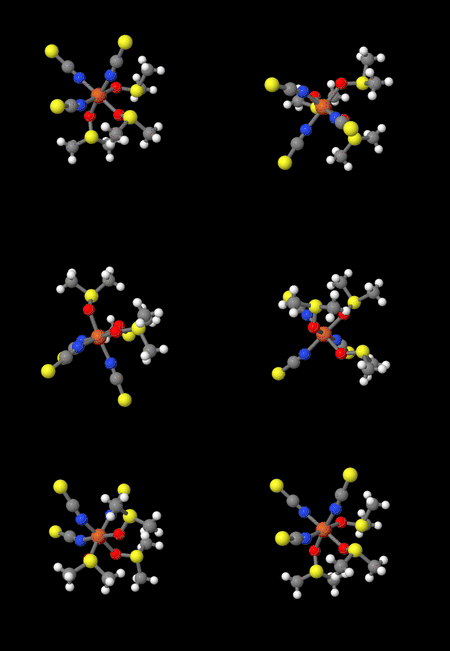
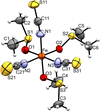
accessThe title complex adopts a fac-octahedral coordination environment around the central FeIII atom with three O-bonded dimethyl sulfoxide ligands and three N-bonded isothiocyanate ligands.
CCDC reference: 2541206
Download citation
Download citation
Open
access
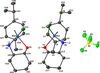
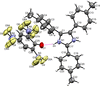
accessThe title compound crystallizes with one neutral RuII species, one cationic RuII species and a BF4− counter-ion in the asymmetric unit. Both RuII centres adopt the expected piano-stool geometry, with the η6-p-cymene ligand forming the seat and the chlorido and bidentate amino-alcohol-derived ligands occupying the remaining coordination sites.
CCDC reference: 2561435
organic compounds
Download citation
Download citation
Open
access
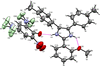
accessThe title imidazolium picrate salt crystallizes in the triclinic space group P1. The asymmetric unit consists of one imidazolium cation and one picrate anion. There is an intramolecular N—H⋯O hydrogen bond within the imidazolium cation and an intermolecular N—H⋯O hydrogen bond between the imidazolium cation and the picrate anion. In the crystal, the ions are further associated through π–π stacking interactions,
CCDC reference: 2555221
Download citation
Download citation
Open
access
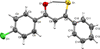
accessIn the title compound, the dihedral angle between the aromatic rings is 13.06 (6)° and an intramolecular O—H⋯S hydrogen bond supports the molecular conformation. In the extended structure, weak C—H⋯O hydrogen bonds connect the molecules into [010] chains.
CCDC reference: 2500235
Download citation
Download citation
Open
access
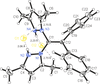
accessThe title compound crystallizes in the triclinic space group P1. The ethene derivative is substituted by two phenyl groups in 2-position and two 3,5-dimethylpyrazolinium units in 1-position, which makes this alkene into a dication. Two chloride ions act as counter-ions in the crystal structure and are linked via N—H⋯Cl and C—H⋯Cl interactions with the alkene. The crystal structure features a three-dimensional network stabilized by N—H⋯Cl, C—H⋯Cl and C—H⋯π interactions.
CCDC reference: 2557894
Download citation
Download citation
Open
access
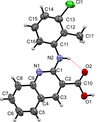
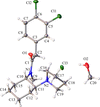
accessSingle crystals of 2-[(3-chloro-2-methylphenyl)amino]quinoline-3-carboxylic acid were obtained from slow evaporation of an ethyl acetate solution. In the crystal, the molecules pair up to form acid–acid homodimers.
CCDC reference: 2558014
Download citation
Download citation
Open
access
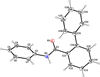
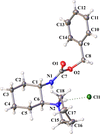
accessThe title molecule contains a carboxamide fragment in which the amide N atom is bonded to a phenyl group, while the carbonyl C atom is attached to a biphenyl unit. In the crystal, molecules are linked by N—H⋯O hydrogen bonds, forming chains running parallel to the a axis. These chains are further connected by C—H⋯π interactions, resulting in a three-dimensional supramolecular network.
CCDC reference: 2558356
Download citation
Download citation
Open
access
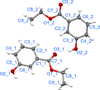
accessThe title compound, C9H10O3, was synthesized through a Fischer esterification: the crystal comprises two independent molecules with essentially the same planar structures.
CCDC reference: 2557954

journal menu
![[publCIF]](/logos/authorchecklist11.gif)