

 journal menu


raw data letters
 | IUCrDATA |
 access
Twinned L-aspartic acid

aStructural Biochemistry, Bijvoet Centre for Biomolecular Research, Faculty of Science, Utrecht University, Universiteitsweg 99, 3584 CG Utrecht, The Netherlands
*Correspondence e-mail: [email protected]
By improving the data quality with appropriate twin handling in the intensity integration, difference-Fourier maps show indications for asymmetric double-well hydrogen bonds between the carboxylate groups of the title molecule. Refinements with spherical scattering factors (IAM) and with non-spherical scattering factors (NoSpherA2) are consistent with this observation.
Keywords: twinning; hydrogen bonding; non-spherical scattering factors; raw data.
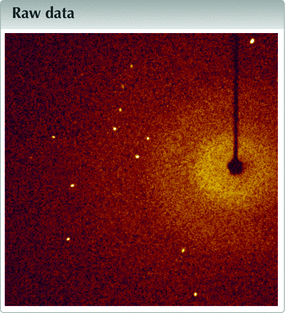
Metadata imgCIF file: https://doi.org/10.1107/S241431462500879X/ii4003img.cif
Introduction
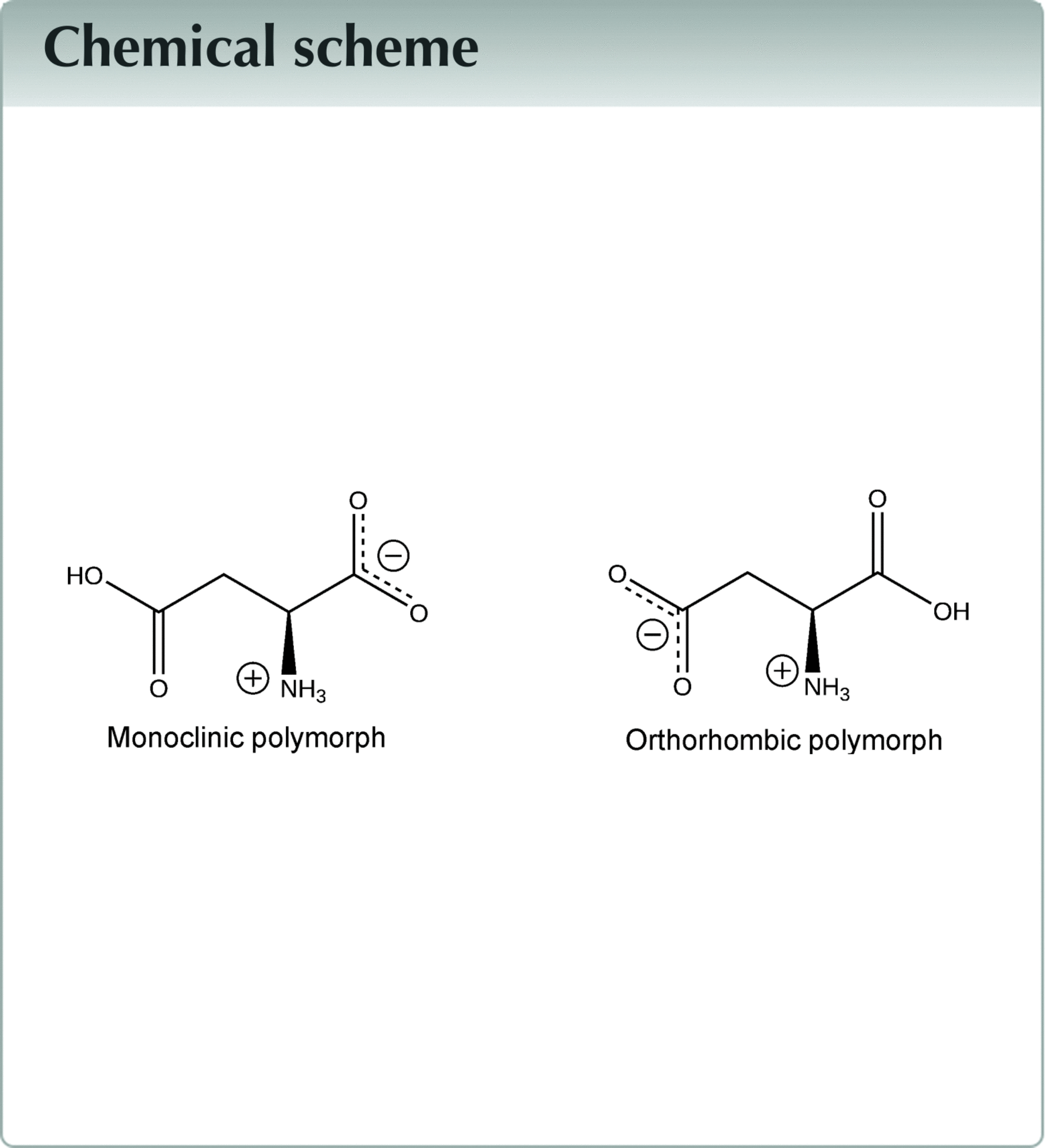
The Cambridge Structural Database (CSD, version 5.46, November 2024; Groom et al., 2016 ) contains seven entries for the enantiopure amino acid L-aspartic acid. Six of these entries are of the monoclinic polymorph with space group P21, and one entry is of the orthorhombic polymorph with space group P212121 (refcode LASPRT06; Illin, 2016). In the gas phase, the most stable form of aspartic acid is a neutral molecule with a neutral NH2 group and two neutral carboxylic acid groups (Li et al., 2007). In the monoclinic L-aspartic acid, the molecule is zwitterionic with a positively charged NH3 group, the main chain carboxylate is deprotonated and negatively charged, while the side-chain carboxylic acid is protonated and neutral. The orthorhombic polymorph is also zwitterionic but here the main-chain carboxylic acid is protonated and the side-chain carboxylate is deprotonated (Fig. 1).
![[Figure 1]](ii4003fig1thm.gif) | Figure 1 Reciprocal space geometry in the twinned title compound. (a) The main lattice is drawn in red, the interfering lattice in green. (b) Overlay of Bernal's twin cell in cyan with the current twin interpretation in red and green. |
In both the monoclinic and the orthorhombic polymorphs, the neutral carboxylic acid group is connected by an intermolecular hydrogen bond to the negatively charged carboxylate group. This raises the question whether the bridging hydrogen atom is localized on one of the two groups. Unfortunately, the data quality of the six published monoclinic structures is not sufficient to answer this question. A problem is that this monoclinic polymorph is affected by A detailed analysis of the is given by (Derissen et al., 1968) while the chirality of the asymmetric center seems to be wrong in their description. The present study (Table 1) aims at obtaining better data of this twinned system.
| ||||||||||||||||||||||||||||||||||||||||||||||||||||||||||||||||||||||||||||||||||||||||||||||||||||||||||||||

 )
)














Data processing and refinement
Indexing of the reflections with the DIRAX program (Duisenberg, 1992) and a high tolerance finds the twin cell, which had first been described in 1931 by Bernal. In this monoclinic twin cell, the unit-cell parameters are a = 15.134, b = 6.918, c = 5.124 Å, β = 99.02°, and V = 529.81 Å3. Among the DIRAX solutions there also is the true according to (Derissen et al., 1968) as well as the second twin component. The volume of the true unit cell is half of the Bernal unit cell. The twin law is then a twofold rotation about uvw = [100]. The geometry of the is shown in Fig. 1.
As consequence of the twinning, intensity integration with the Eval15 software (Schreurs et al., 2010) was based on two orientation matrices. The profile prediction involved an isotropic mosaicity of 0.275°. An example of an overlapping reflection is displayed in Fig. 2.
![[Figure 2]](ii4003fig2thm.gif) | Figure 2 Height plot of the overlapping reflection between hkl = (24  ) of the main lattice, and hkl = (2 ) of the main lattice, and hkl = (2 4) of the interfering lattice. (a) observed profile (central frame). (b) model profile as simulated by Eval15. 4) of the interfering lattice. (a) observed profile (central frame). (b) model profile as simulated by Eval15. |
The result file of the Eval15 integration contains the non-overlapping reflections of twin component 1, the non-overlapping reflections of twin component 2 and the overlapping reflections of both components. This file was read into the TWINABS program (Sevvana et al., 2019) for absorption correction, outlier rejection, error model and merging. After manual removal of space-group absences, the merged reflection file contains 1063 non-overlapping reflections of component 1 and 494 overlapping reflections. This file was used for the structure refinement. Further details are given in Table 2.
|
 (
( (mm
(mm )
)
 reflections
 (Å
(Å ,
,  ,
,  (e Å
(e Å )
)Data description
The true can be transformed to Bernal's twin cell with the matrix (1, 0, 2 / 0, 1, 0 /−1, 0, 0). The determinant of this matrix is 2 and the is consequently 2. On the other hand, Bernal's primitive twin cell can be expressed as a C-centered pseudo-orthorhombic lattice with a = 5.124, b = 29.901, c = 6.920 Å, α = β = 90,γ = 90.74°. The (Le Page, 2002) of the current system is thus δ = 0.74°. The fulfills Mallard's criterion (Nespolo & Ferraris, 2005), which requires a twin index smaller than 6 and a twin obliquity smaller than 6°.
It should be noted that the twin operation needs to be a first kind operation (rotation) because a second kind operation (mirror) is not possible in this enantiopure crystal.
All hydrogen bonds are formed in the (001) plane. These hydrogen-bonded layers are connected by covalent carbon bonds into a three-dimensional network. The twin operation about vector uvw = [100] can be alternatively be described as a twofold rotation about vector hkl = (001) in the monoclinic system. Our model for the twin boundary is therefore based on the hydrogen-bonded layers. It should be noted that face (001) is also most prominent in the Bravais–Friedel–Donnay–Harker morphology prediction (BFDH; Donnay & Harker, 1937), see Table 3.
| |||||||||||||||||||||||||||||||||||


Structure with an independent-atom model in the OLEX2 software (Dolomanov et al., 2009; Bourhis et al., 2015) shows a significant residual electron density on the O—H⋯O hydrogen bond (Fig. 3), which can be an indication for a double-well situation. The peak height for the modeled hydrogen atom and the residual peak are not equal. A ratio of 2:1 can be guessed. This makes it an asymmetric double-well hydrogen bond, such as is frequently observed in hydrogen bonds of moderate strength (Gilli & Gilli, 2010).
![[Figure 3]](ii4003fig3thm.gif) | Figure 3 Residual electron density on the O—H⋯O hydrogen bond. (a) independent-atom model (contour level 0.16 e Å−3. (b) Non-spherical NoSpherA2 model (contour level 0.10 e Å−3. |
In refinements, the use of non-spherical scattering factors can improve the reliability of hydrogen-atom positions (Woińska et al., 2016). In the present case, the use of the NoSpherA2 approach (Kleemiss et al., 2021) in OLEX2 improved the R-values significantly. As is common with this method, the hydrogen atoms were refined with anisotropic displacement parameters. The C—H and N—H hydrogen atoms could be refined this way but the O—H hydrogen atom becomes non-positive definite. In the final refinements, the O—H hydrogen atom was therefore refined isotropically. We believe that this refinement situation confirms the double-well potential as does the remaining residual electron density on the O—H⋯O hydrogen bond (Fig. 3).
Supporting information
DOI: https://doi.org/10.1107/S241431462500879X/ii4003sup1.cif
Structure factors: contains datablock Ia. DOI: https://doi.org/10.1107/S241431462500879X/ii4003Iasup2.hkl
Structure factors: contains datablock Ib. DOI: https://doi.org/10.1107/S241431462500879X/ii4003Ibsup3.hkl
Metadata imgCIF file. DOI: https://doi.org/10.1107/S241431462500879X/ii4003img.cif
CheckCIF for raw data report. DOI: https://doi.org/10.1107/S241431462500879X/ii4003img_check.pdf
| C4H7NO4 | F(000) = 140.133 |
| Mr = 133.10 | Dx = 1.668 Mg m−3 |
| Monoclinic, P21 | Mo Kα radiation, λ = 0.71073 Å |
| a = 5.1237 (2) Å | Cell parameters from 4378 reflections |
| b = 6.9197 (3) Å | θ = 4.0–30.0° |
| c = 7.6006 (4) Å | µ = 0.15 mm−1 |
| β = 100.442 (2)° | T = 150 K |
| V = 265.01 (2) Å3 | Plate, colourless |
| Z = 2 | 0.32 × 0.16 × 0.05 mm |
| Bruker Kappa ApexII diffractometer | 1522 reflections with I ≥ 2u(I) |
| Radiation source: sealed tube | Rint = 0.027 |
| φ and ω scans | θmax = 30.0°, θmin = 2.7° |
| Absorption correction: multi-scan TWINABS-2012/1 | h = −7→7 |
| Tmin = 0.654, Tmax = 0.746 | k = −9→9 |
| 11270 measured reflections | l = −10→10 |
| 1557 independent reflections |
| Refinement on F2 | Secondary atom site location: difference Fourier map |
| Least-squares matrix: full | Hydrogen site location: difference Fourier map |
| R[F2 > 2σ(F2)] = 0.026 | H atoms treated by a mixture of independent and constrained refinement |
| wR(F2) = 0.069 | w = 1/[σ2(Fo2) + (0.046P)2 + 0.0143P] where P = (Fo2 + 2Fc2)/3 |
| S = 1.06 | (Δ/σ)max = 0.001 |
| 1557 reflections | Δρmax = 0.31 e Å−3 |
| 99 parameters | Δρmin = −0.18 e Å−3 |
| 1 restraint | Absolute structure: Hooft, R.W.W., Straver, L.H., Spek, A.L. (2010). J. Appl. Cryst., 43, 665-668. |
| 5 constraints | Absolute structure parameter: 0.1 (2) |
| Primary atom site location: dual |
| x | y | z | Uiso*/Ueq | ||
| O1 | 0.68132 (15) | 0.51119 (13) | 0.01802 (11) | 0.01613 (18) | |
| O2 | 0.25187 (16) | 0.52336 (13) | −0.10959 (10) | 0.01648 (18) | |
| O3 | 0.38789 (16) | 0.48596 (13) | 0.58289 (11) | 0.01603 (17) | |
| H3 | 0.333 (5) | 0.489 (5) | 0.691 (3) | 0.051 (6)* | |
| O4 | 0.0023 (2) | 0.33238 (17) | 0.49259 (13) | 0.0283 (2) | |
| N1 | 0.14057 (19) | 0.71721 (14) | 0.18338 (12) | 0.01218 (18) | |
| H1a | −0.019 (3) | 0.662 (3) | 0.118 (2) | 0.018 (4)* | |
| H1b | 0.102 (4) | 0.754 (3) | 0.295 (3) | 0.023 (4)* | |
| H1c | 0.183 (4) | 0.826 (4) | 0.126 (3) | 0.033 (5)* | |
| C1 | 0.4400 (2) | 0.53553 (15) | 0.02088 (13) | 0.01090 (19) | |
| C2 | 0.3650 (2) | 0.57621 (15) | 0.20458 (14) | 0.01019 (19) | |
| H2 | 0.5217 (2) | 0.63118 (15) | 0.28706 (14) | 0.0122 (2)* | |
| C3 | 0.2852 (3) | 0.38469 (16) | 0.27988 (14) | 0.0144 (2) | |
| H3a | 0.1335 (3) | 0.33005 (16) | 0.19522 (14) | 0.0172 (2)* | |
| H3b | 0.4351 (3) | 0.29300 (16) | 0.28733 (14) | 0.0172 (2)* | |
| C4 | 0.2085 (2) | 0.40003 (15) | 0.46296 (14) | 0.0136 (2) |
| U11 | U22 | U33 | U12 | U13 | U23 | |
| O1 | 0.0128 (3) | 0.0202 (4) | 0.0161 (3) | 0.0004 (3) | 0.0045 (3) | −0.0042 (3) |
| O2 | 0.0151 (4) | 0.0252 (4) | 0.0095 (3) | −0.0014 (4) | 0.0030 (3) | −0.0030 (3) |
| O3 | 0.0178 (4) | 0.0199 (4) | 0.0109 (3) | −0.0024 (3) | 0.0041 (3) | −0.0026 (3) |
| O4 | 0.0306 (5) | 0.0407 (6) | 0.0151 (4) | −0.0180 (5) | 0.0085 (4) | −0.0031 (4) |
| N1 | 0.0144 (4) | 0.0121 (4) | 0.0108 (4) | 0.0022 (4) | 0.0041 (3) | 0.0004 (3) |
| C1 | 0.0144 (4) | 0.0095 (4) | 0.0100 (4) | −0.0016 (4) | 0.0054 (3) | −0.0006 (4) |
| C2 | 0.0120 (4) | 0.0109 (5) | 0.0080 (4) | 0.0012 (3) | 0.0027 (4) | −0.0009 (3) |
| C3 | 0.0239 (5) | 0.0108 (4) | 0.0093 (4) | −0.0009 (4) | 0.0057 (4) | 0.0006 (4) |
| C4 | 0.0203 (5) | 0.0117 (4) | 0.0090 (4) | −0.0003 (4) | 0.0033 (4) | 0.0013 (4) |
| O1—C1 | 1.2522 (13) | N1—C2 | 1.4943 (14) |
| O2—C1 | 1.2541 (13) | C1—C2 | 1.5398 (14) |
| O3—H3 | 0.91 (3) | C2—H2 | 1.0000 |
| O3—C4 | 1.3136 (14) | C2—C3 | 1.5283 (15) |
| O4—C4 | 1.2136 (16) | C3—H3a | 0.9900 |
| N1—H1a | 0.957 (18) | C3—H3b | 0.9900 |
| N1—H1b | 0.941 (19) | C3—C4 | 1.5166 (14) |
| N1—H1c | 0.92 (2) | ||
| C4—O3—H3 | 110.1 (16) | C3—C2—N1 | 110.72 (9) |
| H1b—N1—H1a | 106.0 (15) | C3—C2—C1 | 107.98 (8) |
| H1c—N1—H1a | 109.8 (17) | C3—C2—H2 | 109.51 (6) |
| H1c—N1—H1b | 108.0 (18) | H3a—C3—C2 | 108.64 (6) |
| C2—N1—H1a | 111.4 (11) | H3b—C3—C2 | 108.64 (6) |
| C2—N1—H1b | 111.2 (12) | H3b—C3—H3a | 107.6 |
| C2—N1—H1c | 110.3 (13) | C4—C3—C2 | 114.47 (8) |
| O2—C1—O1 | 126.66 (10) | C4—C3—H3a | 108.64 (6) |
| C2—C1—O1 | 116.74 (9) | C4—C3—H3b | 108.64 (6) |
| C2—C1—O2 | 116.55 (9) | O4—C4—O3 | 124.69 (10) |
| C1—C2—N1 | 109.58 (8) | C3—C4—O3 | 113.79 (10) |
| H2—C2—N1 | 109.51 (5) | C3—C4—O4 | 121.49 (10) |
| H2—C2—C1 | 109.51 (5) | ||
| O1—C1—C2—N1 | 143.71 (10) | O3—C4—C3—C2 | −53.03 (11) |
| O1—C1—C2—C3 | −95.61 (11) | O4—C4—C3—C2 | 129.02 (12) |
| O2—C1—C2—N1 | −38.75 (11) | N1—C2—C3—C4 | −60.79 (9) |
| O2—C1—C2—C3 | 81.93 (11) | C1—C2—C3—C4 | 179.25 (8) |
| D—H···A | D—H | H···A | D···A | D—H···A |
| O3—H3···O2i | 0.91 (3) | 1.66 (3) | 2.5703 (12) | 172 (3) |
| N1—H1a···O1ii | 0.957 (18) | 1.896 (18) | 2.8420 (13) | 169.2 (16) |
| N1—H1b···O4iii | 0.941 (19) | 1.870 (19) | 2.8089 (13) | 175.3 (17) |
| N1—H1c···O1iv | 0.92 (2) | 1.90 (2) | 2.7965 (12) | 166 (2) |
| Symmetry codes: (i) x, y, z+1; (ii) x−1, y, z; (iii) −x, y+1/2, −z+1; (iv) −x+1, y+1/2, −z. |
| C4H7NO4 | F(000) = 140.133 |
| Mr = 133.10 | Dx = 1.668 Mg m−3 |
| Monoclinic, P21 | Mo Kα radiation, λ = 0.71073 Å |
| a = 5.1237 (2) Å | Cell parameters from 4378 reflections |
| b = 6.9197 (3) Å | θ = 4.0–30.0° |
| c = 7.6006 (4) Å | µ = 0.15 mm−1 |
| β = 100.442 (2)° | T = 150 K |
| V = 265.01 (2) Å3 | Plate, colourless |
| Z = 2 | 0.32 × 0.16 × 0.05 mm |
| Bruker Kappa ApexII diffractometer | 1522 reflections with I ≥ 2u(I) |
| Radiation source: sealed tube | Rint = 0.027 |
| φ and ω scans | θmax = 30.0°, θmin = 2.7° |
| Absorption correction: multi-scan TWINABS-2012/1 | h = −7→7 |
| Tmin = 0.654, Tmax = 0.746 | k = −9→9 |
| 11270 measured reflections | l = −10→10 |
| 1557 independent reflections |
| Refinement on F2 | Secondary atom site location: difference Fourier map |
| Least-squares matrix: full | Hydrogen site location: difference Fourier map |
| R[F2 > 2σ(F2)] = 0.017 | All H-atom parameters refined |
| wR(F2) = 0.037 | w = 1/[σ2(Fo2) + (0.0189P)2 + 0.008P] where P = (Fo2 + 2Fc2)/3 |
| S = 0.99 | (Δ/σ)max = 0.001 |
| 1557 reflections | Δρmax = 0.37 e Å−3 |
| 141 parameters | Δρmin = −0.19 e Å−3 |
| 1 restraint | Absolute structure: Hooft, R.W.W., Straver, L.H., Spek, A.L. (2010). J. Appl. Cryst., 43, 665-668. |
| 0 constraints | Absolute structure parameter: 0.1 (2) |
| Primary atom site location: dual |
| x | y | z | Uiso*/Ueq | ||
| O1 | 0.68076 (10) | 0.51134 (8) | 0.01788 (7) | 0.01490 (12) | |
| O2 | 0.25205 (10) | 0.52322 (8) | −0.10925 (6) | 0.01523 (12) | |
| O3 | 0.38709 (11) | 0.48573 (9) | 0.58294 (7) | 0.01495 (12) | |
| H3 | 0.324 (3) | 0.498 (3) | 0.6996 (18) | 0.032 (3)* | |
| O4 | 0.00246 (15) | 0.33224 (10) | 0.49271 (8) | 0.02682 (15) | |
| N1 | 0.14053 (14) | 0.71719 (9) | 0.18330 (9) | 0.01114 (13) | |
| H1a | −0.026 (2) | 0.6565 (18) | 0.1121 (16) | 0.024 (3) | |
| H1b | 0.101 (3) | 0.761 (2) | 0.3010 (17) | 0.036 (3) | |
| H1c | 0.195 (3) | 0.8350 (19) | 0.1147 (16) | 0.030 (3) | |
| C1 | 0.43986 (14) | 0.53548 (10) | 0.02129 (8) | 0.00959 (13) | |
| C2 | 0.36425 (15) | 0.57630 (10) | 0.20459 (9) | 0.00931 (13) | |
| H2a | 0.5401 (19) | 0.6369 (18) | 0.2944 (14) | 0.020 (3) | |
| C3 | 0.28535 (18) | 0.38494 (11) | 0.28029 (10) | 0.01333 (14) | |
| H3a | 0.122 (3) | 0.3189 (19) | 0.1867 (16) | 0.034 (3) | |
| H3b | 0.468 (3) | 0.291 (2) | 0.2925 (18) | 0.038 (4) | |
| C4 | 0.20931 (16) | 0.40001 (10) | 0.46282 (9) | 0.01254 (14) |
| U11 | U22 | U33 | U12 | U13 | U23 | |
| O1 | 0.0111 (2) | 0.0199 (3) | 0.0145 (2) | 0.0005 (2) | 0.00426 (19) | −0.0048 (2) |
| O2 | 0.0133 (2) | 0.0251 (3) | 0.0077 (2) | −0.0014 (3) | 0.00291 (19) | −0.0029 (2) |
| O3 | 0.0162 (3) | 0.0190 (3) | 0.0103 (2) | −0.0025 (2) | 0.0039 (2) | −0.0023 (2) |
| O4 | 0.0289 (3) | 0.0405 (4) | 0.0128 (2) | −0.0194 (3) | 0.0083 (2) | −0.0043 (3) |
| N1 | 0.0130 (3) | 0.0111 (3) | 0.0097 (3) | 0.0027 (3) | 0.0032 (3) | 0.0001 (3) |
| H1a | 0.016 (6) | 0.014 (6) | 0.038 (8) | 0.004 (6) | −0.008 (6) | −0.003 (7) |
| H1b | 0.045 (8) | 0.030 (8) | 0.032 (7) | 0.014 (7) | 0.002 (7) | −0.004 (6) |
| H1c | 0.049 (9) | 0.015 (7) | 0.029 (7) | 0.006 (7) | 0.018 (7) | 0.002 (6) |
| C1 | 0.0105 (3) | 0.0106 (3) | 0.0084 (3) | −0.0010 (3) | 0.0034 (2) | −0.0011 (2) |
| C2 | 0.0119 (3) | 0.0101 (3) | 0.0065 (3) | −0.0006 (3) | 0.0031 (3) | −0.0013 (2) |
| H2a | 0.012 (6) | 0.022 (6) | 0.026 (6) | −0.012 (5) | 0.005 (5) | −0.004 (5) |
| C3 | 0.0227 (4) | 0.0100 (3) | 0.0081 (3) | −0.0010 (3) | 0.0050 (3) | 0.0002 (3) |
| H3a | 0.057 (9) | 0.019 (7) | 0.027 (7) | −0.014 (7) | 0.011 (7) | −0.004 (6) |
| H3b | 0.034 (8) | 0.045 (10) | 0.035 (8) | 0.027 (8) | 0.007 (7) | 0.004 (7) |
| C4 | 0.0184 (3) | 0.0123 (3) | 0.0077 (3) | −0.0017 (3) | 0.0043 (3) | 0.0008 (2) |
| O1—C1 | 1.2505 (9) | N1—C2 | 1.4911 (10) |
| O2—C1 | 1.2536 (8) | C1—C2 | 1.5383 (10) |
| O3—H3 | 1.001 (14) | C2—H2a | 1.109 (10) |
| O3—C4 | 1.3090 (9) | C2—C3 | 1.5271 (10) |
| O4—C4 | 1.2175 (10) | C3—H3a | 1.096 (13) |
| N1—H1a | 1.013 (12) | C3—H3b | 1.128 (13) |
| N1—H1b | 1.001 (13) | C3—C4 | 1.5111 (10) |
| N1—H1c | 1.032 (13) | ||
| C4—O3—H3 | 111.1 (8) | C3—C2—N1 | 110.92 (6) |
| H1b—N1—H1a | 108.5 (11) | C3—C2—C1 | 108.02 (5) |
| H1c—N1—H1a | 109.5 (10) | C3—C2—H2a | 109.7 (6) |
| H1c—N1—H1b | 109.0 (11) | H3a—C3—C2 | 109.9 (6) |
| C2—N1—H1a | 110.0 (7) | H3b—C3—C2 | 104.9 (8) |
| C2—N1—H1b | 112.3 (8) | H3b—C3—H3a | 109.8 (11) |
| C2—N1—H1c | 107.4 (7) | C4—C3—C2 | 114.58 (6) |
| O2—C1—O1 | 126.40 (6) | C4—C3—H3a | 109.3 (6) |
| C2—C1—O1 | 117.06 (6) | C4—C3—H3b | 108.2 (7) |
| C2—C1—O2 | 116.49 (6) | O4—C4—O3 | 124.31 (7) |
| C1—C2—N1 | 109.67 (6) | C3—C4—O3 | 114.14 (7) |
| H2a—C2—N1 | 110.0 (6) | C3—C4—O4 | 121.52 (7) |
| H2a—C2—C1 | 108.5 (5) | ||
| O1—C1—C2—N1 | 143.52 (7) | O3—C4—C3—C2 | −53.08 (7) |
| O1—C1—C2—C3 | −95.49 (8) | O4—C4—C3—C2 | 128.79 (8) |
| O2—C1—C2—N1 | −38.83 (8) | N1—C2—C3—C4 | −60.75 (7) |
| O2—C1—C2—C3 | 82.16 (7) | C1—C2—C3—C4 | 179.04 (6) |
| D—H···A | D—H | H···A | D···A | D—H···A |
| O3—H3···O2i | 1.001 (14) | 1.572 (14) | 2.5702 (7) | 174.6 (13) |
| N1—H1a···O1ii | 1.013 (12) | 1.843 (13) | 2.8435 (9) | 168.9 (11) |
| N1—H1b···O4iii | 1.001 (13) | 1.811 (13) | 2.8086 (9) | 174.5 (13) |
| N1—H1c···O1iv | 1.032 (13) | 1.773 (13) | 2.7977 (9) | 171.0 (11) |
| Symmetry codes: (i) x, y, z+1; (ii) x−1, y, z; (iii) −x, y+1/2, −z+1; (iv) −x+1, y+1/2, −z. |
Acknowledgements
The X-ray diffractometer has been financed by the Netherlands Organization for Scientific Research (NWO).
Conflict of interest
There are no conflicts of interest.
Funding information
The following funding is acknowledged: Nederlandse Organisatie voor Wetenschappelijk Onderzoek.
References
 Bernal, J. D. (1931). Z. Krist. Crystal. Mater. 78, 363–369. https://doi.org/10.1524/zkri.1931.78.1.363 Google Scholar
Bourhis, L. J., Dolomanov, O. V., Gildea, R. J., Howard, J. A. K. & Puschmann, H. (2015). Acta Cryst. A71, 59–75. https://doi.org/10.1107/S2053273314022207 Google Scholar
Derissen, J. L., Endeman, H. J. & Peerdeman, A. F. (1968). Acta Cryst. B24, 1349–1354. https://doi.org/10.1107/S0567740868004280 Google Scholar
Dolomanov, O. V., Bourhis, L. J., Gildea, R. J., Howard, J. A. K. & Puschmann, H. (2009). J. Appl. Cryst. 42, 339–341. https://doi.org/10.1107/S0021889808042726 Google Scholar
Donnay, J. D. H. & Harker, D. (1937). Am. Mineral. 22, 446–467. CAS Google Scholar
Duisenberg, A. J. M. (1992). J. Appl. Cryst. 25, 92–96. https://doi.org/10.1107/S0021889891010634 Google Scholar
Gilli, P. & Gilli, G. (2010). J. Mol. Struct. 972, 2–10. Horizons in hydrogen bond research 2009. https://www.sciencedirect.com/science/article/pii/S0022286010001262 Google Scholar
Groom, C. R., Bruno, I. J., Lightfoot, M. P. & Ward, S. C. (2016). Acta Cryst. 72, 171–179. https://doi.org/10.1107/S2052520616003954 Google Scholar
Illin, A. I. (2016). Private Communication (refcode LASPRT06). CCDC, Cambridge, England. Google Scholar
Kleemiss, F., Dolomanov, O. V., Bodensteiner, M., Peyerimhoff, N., Midgley, L., Bourhis, L. J., Genoni, A., Malaspina, L. A., Jayatilaka, D., Spencer, J. L., White, F., Grundkötter-Stock, B., Steinhauer, S., Lentz, D., Puschmann, H. & Grabowsky, S. (2021). Chem. Sci. 12, 1675–1692. http://dx.doi.org/10.1039/D0SC05526C Google Scholar
Le Page, Y. (2002). J. Appl. Cryst. 35, 175–181. https://doi.org/10.1107/S0021889801021574 Google Scholar
Li, Z., Matus, M. H., Velazquez, H. A., Dixon, D. A. & Cassady, C. J. (2007). Int. J. Mass Spec. 265, 213–223. Jean H. Futrell Honour Issue. https://www.sciencedirect.com/science/article/pii/S1387380607000681 Google Scholar
Macrae, C. F., Edgington, P. R., McCabe, P., Pidcock, E., Shields, G. P., Taylor, R., Towler, M. & van de Streek, J. (2006). J. Appl. Cryst. 39, 453–457. https://doi.org/10.1107/S002188980600731X Google Scholar
Nespolo, M. & Ferraris, G. (2005). Z. Krist. Cryst. Mater. 220, 317–323. https://doi.org/10.1524/zkri.220.4.317.61622 Google Scholar
Schreurs, A. M. M., Xian, X. & Kroon-Batenburg, L. M. J. (2010). J. Appl. Cryst. 43, 70–82. https://doi.org/10.1107/S0021889809043234 Google Scholar
Sevvana, M., Ruf, M., Usón, I., Sheldrick, G. M. & Herbst-Irmer, R. (2019). Acta Cryst. D75, 1040–1050. https://doi.org/10.1107/S2059798319010179 Google Scholar
Woińska, M., Grabowsky, S., Dominiak, P. M., Woźniak, K. & Jayatilaka, D. (2016). Sci. Adv. 2, e1600192. https://www.science.org/doi/abs/10.1126/sciadv.1600192 Google Scholar
This is an open-access article distributed under the terms of the Creative Commons Attribution (CC-BY) Licence, which permits unrestricted use, distribution, and reproduction in any medium, provided the original authors and source are cited.
| IUCrDATA |


