

 menu


organic compounds
 | IUCrDATA |
 access
1,1′-(Propane-1,3-diyl)bis[3-(4-chlorophenyl)thiourea]

aUniversité Alioune Diop de Bambey, UFR Sciences Appliquées et Technologies de l'information et de la communication (SATIC), Equipe Chimie des Matériaux Inorganiques et Organiques (ECMIO), Senegal, bUniversité Alioune Diop de Bambey, UFR Sciences Appliquées et Technologies de l'information et de la communication (SATIC), Equipe Chimie Organique Therapeutique (ECOT), Senegal, and cCentre de Diffractométrie Henrie Longchambon, Univ. Claude Bernard Lyon 1, 43 Bd 11 Novembre 1918, F-69622 Villeurbanne, France
*Correspondence e-mail: [email protected]
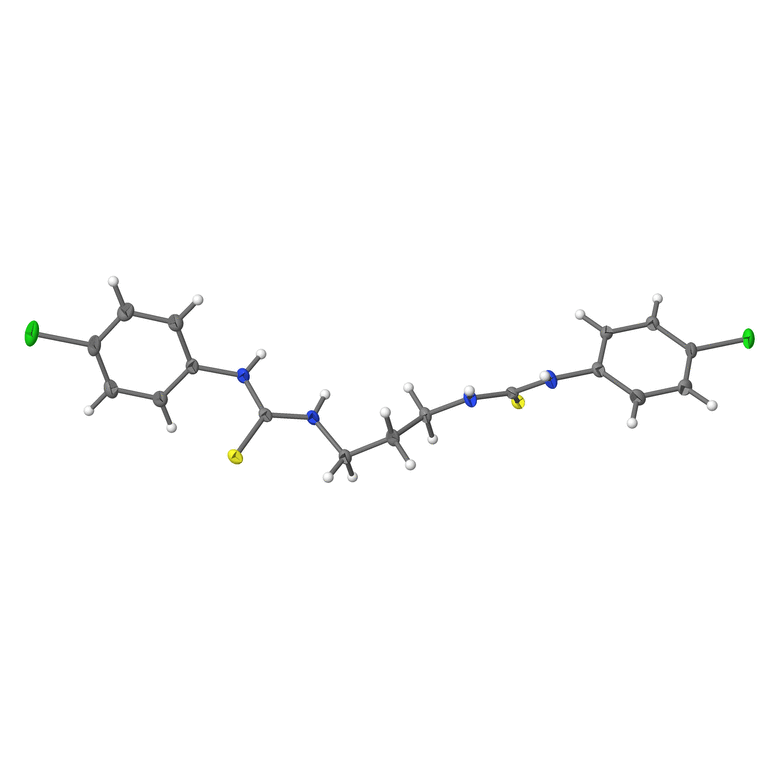
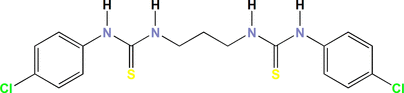
The title compound, C17H18Cl2N4S2, crystallizes in the monoclinic space group I2/a with one molecule in the In the molecule, two 1-(4-chlorophenyl)thiourea entities are bridged by a propyl fragment. The thiourea entities are inclined relative to the propyl group in different ways, as shown by the C—C—C—N torsion angles of −71.23 (13) and −179.50 (10)°. In the crystal, N—H⋯S hydrogen bonds lead to the formation of supramolecular layers parallel to (001).
CCDC reference: 2598518
Structure description
The thiourea moiety is an important pharmacophore for developing new drug prototypes with biological activities including anti-inflammatory, anticancer, antifungal properties (Ölmez & Waseer, 2020 ; Aguiar et al., 2011; Keche & Kamble, 2014; Abbas et al., 2020). A recent study reported the antimycobactarial and anti-inflammatory activities of thiourea derivatives in the treatment for severe pulmonary tuberculosis (Calixto et al., 2022). Taking into account the presence of a chlorophenyl group in some antimicrobial compounds, we prepared the title thiourea derivative, C17H18Cl2N4S2, and report here its crystal and molecular structure.
The asymmetric unit comprises one molecule (Fig. 1). This consists of two 1-(4-chlorophenyl)thiourea entities bridged by a propyl fragment. The arrangement of the thiourea fragments relative to the propyl fragment is markedly different, as can be seen from the torsion angles of N2—C8—C9—C10 = −71.23 (13)° and N3—C10—C9—C8 = −179.50 (10)°. The dihedral angles between the thiourea fragments and the attached phenyl ring are virtually identical [61.91 (6)° for thiourea group containing S2 and the C1–C6 ring; 61.97 (6)° for S3-thiourea group and the C12–C17 ring]; the thiourea fragments are inclined to each other by a dihedral angle of 71.37 (6)°, and the phenyl rings by 66.91 (6)°.
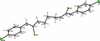 | Figure 1 Molecular structure of the title compound with displacement ellipsoids drawn at the 50% probability level. |
Two adjacent molecules form a centrosymmetric dimer (Fig. 2) via pairwise N—H⋯S hydrogen bonds (entry #3 in Table 1) with an R22(16) graph-set motif (Etter et al., 1990). These dimers are further connected through somewhat weaker hydrogen bonds (entries 1 and 2 in Table 1), resulting in sheets propagating parallel to (001), Fig. 3. The fourth NH group (N4—H4) does not participate in hydrogen bonding.
| |||||||||||||||||||||||||||
 ; (ii)
 ; (iii)
 .
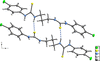 | Figure 2 Formation of a centrosymmetric N—H⋯S hydrogen-bonded dimer with graph-set motif R22(16); hydrogen bonds (entry 3 in Table 1 ) are shown as blue dashed lines. |
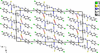 | Figure 3 The packing of molecules in the crystal in a projection along [010]. N—H⋯S hydrogen-bonding interactions are shown as blue dashed lines (entry 3 in Table 1 ) and red dashed lines (entry 2 in Table 1). |
Synthesis and crystallization
A 3 mmol sample of 4-chlorophenyl isothiocyanate was dissolved in 20 ml of ethanol. This solution was added to a 250 ml flask containing 1,2 diaminopropane (3 mmol). The resulting mixture was stirred at room temperature for one h producing a clear solution. Slow evaporation over the course of weeks produced colourless single-crystals suitable for X-ray diffraction studies.
Refinement
Crystal data, data collection and structure details are summarized in Table 2.
|
Structural data
CCDC reference: 2598518
contains datablock I. DOI: https://doi.org/10.1107/S2414314626011168/wm4261sup1.cif
Structure factors: contains datablock I. DOI: https://doi.org/10.1107/S2414314626011168/wm4261Isup3.hkl
Supporting information file. DOI: https://doi.org/10.1107/S2414314626011168/wm4261Isup3.cml
| C17H18Cl2N4S2 | F(000) = 1712 |
| Mr = 413.37 | Dx = 1.473 Mg m−3 |
| Monoclinic, I2/a | Mo Kα radiation, λ = 0.71073 Å |
| a = 17.7563 (2) Å | Cell parameters from 37150 reflections |
| b = 5.4972 (1) Å | θ = 5.4–30.3° |
| c = 38.2124 (5) Å | µ = 0.58 mm−1 |
| β = 92.168 (1)° | T = 100 K |
| V = 3727.24 (9) Å3 | Plate, colourless |
| Z = 8 | 0.22 × 0.21 × 0.05 mm |
| XtaLAB Synergy, Dualflex, HyPix-Arc 100 diffractometer | 5080 independent reflections |
| Radiation source: micro-focus sealed X-ray tube, PhotonJet (Mo) X-ray Source | 4601 reflections with I > 2σ(I) |
| Mirror monochromator | Rint = 0.031 |
| Detector resolution: 10.0000 pixels mm-1 | θmax = 30.3°, θmin = 5.3° |
| ω scans | h = −22→24 |
| Absorption correction: multi-scan (CrysAlisPro; Rigaku OD, 2022) | k = −7→7 |
| Tmin = 0.906, Tmax = 1.000 | l = −53→53 |
| 54093 measured reflections |
| Refinement on F2 | Primary atom site location: dual |
| Least-squares matrix: full | Hydrogen site location: inferred from neighbouring sites |
| R[F2 > 2σ(F2)] = 0.029 | H-atom parameters constrained |
| wR(F2) = 0.076 | w = 1/[σ2(Fo2) + (0.038P)2 + 4.1233P] where P = (Fo2 + 2Fc2)/3 |
| S = 1.03 | (Δ/σ)max = 0.003 |
| 5080 reflections | Δρmax = 0.36 e Å−3 |
| 226 parameters | Δρmin = −0.35 e Å−3 |
| 0 restraints |
Geometry. All esds (except the esd in the dihedral angle between two l.s. planes) are estimated using the full covariance matrix. The cell esds are taken into account individually in the estimation of esds in distances, angles and torsion angles; correlations between esds in cell parameters are only used when they are defined by crystal symmetry. An approximate (isotropic) treatment of cell esds is used for estimating esds involving l.s. planes. |
Refinement. N-bound hydrogen atoms were discernible from difference-Fourier maps and were modelled with a fixed N—H distance of 0.88 Å and Uiso(H) = 1.2Ueq(N). |
| x | y | z | Uiso*/Ueq | ||
| Cl1 | 0.44228 (2) | 1.28574 (8) | 0.73158 (2) | 0.03525 (10) | |
| Cl4 | 0.80672 (2) | −0.08518 (7) | 0.28692 (2) | 0.03111 (9) | |
| S2 | 0.52537 (2) | 1.48529 (5) | 0.56514 (2) | 0.01720 (7) | |
| S3 | 0.78472 (2) | 0.62155 (5) | 0.42899 (2) | 0.01515 (7) | |
| N1 | 0.57320 (6) | 1.06881 (19) | 0.59471 (3) | 0.0203 (2) | |
| H1 | 0.594183 | 0.924784 | 0.592614 | 0.024* | |
| N2 | 0.61224 (6) | 1.13321 (18) | 0.53974 (3) | 0.01702 (19) | |
| H2 | 0.634429 | 0.990842 | 0.542284 | 0.020* | |
| N3 | 0.64312 (5) | 0.76112 (19) | 0.43933 (3) | 0.0183 (2) | |
| H3 | 0.594918 | 0.753224 | 0.433186 | 0.022* | |
| N4 | 0.65752 (6) | 0.5310 (2) | 0.39102 (3) | 0.0189 (2) | |
| H4 | 0.608792 | 0.553998 | 0.387461 | 0.023* | |
| C1 | 0.48211 (7) | 1.2199 (3) | 0.69173 (3) | 0.0248 (3) | |
| C2 | 0.53671 (8) | 1.3750 (3) | 0.67922 (3) | 0.0255 (3) | |
| H2A | 0.553131 | 1.512301 | 0.692525 | 0.031* | |
| C3 | 0.56700 (7) | 1.3262 (2) | 0.64691 (3) | 0.0230 (2) | |
| H3A | 0.604765 | 1.429330 | 0.638078 | 0.028* | |
| C4 | 0.54168 (7) | 1.1251 (2) | 0.62754 (3) | 0.0192 (2) | |
| C5 | 0.48772 (8) | 0.9711 (3) | 0.64054 (4) | 0.0259 (3) | |
| H5 | 0.471032 | 0.833825 | 0.627278 | 0.031* | |
| C6 | 0.45787 (8) | 1.0178 (3) | 0.67314 (4) | 0.0292 (3) | |
| H6 | 0.421353 | 0.911746 | 0.682391 | 0.035* | |
| C7 | 0.57360 (6) | 1.2175 (2) | 0.56657 (3) | 0.0156 (2) | |
| C8 | 0.62026 (7) | 1.2604 (2) | 0.50650 (3) | 0.0190 (2) | |
| H8A | 0.672323 | 1.323510 | 0.505360 | 0.023* | |
| H8B | 0.585453 | 1.401093 | 0.505448 | 0.023* | |
| C9 | 0.60351 (7) | 1.0963 (2) | 0.47508 (3) | 0.0189 (2) | |
| H9A | 0.554710 | 1.013312 | 0.478154 | 0.023* | |
| H9B | 0.598473 | 1.197759 | 0.453719 | 0.023* | |
| C10 | 0.66419 (7) | 0.9056 (2) | 0.46999 (3) | 0.0168 (2) | |
| H10A | 0.713343 | 0.985770 | 0.466688 | 0.020* | |
| H10B | 0.669014 | 0.799749 | 0.490918 | 0.020* | |
| C11 | 0.69113 (6) | 0.6393 (2) | 0.41971 (3) | 0.0144 (2) | |
| C12 | 0.69487 (6) | 0.3836 (2) | 0.36636 (3) | 0.0163 (2) | |
| C13 | 0.69330 (8) | 0.4534 (2) | 0.33133 (3) | 0.0221 (2) | |
| H13 | 0.669108 | 0.600518 | 0.324295 | 0.027* | |
| C14 | 0.72715 (8) | 0.3078 (2) | 0.30660 (3) | 0.0237 (3) | |
| H14 | 0.725888 | 0.353845 | 0.282618 | 0.028* | |
| C15 | 0.76259 (7) | 0.0955 (2) | 0.31740 (3) | 0.0202 (2) | |
| C16 | 0.76456 (7) | 0.0233 (2) | 0.35231 (3) | 0.0188 (2) | |
| H16 | 0.789057 | −0.123378 | 0.359314 | 0.023* | |
| C17 | 0.73028 (7) | 0.1685 (2) | 0.37677 (3) | 0.0174 (2) | |
| H17 | 0.730993 | 0.120824 | 0.400674 | 0.021* |
| U11 | U22 | U33 | U12 | U13 | U23 | |
| Cl1 | 0.03533 (19) | 0.0516 (2) | 0.01934 (15) | 0.01032 (16) | 0.00848 (12) | −0.00351 (14) |
| Cl4 | 0.0425 (2) | 0.03006 (17) | 0.02166 (15) | 0.00403 (14) | 0.01338 (13) | −0.00732 (12) |
| S2 | 0.01332 (13) | 0.01440 (13) | 0.02396 (14) | 0.00229 (9) | 0.00182 (10) | −0.00305 (10) |
| S3 | 0.01252 (13) | 0.01588 (13) | 0.01699 (13) | 0.00161 (9) | −0.00012 (9) | −0.00183 (10) |
| N1 | 0.0269 (5) | 0.0147 (5) | 0.0196 (5) | 0.0057 (4) | 0.0073 (4) | −0.0015 (4) |
| N2 | 0.0194 (5) | 0.0140 (4) | 0.0178 (4) | 0.0039 (4) | 0.0023 (4) | −0.0024 (4) |
| N3 | 0.0123 (4) | 0.0223 (5) | 0.0202 (5) | 0.0002 (4) | 0.0007 (3) | −0.0079 (4) |
| N4 | 0.0137 (4) | 0.0220 (5) | 0.0207 (5) | 0.0027 (4) | −0.0018 (4) | −0.0083 (4) |
| C1 | 0.0244 (6) | 0.0327 (7) | 0.0176 (5) | 0.0095 (5) | 0.0048 (4) | −0.0019 (5) |
| C2 | 0.0306 (7) | 0.0247 (6) | 0.0212 (6) | 0.0031 (5) | 0.0012 (5) | −0.0062 (5) |
| C3 | 0.0250 (6) | 0.0213 (6) | 0.0229 (6) | −0.0005 (5) | 0.0049 (5) | −0.0024 (5) |
| C4 | 0.0210 (6) | 0.0182 (5) | 0.0187 (5) | 0.0054 (4) | 0.0047 (4) | −0.0016 (4) |
| C5 | 0.0293 (7) | 0.0236 (6) | 0.0252 (6) | −0.0032 (5) | 0.0071 (5) | −0.0050 (5) |
| C6 | 0.0284 (7) | 0.0320 (7) | 0.0280 (7) | −0.0038 (6) | 0.0103 (5) | −0.0009 (6) |
| C7 | 0.0124 (5) | 0.0149 (5) | 0.0194 (5) | −0.0009 (4) | 0.0003 (4) | −0.0039 (4) |
| C8 | 0.0243 (6) | 0.0160 (5) | 0.0168 (5) | 0.0024 (4) | 0.0028 (4) | −0.0023 (4) |
| C9 | 0.0192 (5) | 0.0195 (6) | 0.0179 (5) | 0.0052 (4) | 0.0005 (4) | −0.0034 (4) |
| C10 | 0.0160 (5) | 0.0179 (5) | 0.0165 (5) | 0.0025 (4) | 0.0006 (4) | −0.0047 (4) |
| C11 | 0.0154 (5) | 0.0122 (5) | 0.0155 (5) | −0.0004 (4) | 0.0014 (4) | −0.0007 (4) |
| C12 | 0.0153 (5) | 0.0166 (5) | 0.0168 (5) | −0.0005 (4) | −0.0001 (4) | −0.0046 (4) |
| C13 | 0.0289 (6) | 0.0181 (6) | 0.0189 (5) | 0.0029 (5) | −0.0040 (5) | −0.0010 (5) |
| C14 | 0.0349 (7) | 0.0223 (6) | 0.0139 (5) | −0.0008 (5) | 0.0004 (5) | 0.0001 (5) |
| C15 | 0.0246 (6) | 0.0203 (6) | 0.0162 (5) | −0.0016 (5) | 0.0058 (4) | −0.0054 (4) |
| C16 | 0.0222 (6) | 0.0165 (5) | 0.0178 (5) | 0.0016 (4) | 0.0024 (4) | −0.0015 (4) |
| C17 | 0.0216 (5) | 0.0165 (5) | 0.0144 (5) | −0.0011 (4) | 0.0023 (4) | −0.0011 (4) |
| Cl1—C1 | 1.7410 (12) | C4—C5 | 1.3847 (18) |
| Cl4—C15 | 1.7396 (12) | C5—H5 | 0.9500 |
| S2—C7 | 1.7029 (12) | C5—C6 | 1.3961 (18) |
| S3—C11 | 1.6889 (11) | C6—H6 | 0.9500 |
| N1—H1 | 0.8800 | C8—H8A | 0.9900 |
| N1—C4 | 1.4269 (15) | C8—H8B | 0.9900 |
| N1—C7 | 1.3510 (16) | C8—C9 | 1.5222 (16) |
| N2—H2 | 0.8800 | C9—H9A | 0.9900 |
| N2—C7 | 1.3380 (14) | C9—H9B | 0.9900 |
| N2—C8 | 1.4613 (15) | C9—C10 | 1.5210 (16) |
| N3—H3 | 0.8800 | C10—H10A | 0.9900 |
| N3—C10 | 1.4529 (14) | C10—H10B | 0.9900 |
| N3—C11 | 1.3363 (15) | C12—C13 | 1.3916 (17) |
| N4—H4 | 0.8800 | C12—C17 | 1.3904 (17) |
| N4—C11 | 1.3647 (14) | C13—H13 | 0.9500 |
| N4—C12 | 1.4252 (14) | C13—C14 | 1.3921 (18) |
| C1—C2 | 1.389 (2) | C14—H14 | 0.9500 |
| C1—C6 | 1.379 (2) | C14—C15 | 1.3817 (18) |
| C2—H2A | 0.9500 | C15—C16 | 1.3912 (16) |
| C2—C3 | 1.3910 (17) | C16—H16 | 0.9500 |
| C3—H3A | 0.9500 | C16—C17 | 1.3868 (16) |
| C3—C4 | 1.3950 (18) | C17—H17 | 0.9500 |
| C4—N1—H1 | 117.2 | H8A—C8—H8B | 107.9 |
| C7—N1—H1 | 117.2 | C9—C8—H8A | 109.1 |
| C7—N1—C4 | 125.63 (10) | C9—C8—H8B | 109.1 |
| C7—N2—H2 | 117.6 | C8—C9—H9A | 109.0 |
| C7—N2—C8 | 124.76 (10) | C8—C9—H9B | 109.0 |
| C8—N2—H2 | 117.6 | H9A—C9—H9B | 107.8 |
| C10—N3—H3 | 117.4 | C10—C9—C8 | 113.01 (10) |
| C11—N3—H3 | 117.4 | C10—C9—H9A | 109.0 |
| C11—N3—C10 | 125.19 (10) | C10—C9—H9B | 109.0 |
| C11—N4—H4 | 117.3 | N3—C10—C9 | 108.53 (9) |
| C11—N4—C12 | 125.37 (10) | N3—C10—H10A | 110.0 |
| C12—N4—H4 | 117.3 | N3—C10—H10B | 110.0 |
| C2—C1—Cl1 | 119.04 (11) | C9—C10—H10A | 110.0 |
| C6—C1—Cl1 | 119.27 (11) | C9—C10—H10B | 110.0 |
| C6—C1—C2 | 121.68 (12) | H10A—C10—H10B | 108.4 |
| C1—C2—H2A | 120.5 | N3—C11—S3 | 123.67 (9) |
| C1—C2—C3 | 119.04 (12) | N3—C11—N4 | 113.61 (10) |
| C3—C2—H2A | 120.5 | N4—C11—S3 | 122.71 (9) |
| C2—C3—H3A | 120.1 | C13—C12—N4 | 119.11 (11) |
| C2—C3—C4 | 119.73 (12) | C17—C12—N4 | 120.73 (10) |
| C4—C3—H3A | 120.1 | C17—C12—C13 | 120.12 (11) |
| C3—C4—N1 | 120.61 (11) | C12—C13—H13 | 120.0 |
| C5—C4—N1 | 118.83 (11) | C12—C13—C14 | 120.09 (12) |
| C5—C4—C3 | 120.51 (11) | C14—C13—H13 | 120.0 |
| C4—C5—H5 | 120.0 | C13—C14—H14 | 120.5 |
| C4—C5—C6 | 119.91 (13) | C15—C14—C13 | 119.09 (11) |
| C6—C5—H5 | 120.0 | C15—C14—H14 | 120.5 |
| C1—C6—C5 | 119.10 (13) | C14—C15—Cl4 | 119.60 (9) |
| C1—C6—H6 | 120.5 | C14—C15—C16 | 121.47 (11) |
| C5—C6—H6 | 120.5 | C16—C15—Cl4 | 118.93 (10) |
| N1—C7—S2 | 122.06 (9) | C15—C16—H16 | 120.4 |
| N2—C7—S2 | 123.13 (9) | C17—C16—C15 | 119.11 (11) |
| N2—C7—N1 | 114.76 (10) | C17—C16—H16 | 120.4 |
| N2—C8—H8A | 109.1 | C12—C17—H17 | 119.9 |
| N2—C8—H8B | 109.1 | C16—C17—C12 | 120.13 (11) |
| N2—C8—C9 | 112.30 (10) | C16—C17—H17 | 119.9 |
| Cl1—C1—C2—C3 | −178.19 (10) | C7—N2—C8—C9 | −131.43 (12) |
| Cl1—C1—C6—C5 | 177.41 (11) | C8—N2—C7—S2 | 2.01 (16) |
| Cl4—C15—C16—C17 | 179.18 (9) | C8—N2—C7—N1 | 179.55 (11) |
| N1—C4—C5—C6 | 177.86 (13) | C8—C9—C10—N3 | −179.50 (10) |
| N2—C8—C9—C10 | −71.23 (13) | C10—N3—C11—S3 | 3.56 (17) |
| N4—C12—C13—C14 | −177.76 (12) | C10—N3—C11—N4 | −175.89 (11) |
| N4—C12—C17—C16 | 178.16 (11) | C11—N3—C10—C9 | 155.32 (11) |
| C1—C2—C3—C4 | 0.7 (2) | C11—N4—C12—C13 | −120.63 (13) |
| C2—C1—C6—C5 | −1.5 (2) | C11—N4—C12—C17 | 61.58 (17) |
| C2—C3—C4—N1 | −178.60 (12) | C12—N4—C11—S3 | 2.69 (17) |
| C2—C3—C4—C5 | −1.3 (2) | C12—N4—C11—N3 | −177.84 (11) |
| C3—C4—C5—C6 | 0.5 (2) | C12—C13—C14—C15 | −0.5 (2) |
| C4—N1—C7—S2 | −8.03 (17) | C13—C12—C17—C16 | 0.38 (18) |
| C4—N1—C7—N2 | 174.40 (11) | C13—C14—C15—Cl4 | −178.75 (10) |
| C4—C5—C6—C1 | 0.9 (2) | C13—C14—C15—C16 | 0.6 (2) |
| C6—C1—C2—C3 | 0.7 (2) | C14—C15—C16—C17 | −0.15 (19) |
| C7—N1—C4—C3 | −58.55 (18) | C15—C16—C17—C12 | −0.33 (18) |
| C7—N1—C4—C5 | 124.08 (14) | C17—C12—C13—C14 | 0.05 (19) |
| D—H···A | D—H | H···A | D···A | D—H···A |
| N1—H1···S2i | 0.88 | 2.89 | 3.4950 (11) | 128 |
| N2—H2···S3ii | 0.88 | 2.70 | 3.5386 (10) | 161 |
| N3—H3···S2iii | 0.88 | 2.51 | 3.2827 (10) | 147 |
| Symmetry codes: (i) x, y−1, z; (ii) −x+3/2, y, −z+1; (iii) −x+1, −y+2, −z+1. |
Acknowledgements
The authors thanks ICSN cristallochimie service (France) for instrumentation use.
Funding information
Funding for this research was provided by: Universié Alioune Diop de Bambey-Ministère de l'Enseignement Supérieur, de la Recherche et de l'Innovation.
References
 Abbas, S. Y., Al-Harbi, R. A. K. & Sh El-Sharief, M. A. M. (2020). Eur. J. Med. Chem. 198, 112363–112372. CrossRef CAS PubMed Google Scholar
Aguiar, L. C. de Sequeira, M. Viana, G., V. dos Santos Romualdo, M., V. Costa, M. & S. Bonato, B. (2011). Lett. Org. Chem. 8, 540–544. Google Scholar
Calixto, S. D., Simão, T. L. B. V., Palmeira-Mello, M. V., Viana, G. M., Assumpção, P. W. M. C., Rezende, M. G., do Espirito Santo, C. C., de Oliveira Mussi, V., Rodrigues, C. R., Lasunskaia, E., de Souza, A. M. T., Cabral, L. M. & Muzitano, M. F. (2022). Bioorg. Med. Chem. 53, 116506. CrossRef PubMed Google Scholar
Dolomanov, O. V., Bourhis, L. J., Gildea, R. J., Howard, J. A. K. & Puschmann, H. (2009). J. Appl. Cryst. 42, 339–341. Web of Science CrossRef CAS IUCr Journals Google Scholar
Etter, M. C., MacDonald, J. C. & Bernstein, J. (1990). Acta Cryst. B46, 256–262. CrossRef ICSD CAS Web of Science IUCr Journals Google Scholar
Keche, A. P. & Kamble, V. M. (2014). Arabian J. Chem. 12, 1522-1531. CrossRef Google Scholar
Ölmez, N. A. & Waseer, F. (2020). Curr. Org. Synth. 17, 525–534. PubMed Google Scholar
Rigaku OD (2022). CrysAlis PRO. Rigaku Corporation, Oxford, England. Google Scholar
Sheldrick, G. M. (2015a). Acta Cryst. A71, 3–8. Web of Science CrossRef IUCr Journals Google Scholar
Sheldrick, G. M. (2015b). Acta Cryst. C71, 3–8. Web of Science CrossRef IUCr Journals Google Scholar
Westrip, S. P. (2010). J. Appl. Cryst. 43, 920–925. Web of Science CrossRef CAS IUCr Journals Google Scholar
This is an open-access article distributed under the terms of the Creative Commons Attribution (CC-BY) Licence, which permits unrestricted use, distribution, and reproduction in any medium, provided the original authors and source are cited.
| IUCrDATA |