

 menu


organic compounds
 | IUCrDATA |
 access
1,3,4,5,6-Penta-O-acetyl-L-sorbose

aGraduate School of Science for Creative Emergence, Kagawa University, 2217-20 Hayashi-cho, Takamatsu, Kagawa 761-0396, Japan, and bFUSHIMI Pharmaceutical Co., Ltd., 307 Minatomachi, Marugame, Kagawa 763-8605, Japan
*Correspondence e-mail: [email protected]
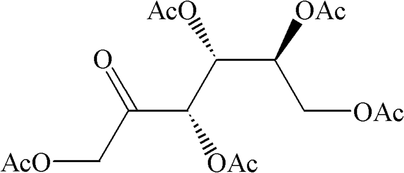
The of the title compound, C16H22O11, was determined. The compound crystallizes in the monoclinic space group P21, with one molecule in the asymmetric unit. Unlike unmodified L-sorbose, which adopts an α-L-sorbopyranose form and forms an extensive three-dimensional O—H⋯O hydrogen-bonding network in the crystal, the title compound adopts an acyclic keto form. Acetylation of all five hydroxy groups removes the O—H hydrogen-bond donors; consequently, no conventional intermolecular O—H⋯O hydrogen bonds are present. The crystal packing features intermolecular C—H⋯O contacts involving the acetyl groups.
Keywords: crystal structure; rare sugar; L-sorbose; acetylation; hydrogen bonding.
CCDC reference: 2597480
Structure description
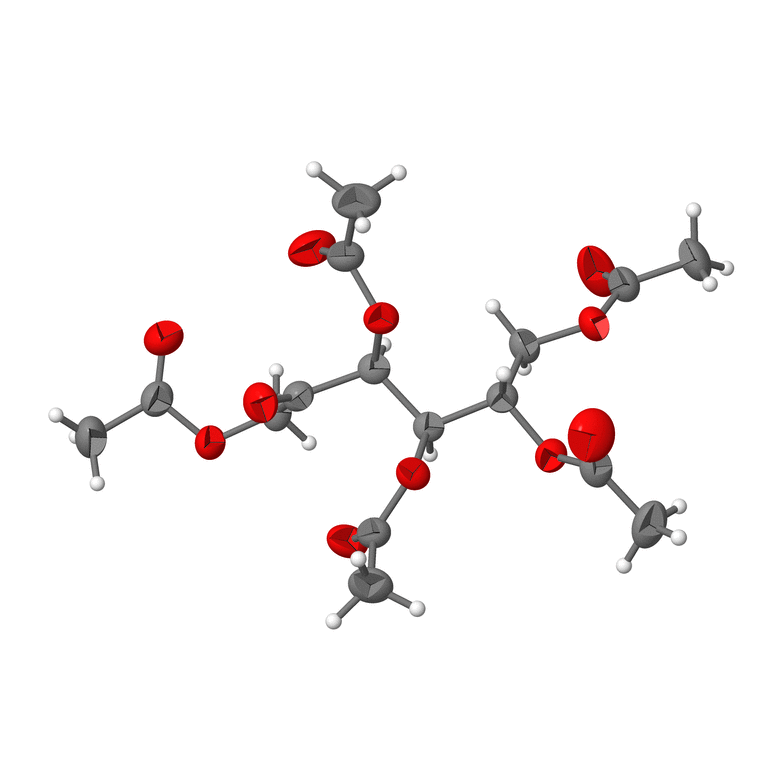
The title compound, C16H22O11, was obtained by acetylation of L-sorbose. The molecular structure is shown in Fig. 1 . The compound crystallizes in the monoclinic space group P21, with one molecule in the asymmetric unit. Unmodified L-sorbose crystallizes as α-L-sorbopyranose (CSD refcode SORBOL01; Nordenson et al., 1979), whereas the title compound adopts an acyclic keto form, as indicated by the C2=O2 bond length of 1.194 (4) Å. In the crystal structure of unmodified L-sorbose, the five hydroxy groups act as hydrogen-bond donors and acceptors, linking the molecules through an extended three-dimensional O—H⋯O hydrogen-bond network. Unmodified L-sorbose crystallizes in the orthorhombic space group P212121, with a reported unit-cell volume of approximately 745 Å3 for Z = 4 (CSD refcode SORBOL01; Nordenson et al., 1979). In the title compound, all five hydroxy groups of L-sorbose are converted into acetate ester groups. Consequently, the molecule has no O—H hydrogen-bond donors, and no conventional O—H⋯O hydrogen bonds are present in the crystal. Selected C—H⋯O contacts are listed in Table 1 and shown as black dashed lines in Fig. 2. The absolute configuration is consistent with that of the L-sorbose starting material and is supported by a Flack parameter of 0.02 (10), determined using 1441 quotients.
|
 ; (ii)
 ; (iii)
 ; (iv)
 .
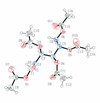 | Figure 1 Molecular structure of the title compound showing the atom-labelling scheme. The carbon atoms of the original L-sorbose skeleton are shown in blue, and the carbon atoms of the acetyl groups in grey. Displacement ellipsoids are drawn at the 50% probability level, and H atoms are shown as small spheres of arbitrary radii. |
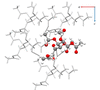 | Figure 2 Crystal-packing diagram of the title compound, viewed along the b axis. Selected intermolecular C—H⋯O contacts are shown as black dashed lines (details in Table 1 ). |
Synthesis and crystallization
L-Sorbose (20.0 g) was suspended in dichloromethane (100 ml) and stirred at room temperature. Acetic anhydride (80 ml) and 4-dimethylaminopyridine (DMAP) were added, and the reaction mixture was stirred for 24 h. The reaction was quenched by the addition of methanol, and the solvents were removed under reduced pressure. The residue was dissolved in ethyl acetate and washed with hydrochloric acid and water to remove DMAP, followed successively by saturated aqueous sodium hydrogen carbonate solution and water. The organic layer was concentrated under reduced pressure to afford the crude product as a syrup.
The crude product was purified by silica-gel column chromatography. The fractions containing the major product were collected and concentrated. Crystallization from an ethyl acetate/hexane solvent system, followed by recrystallization from the same solvent system, afforded colorless block-shaped crystals of the title compound (6.5 g, 15.0% yield based on L-sorbose), suitable for single-crystal X-ray diffraction.
Refinement
Crystal data, data collection and structure details are summarized in Table 2.
|
Structural data
CCDC reference: 2597480
contains datablock I. DOI: https://doi.org/10.1107/S2414314626011703/vm4089sup1.cif
Structure factors: contains datablock I. DOI: https://doi.org/10.1107/S2414314626011703/vm4089Isup2.hkl
Point-by-point response to the co-editors comments for data article vm4089. DOI: https://doi.org/10.1107/S2414314626011703/vm4089sup3.docx
| C16H22O11 | F(000) = 412 |
| Mr = 390.33 | Dx = 1.347 Mg m−3 |
| Monoclinic, P21 | Cu Kα radiation, λ = 1.5418 Å |
| a = 6.1780 (7) Å | Cell parameters from 10151 reflections |
| b = 20.434 (2) Å | θ = 4.3–68.3° |
| c = 7.9015 (8) Å | µ = 1.00 mm−1 |
| β = 105.199 (7)° | T = 296 K |
| V = 962.58 (18) Å3 | Block, clear light colourless |
| Z = 2 | 0.1 × 0.1 × 0.1 mm |
| Rigaku R-AXIS RAPID diffractometer | 3273 reflections with I > 2σ(I) |
| ω scans | Rint = 0.054 |
| Absorption correction: multi-scan (ABSCOR; Rigaku, 1995) | θmax = 68.2°, θmin = 4.3° |
| Tmin = 0.522, Tmax = 1.000 | h = −7→7 |
| 10458 measured reflections | k = −24→24 |
| 3422 independent reflections | l = −9→9 |
| Refinement on F2 | Hydrogen site location: inferred from neighbouring sites |
| Least-squares matrix: full | H-atom parameters constrained |
| R[F2 > 2σ(F2)] = 0.046 | w = 1/[σ2(Fo2) + (0.0693P)2 + 0.0505P] where P = (Fo2 + 2Fc2)/3 |
| wR(F2) = 0.113 | (Δ/σ)max < 0.001 |
| S = 1.10 | Δρmax = 0.24 e Å−3 |
| 3422 reflections | Δρmin = −0.32 e Å−3 |
| 249 parameters | Absolute structure: Flack x determined using 1441 quotients [(I+)-(I-)]/[(I+)+(I-)] (Parsons et al., 2013) |
| 1 restraint | Absolute structure parameter: 0.02 (10) |
| Primary atom site location: dual |
Geometry. All esds (except the esd in the dihedral angle between two l.s. planes) are estimated using the full covariance matrix. The cell esds are taken into account individually in the estimation of esds in distances, angles and torsion angles; correlations between esds in cell parameters are only used when they are defined by crystal symmetry. An approximate (isotropic) treatment of cell esds is used for estimating esds involving l.s. planes. |
Refinement. All H atoms were placed in geometrically calculated positions and refined using a riding model, with C—H distances of 0.96–0.98 Å. Their isotropic displacement parameters were set at Uiso(H) = 1.2Ueq(C) for methine and methylene H atoms and 1.5Ueq(C) for methyl H atoms. Methyl groups were allowed to rotate about their C—C bonds. The absolute structure was determined using 1441 quotients of the form [(I+) - (I–)]/[(I+) + (I–)], giving a Flack parameter of 0.02 (10) (Parsons et al., 2013). |
| x | y | z | Uiso*/Ueq | ||
| O1 | 1.1314 (4) | 0.61300 (11) | 0.3088 (3) | 0.0492 (5) | |
| O2 | 0.7378 (4) | 0.62487 (11) | 0.4003 (3) | 0.0503 (5) | |
| O3 | 0.6634 (4) | 0.56616 (10) | 0.6939 (3) | 0.0426 (5) | |
| O4 | 0.4932 (3) | 0.48793 (11) | 0.3710 (2) | 0.0390 (4) | |
| O5 | 0.5064 (3) | 0.37254 (9) | 0.5541 (3) | 0.0404 (5) | |
| O6 | 0.6531 (4) | 0.37666 (11) | 0.9092 (3) | 0.0475 (5) | |
| O7 | 1.2431 (5) | 0.69183 (14) | 0.5087 (3) | 0.0678 (7) | |
| O8 | 0.9614 (5) | 0.62743 (16) | 0.8212 (4) | 0.0728 (8) | |
| O9 | 0.7110 (4) | 0.48931 (15) | 0.1837 (3) | 0.0577 (6) | |
| O10 | 0.1614 (4) | 0.39293 (17) | 0.5829 (4) | 0.0745 (8) | |
| O11 | 0.9864 (6) | 0.3561 (2) | 1.0954 (4) | 0.0857 (10) | |
| C1 | 1.0909 (5) | 0.57142 (16) | 0.4421 (4) | 0.0463 (7) | |
| H1A | 1.204134 | 0.579410 | 0.550999 | 0.056* | |
| H1B | 1.103443 | 0.526106 | 0.409333 | 0.056* | |
| C2 | 0.8636 (5) | 0.58266 (14) | 0.4701 (4) | 0.0382 (6) | |
| C3 | 0.8045 (5) | 0.53460 (14) | 0.6011 (4) | 0.0369 (6) | |
| H3 | 0.943816 | 0.521460 | 0.686033 | 0.044* | |
| C4 | 0.6851 (5) | 0.47292 (13) | 0.5143 (3) | 0.0344 (6) | |
| H4 | 0.790640 | 0.446029 | 0.471078 | 0.041* | |
| C5 | 0.5902 (5) | 0.43266 (14) | 0.6410 (4) | 0.0369 (6) | |
| H5 | 0.468004 | 0.456706 | 0.670845 | 0.044* | |
| C6 | 0.7665 (6) | 0.41474 (17) | 0.8062 (4) | 0.0449 (7) | |
| H6A | 0.885523 | 0.389430 | 0.778394 | 0.054* | |
| H6B | 0.831168 | 0.453810 | 0.869289 | 0.054* | |
| C7 | 1.2058 (6) | 0.67348 (16) | 0.3604 (5) | 0.0502 (8) | |
| C8 | 1.2355 (9) | 0.7120 (2) | 0.2084 (6) | 0.0781 (14) | |
| H8A | 1.391260 | 0.712445 | 0.209468 | 0.117* | |
| H8B | 1.184981 | 0.756077 | 0.216245 | 0.117* | |
| H8C | 1.149530 | 0.692442 | 0.101426 | 0.117* | |
| C9 | 0.7682 (6) | 0.61372 (17) | 0.8059 (4) | 0.0496 (7) | |
| C10 | 0.6165 (9) | 0.6434 (2) | 0.9033 (6) | 0.0716 (11) | |
| H10A | 0.465041 | 0.642506 | 0.831137 | 0.107* | |
| H10B | 0.660841 | 0.687839 | 0.932870 | 0.107* | |
| H10C | 0.625932 | 0.618896 | 1.008680 | 0.107* | |
| C11 | 0.5274 (5) | 0.49127 (16) | 0.2087 (4) | 0.0440 (7) | |
| C12 | 0.3111 (6) | 0.4964 (2) | 0.0716 (4) | 0.0609 (9) | |
| H12A | 0.235497 | 0.454908 | 0.059101 | 0.091* | |
| H12B | 0.339506 | 0.508457 | −0.038020 | 0.091* | |
| H12C | 0.218697 | 0.529035 | 0.105211 | 0.091* | |
| C13 | 0.2902 (5) | 0.35653 (17) | 0.5416 (4) | 0.0475 (7) | |
| C14 | 0.2420 (7) | 0.2890 (2) | 0.4686 (6) | 0.0687 (11) | |
| H14A | 0.284440 | 0.285803 | 0.360406 | 0.103* | |
| H14B | 0.084588 | 0.280055 | 0.447516 | 0.103* | |
| H14C | 0.325876 | 0.257838 | 0.550988 | 0.103* | |
| C15 | 0.7878 (7) | 0.35047 (17) | 1.0555 (5) | 0.0545 (8) | |
| C16 | 0.6523 (10) | 0.3151 (2) | 1.1598 (6) | 0.0775 (13) | |
| H16A | 0.654682 | 0.339533 | 1.263955 | 0.116* | |
| H16B | 0.715418 | 0.272468 | 1.191641 | 0.116* | |
| H16C | 0.500265 | 0.310598 | 1.090212 | 0.116* |
| U11 | U22 | U33 | U12 | U13 | U23 | |
| O1 | 0.0562 (13) | 0.0454 (12) | 0.0503 (11) | −0.0113 (10) | 0.0216 (10) | −0.0018 (9) |
| O2 | 0.0520 (13) | 0.0427 (12) | 0.0554 (12) | 0.0105 (10) | 0.0128 (10) | 0.0109 (9) |
| O3 | 0.0444 (11) | 0.0434 (11) | 0.0418 (11) | 0.0004 (9) | 0.0148 (9) | −0.0057 (8) |
| O4 | 0.0354 (10) | 0.0443 (11) | 0.0364 (9) | 0.0025 (8) | 0.0079 (8) | 0.0021 (8) |
| O5 | 0.0373 (10) | 0.0383 (11) | 0.0460 (10) | −0.0019 (8) | 0.0120 (8) | −0.0012 (8) |
| O6 | 0.0561 (13) | 0.0481 (12) | 0.0402 (10) | −0.0062 (10) | 0.0156 (9) | 0.0068 (9) |
| O7 | 0.086 (2) | 0.0589 (16) | 0.0601 (16) | −0.0127 (14) | 0.0210 (14) | −0.0134 (12) |
| O8 | 0.0650 (18) | 0.080 (2) | 0.0706 (17) | −0.0182 (15) | 0.0129 (14) | −0.0279 (15) |
| O9 | 0.0595 (14) | 0.0738 (16) | 0.0443 (11) | −0.0043 (13) | 0.0213 (10) | −0.0069 (12) |
| O10 | 0.0398 (14) | 0.084 (2) | 0.103 (2) | 0.0011 (14) | 0.0248 (14) | 0.0035 (17) |
| O11 | 0.071 (2) | 0.104 (2) | 0.0721 (18) | −0.0015 (18) | 0.0026 (15) | 0.0419 (17) |
| C1 | 0.0419 (16) | 0.0419 (16) | 0.0564 (18) | −0.0011 (13) | 0.0150 (14) | 0.0063 (13) |
| C2 | 0.0397 (15) | 0.0349 (14) | 0.0384 (14) | −0.0012 (11) | 0.0070 (11) | −0.0021 (11) |
| C3 | 0.0343 (13) | 0.0377 (14) | 0.0374 (14) | 0.0053 (11) | 0.0072 (11) | 0.0006 (11) |
| C4 | 0.0317 (13) | 0.0356 (14) | 0.0344 (13) | 0.0040 (10) | 0.0062 (10) | 0.0013 (10) |
| C5 | 0.0359 (14) | 0.0371 (14) | 0.0384 (13) | 0.0016 (11) | 0.0111 (11) | −0.0010 (10) |
| C6 | 0.0440 (17) | 0.0497 (17) | 0.0406 (15) | −0.0046 (13) | 0.0103 (12) | 0.0082 (12) |
| C7 | 0.0500 (18) | 0.0451 (17) | 0.0561 (19) | −0.0076 (14) | 0.0152 (15) | −0.0022 (14) |
| C8 | 0.102 (4) | 0.065 (3) | 0.065 (2) | −0.033 (2) | 0.017 (2) | 0.009 (2) |
| C9 | 0.061 (2) | 0.0471 (17) | 0.0392 (15) | −0.0004 (15) | 0.0101 (13) | −0.0054 (12) |
| C10 | 0.096 (3) | 0.066 (2) | 0.058 (2) | 0.010 (2) | 0.027 (2) | −0.0168 (18) |
| C11 | 0.0535 (18) | 0.0396 (15) | 0.0381 (14) | −0.0017 (14) | 0.0107 (12) | −0.0037 (12) |
| C12 | 0.061 (2) | 0.072 (2) | 0.0401 (16) | 0.0010 (19) | −0.0038 (14) | 0.0003 (16) |
| C13 | 0.0368 (15) | 0.0527 (18) | 0.0481 (16) | −0.0043 (14) | 0.0026 (12) | 0.0132 (14) |
| C14 | 0.060 (2) | 0.053 (2) | 0.080 (3) | −0.0185 (18) | −0.003 (2) | 0.0095 (19) |
| C15 | 0.073 (2) | 0.0473 (19) | 0.0441 (16) | −0.0028 (17) | 0.0160 (16) | 0.0079 (14) |
| C16 | 0.113 (4) | 0.069 (3) | 0.057 (2) | −0.015 (3) | 0.033 (2) | 0.019 (2) |
| O1—C1 | 1.426 (4) | C5—H5 | 0.9800 |
| O1—C7 | 1.344 (4) | C5—C6 | 1.510 (4) |
| O2—C2 | 1.194 (4) | C6—H6A | 0.9700 |
| O3—C3 | 1.432 (3) | C6—H6B | 0.9700 |
| O3—C9 | 1.359 (4) | C7—C8 | 1.487 (5) |
| O4—C4 | 1.441 (3) | C8—H8A | 0.9600 |
| O4—C11 | 1.355 (3) | C8—H8B | 0.9600 |
| O5—C5 | 1.436 (3) | C8—H8C | 0.9600 |
| O5—C13 | 1.353 (4) | C9—C10 | 1.488 (5) |
| O6—C6 | 1.435 (4) | C10—H10A | 0.9600 |
| O6—C15 | 1.345 (4) | C10—H10B | 0.9600 |
| O7—C7 | 1.194 (4) | C10—H10C | 0.9600 |
| O8—C9 | 1.201 (5) | C11—C12 | 1.487 (5) |
| O9—C11 | 1.202 (4) | C12—H12A | 0.9600 |
| O10—C13 | 1.195 (5) | C12—H12B | 0.9600 |
| O11—C15 | 1.189 (5) | C12—H12C | 0.9600 |
| C1—H1A | 0.9700 | C13—C14 | 1.495 (5) |
| C1—H1B | 0.9700 | C14—H14A | 0.9600 |
| C1—C2 | 1.496 (4) | C14—H14B | 0.9600 |
| C2—C3 | 1.538 (4) | C14—H14C | 0.9600 |
| C3—H3 | 0.9800 | C15—C16 | 1.505 (5) |
| C3—C4 | 1.529 (4) | C16—H16A | 0.9600 |
| C4—H4 | 0.9800 | C16—H16B | 0.9600 |
| C4—C5 | 1.527 (4) | C16—H16C | 0.9600 |
| C7—O1—C1 | 115.8 (3) | C7—C8—H8B | 109.5 |
| C9—O3—C3 | 114.0 (2) | C7—C8—H8C | 109.5 |
| C11—O4—C4 | 117.0 (2) | H8A—C8—H8B | 109.5 |
| C13—O5—C5 | 117.8 (2) | H8A—C8—H8C | 109.5 |
| C15—O6—C6 | 114.8 (3) | H8B—C8—H8C | 109.5 |
| O1—C1—H1A | 109.3 | O3—C9—C10 | 111.8 (3) |
| O1—C1—H1B | 109.3 | O8—C9—O3 | 121.6 (3) |
| O1—C1—C2 | 111.8 (3) | O8—C9—C10 | 126.6 (3) |
| H1A—C1—H1B | 107.9 | C9—C10—H10A | 109.5 |
| C2—C1—H1A | 109.3 | C9—C10—H10B | 109.5 |
| C2—C1—H1B | 109.3 | C9—C10—H10C | 109.5 |
| O2—C2—C1 | 124.4 (3) | H10A—C10—H10B | 109.5 |
| O2—C2—C3 | 122.1 (3) | H10A—C10—H10C | 109.5 |
| C1—C2—C3 | 113.5 (2) | H10B—C10—H10C | 109.5 |
| O3—C3—C2 | 109.9 (2) | O4—C11—C12 | 111.1 (3) |
| O3—C3—H3 | 108.4 | O9—C11—O4 | 122.8 (3) |
| O3—C3—C4 | 108.3 (2) | O9—C11—C12 | 126.1 (3) |
| C2—C3—H3 | 108.4 | C11—C12—H12A | 109.5 |
| C4—C3—C2 | 113.3 (2) | C11—C12—H12B | 109.5 |
| C4—C3—H3 | 108.4 | C11—C12—H12C | 109.5 |
| O4—C4—C3 | 112.2 (2) | H12A—C12—H12B | 109.5 |
| O4—C4—H4 | 109.3 | H12A—C12—H12C | 109.5 |
| O4—C4—C5 | 104.6 (2) | H12B—C12—H12C | 109.5 |
| C3—C4—H4 | 109.3 | O5—C13—C14 | 110.1 (3) |
| C5—C4—C3 | 111.9 (2) | O10—C13—O5 | 123.0 (3) |
| C5—C4—H4 | 109.3 | O10—C13—C14 | 126.9 (3) |
| O5—C5—C4 | 107.4 (2) | C13—C14—H14A | 109.5 |
| O5—C5—H5 | 109.9 | C13—C14—H14B | 109.5 |
| O5—C5—C6 | 107.1 (2) | C13—C14—H14C | 109.5 |
| C4—C5—H5 | 109.9 | H14A—C14—H14B | 109.5 |
| C6—C5—C4 | 112.6 (2) | H14A—C14—H14C | 109.5 |
| C6—C5—H5 | 109.9 | H14B—C14—H14C | 109.5 |
| O6—C6—C5 | 105.9 (2) | O6—C15—C16 | 110.7 (4) |
| O6—C6—H6A | 110.6 | O11—C15—O6 | 123.5 (3) |
| O6—C6—H6B | 110.6 | O11—C15—C16 | 125.8 (4) |
| C5—C6—H6A | 110.6 | C15—C16—H16A | 109.5 |
| C5—C6—H6B | 110.6 | C15—C16—H16B | 109.5 |
| H6A—C6—H6B | 108.7 | C15—C16—H16C | 109.5 |
| O1—C7—C8 | 110.3 (3) | H16A—C16—H16B | 109.5 |
| O7—C7—O1 | 123.3 (3) | H16A—C16—H16C | 109.5 |
| O7—C7—C8 | 126.4 (3) | H16B—C16—H16C | 109.5 |
| C7—C8—H8A | 109.5 | ||
| O1—C1—C2—O2 | −5.8 (4) | C3—C4—C5—O5 | −173.2 (2) |
| O1—C1—C2—C3 | 174.8 (3) | C3—C4—C5—C6 | −55.5 (3) |
| O2—C2—C3—O3 | −31.4 (4) | C4—O4—C11—O9 | −8.2 (5) |
| O2—C2—C3—C4 | 89.9 (3) | C4—O4—C11—C12 | 170.9 (3) |
| O3—C3—C4—O4 | 70.2 (3) | C4—C5—C6—O6 | −179.2 (2) |
| O3—C3—C4—C5 | −47.0 (3) | C5—O5—C13—O10 | 7.9 (4) |
| O4—C4—C5—O5 | 65.1 (3) | C5—O5—C13—C14 | −172.7 (3) |
| O4—C4—C5—C6 | −177.2 (2) | C6—O6—C15—O11 | −2.4 (5) |
| O5—C5—C6—O6 | −61.3 (3) | C6—O6—C15—C16 | 176.5 (3) |
| C1—O1—C7—O7 | 2.1 (5) | C7—O1—C1—C2 | 83.9 (3) |
| C1—O1—C7—C8 | −178.6 (3) | C9—O3—C3—C2 | −68.6 (3) |
| C1—C2—C3—O3 | 147.9 (2) | C9—O3—C3—C4 | 167.1 (2) |
| C1—C2—C3—C4 | −90.7 (3) | C11—O4—C4—C3 | 92.4 (3) |
| C2—C3—C4—O4 | −52.1 (3) | C11—O4—C4—C5 | −146.1 (2) |
| C2—C3—C4—C5 | −169.3 (2) | C13—O5—C5—C4 | −125.0 (2) |
| C3—O3—C9—O8 | 0.8 (4) | C13—O5—C5—C6 | 113.9 (3) |
| C3—O3—C9—C10 | −178.1 (3) | C15—O6—C6—C5 | 173.8 (3) |
| D—H···A | D—H | H···A | D···A | D—H···A |
| C4—H4···O10i | 0.98 | 2.48 | 3.285 (4) | 139 |
| C6—H6A···O10i | 0.97 | 2.58 | 3.394 (4) | 141 |
| C8—H8C···O8ii | 0.96 | 2.58 | 3.536 (5) | 172 |
| C12—H12A···O11iii | 0.96 | 2.60 | 3.531 (6) | 164 |
| C12—H12C···O1iv | 0.96 | 2.51 | 3.393 (5) | 154 |
| Symmetry codes: (i) x+1, y, z; (ii) x, y, z−1; (iii) x−1, y, z−1; (iv) x−1, y, z. |
Acknowledgements
The authors are grateful to Professor Genta Sakane (Okayama University of Science) for helpful discussions and advice, and to Associate Professor Yoji Horii (Kagawa University) for assistance with the single-crystal X-ray diffraction measurements.
Funding information
This work was supported by the JST Support for Pioneering Research Initiated by the Next Generation (SPRING) program.
References
 Dolomanov, O. V., Bourhis, L. J., Gildea, R. J., Howard, J. A. K. & Puschmann, H. (2009). J. Appl. Cryst. 42, 339–341. Web of Science CrossRef CAS IUCr Journals Google Scholar
Nordenson, S., Takagi, S. & Jeffrey, G. A. (1979). Acta Cryst. B35, 1005–1007. CSD CrossRef CAS IUCr Journals Web of Science Google Scholar
Parsons, S., Flack, H. D. & Wagner, T. (2013). Acta Cryst. B69, 249–259. Web of Science CSD CrossRef CAS IUCr Journals Google Scholar
Rigaku (1995). ABSCOR. Rigaku Corporation, Tokyo, Japan. Google Scholar
Rigaku (2009). RAPID-AUTO. Rigaku Corporation, Tokyo, Japan. Google Scholar
Sheldrick, G. M. (2015a). Acta Cryst. A71, 3–8. Web of Science CrossRef IUCr Journals Google Scholar
Sheldrick, G. M. (2015b). Acta Cryst. C71, 3–8. Web of Science CrossRef IUCr Journals Google Scholar
This is an open-access article distributed under the terms of the Creative Commons Attribution (CC-BY) Licence, which permits unrestricted use, distribution, and reproduction in any medium, provided the original authors and source are cited.
| IUCrDATA |