

 menu


organic compounds
 | IUCrDATA |
 access
N,N-Diethyl-4-glutaratotryptamine

aUniversity of Massachusetts Dartmouth, 285 Old Westport Road, North Dartmouth, MA 02747, USA, and bCaaMTech, Inc., 58 Sunset Way, Suite 209, Issaquah, WA 98027, USA
*Correspondence e-mail: [email protected]
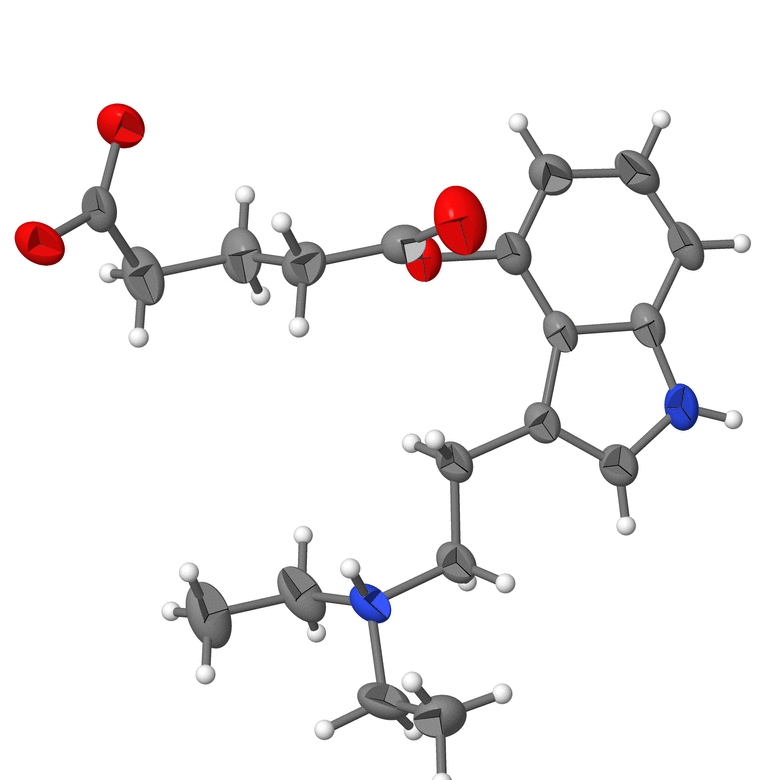
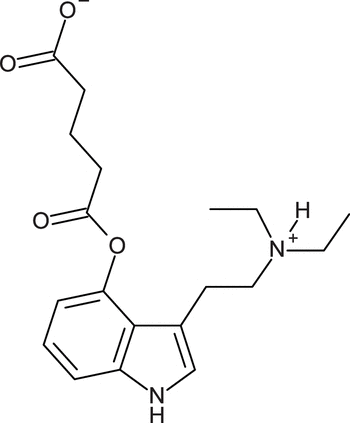
The synthesis and structure of the title compound, C19H26N2O4 [systematic name: 5-({3-[2-(diethylazaniumyl)ethyl]-1H-indol-4-yl}oxy)-5-oxopentanoate], are reported. The title compound exists as a zwitterion in the solid state with a protonated tertiary ammonium group and a deprotonated glutarato carboxylate group. In the extended structure, the tryptamine zwitterions dimerize through pairwise N—H⋯O hydrogen bonds, and additional N—H⋯O hydrogen bonds join these dimers together in an infinite two-dimensional network lying parallel to the (102) plane.
Keywords: crystal structure; tryptamines; indoles; hydrogen bonding.
CCDC reference: 2602626
Structure description
Serotonergic pharmacology and potential therapeutic applications have stimulated renewed interest in 4-hydroxytryptamines and their prodrugs, most notably the natural products psilocin (4-hydroxy-N,N-dimethyltryptamine) and psilocybin (4-phosphoryloxy-N,N-dimethyltryptamine). Esterification of the 4-hydroxy group provides a route to synthetic prodrugs that release their active metabolite following hydrolysis, as demonstrated by the conversion of psilacetin (4-acetoxy-N,N-dimethyltryptamine) to psilocin in vivo (Jones et al., 2024 ; Pego et al., 2025). Other psilocin esters have been examined for the varied chemical stability and metabolic properties (Eklund et al., 2025). The 4-glutarato substituent is of particular interest because it combines a cleavable ester linkage with a terminal carboxylic acid group. Together with the basic tertiary amine, this functionality permits zwitterion formation and introduces additional hydrogen bonding interactions. These features raise questions concerning protonation state, crystal packing and solvation, and their impact on aqueous solubility, dissolution and chemical stability. Consequently, characterization of the molecular structure and crystalline form is important for establishing the composition and molecular formula of the isolated material and for calculating molar concentrations in subsequent physicochemical and biological investigations.
We have previously reported the solid-state structures of more than a dozen ester prodrugs of 4-hydroxytryptamines (see below). Our investigations of 4-glutarato-N,N-diisopropyltryptamine provided the first crystal structures of this compound, identifying its methanol and ethanol monosolvates (Naeem, Bauer et al., 2022). Both structures established a zwitterionic molecule, with a protonated amine and deprotonated terminal carboxylate group, and demonstrated stoichiometric incorporation of alcohol within the extended structure. Subsequent single-crystal characterization identified a 2-propanol monosolvate (Bryson & Nap, 2026), showing that there are multiple distinct solvent-containing crystalline forms of this prodrug.
The pharmacological relevance of the 4-glutarato group is illustrated by Reunion Neuroscience's clinical drug candidate, RE104, a prodrug of 4-hydroxy-N,N-diisopropyltryptamine. Conversion to the parent hydroxy compound was demonstrated in preclinical investigations (Bryson et al., 2024), followed by clinical investigation of its pharmacokinetics and psychoactive effects in healthy volunteers (Ludbrook et al., 2025). The preclinical report also describes solvent retention during preparation and uses both hydrochloride and zwitterionic terminology for the material. These observations highlight the importance of establishing the chemical form and solvent content of the isolated solid. We previously noted that solvate formation could contribute to the reported purification difficulties (Naeem et al., 2025), although residual solvent alone does not establish crystalline solvate. Determining protonation state, counter-ion content and solvation is therefore important when assigning molecular formulae and interpreting concentration-dependent biological measurements.
Recently, we reported the crystal structures of 4-hydroxy-N,N-diethylammonium hydrofumarate and the corresponding 4-acetoxy prodrug as its fumarate-fumaric acid salt/adduct (Naeem et al., 2026). Herein, we extend these investigations to N,N-diethyl-4-glutaratotryptamine, C19H26N2O4 (I), a putative prodrug of 4-hydroxy-N,N-diethyltryptamine. The title compound crystallizes as an unsolvated zwitterion, allowing for comparison with the alcohol-solvated N,N-diisopropyl analogue.
Compound (I) exists in the solid-state as a zwitterion, with a protonated tertiary ammonium group and a deprotonated carboxylate anion on the glutarato group. The asymmetric unit contains a single zwitterionic molecule (Fig. 1). The C1–C8/N1 indole unit is near planar with an r.m.s. deviation from planarity of 0.012 Å. The glutarato unit is turned nearly perpendicular to the indole plane demonstrated by a C7—C6—O1—C15 torsion angle of 95.37 (16)°. By contrast, the ethylamino arm is almost in plane with the indole ring system as demonstrated by a C7—C8—C9—C10 torsion angle of 177.58 (13)°. The ethylamino arm demonstrates an anti conformation with a C8—C9—C10—N2 torsion angle of 172.46 (10)°.
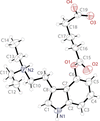 | Figure 1 The molecular structure of (I) showing displacement ellipsoids drawn at the 50% probability level. |
In the extended structure of (I), there are pairwise N2—H2⋯O4 bonds (Table 1) between the diethyltryptammonium cation and the carboxylate anion of another zwitterionic molecule. These interactions form centrosymmetric dimers (Fig. 2), which form rings with graph-set notation of R22(28) (Etter et al., 1990). The dimers are joined together through N1—H1⋯O3 hydrogen bonds between the indole nitrogen atom and a carboxylate oxygen atom of another molecule. These interactions combine to form a two-dimensional network lying in the (10 ) plane. The packing diagram of (I) is shown in Fig. 3.
| ||||||||||||||||||||||
 ; (ii)
 .
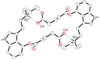 | Figure 2 The ring formed by the dimerization of two zwitterionic molecules of (I) with graph set notation R22(28). Hydrogen bonds are shown as dashed lines. H atoms not involved in hydrogen bonding are omitted for clarity. Symmetry code: (i) 2 − x, 1 − y, 1 − z. |
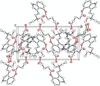 | Figure 3 The packing of (I) viewed along the c-axis direction. Hydrogen bonds are shown as dashed lines. H atoms not involved in hydrogen bonding are omitted for clarity. |
The literature structures most closely related to (I) are the ethanol and methanol solvates of 4-glutarato-N,N-diisopropyltryptamine (Naeem, Bauer et al., 2022; Cambridge Structural Database refcodes TEKWOZ, TEKWUF). There are three structures reported in the literature that posses N,N-diethyltryptamine cores, which are 4-phosphoryloxy-N,N-diethyltryptamine (Baker et al., 1973; KOWHOT) as well as 4-hydroxy-N,N-diethyltrpytamine as its hydrofumarate salt and 4-acetoxy-N,N-diethyltryptamine as its fumarate salt with a fumaric acid adduct (Naeem et al., 2026). Beyond the structures of 4-glutarato-N,N-diisopropyltryptamine, there are eleven structures of 4-substituted esters of tryptamines. Ten of these esters are 4-acetoxy derivatives that include psilacetin, 4-acetoxy-N,N-dimethyltryptamine, as its hydrofumarate (Chadeayne et al., 2019a: HOCJUH) and fumarate (Chadeayne et al., 2019b: XOFDOO) salts, 4-acetoxy-N-methyl-N-ethyltryptamine as its hydrofumarate salt, 4-acetoxy-N-methyl-N-allyltryptamine as its hydrofumarate salt, 4-acetoxy-N,N-diallyltryptamine as its fumarate/fumaric acid (Pham et al., 2021: OJIQIK, OJIQOQ, OJIQUW), 4-acetoxy-N,N,N-timethyltryptammonium iodide (Chadeayne, Pham, Reid et al., 2020: XUXDUS), 4-acetoxy-N-ethyl-N,N-dimethyltryptammonium iodide, 4-acetoxy-N-propyl-N,N-dimethyltryptammonium iodide, 4-acetoxy-N-isopropyl-N,N-dimethyltryptammonium iodide (Glatfelter, Pham et al., 2022: EDOZEG, EDOYOP, EDZAC), and 4-acetoxy-N-methyltryptamine as its chloride salt (Glatfelter, Pottie et al., 2022). There is also one reported 4-propionoxy tryptamine ester, which is the hydrofumarate salt of 4-propionoxy-N,N-dimethyltryptamine (Glatfelter et al., 2023). There are five zwitterionic tryptamine structures reported, which are the two aforementioned 4-glutarato-N,N-diisopropyltryptamine structures, the aforementioned 4-phosphoryloxy-N,N-diethyltryptamine structure, and two natural products, which are baeocystin, 4-phosphoryloxy-N-methyltryptamine (Naeem, Chadeayne et al., 2022; FEJBAB) and psilocybin, 4-phosphoryloxy-N,N-dimethyltryptamine (Weber & Petcher, 1974; PSILOC; Sherwood et al., 2022; TAVZID, TAVZID01).
Synthesis and crystallization
70 mg (1.0 mmol) of 4-hydroxy-N,N-diethyltryptamine were dissolved in 5 ml of chloroform and 0.20 ml of triethylamine. 343 mg (10.0 mmol) of glutaric anhydride was added to the mixture and it was stirred at room temperature for 12 h. The resulting precipitate was isolated via filtration and washed with chloroform (5 ml) to yield the title compound as a white powder (35 mg, 50% yield). 1H NMR (400 MHz, DMSO-d6): δ 11.04 (br s, 1H, NH), 8.31 (s, 1H, NH), 7.22 (d, J = 8.1 Hz, 1H, ArH), 7.15 (d, J = 2.3 Hz, 1H, ArH), 7.03 (t, J = 7.9 Hz, 1H, ArH), 6.65 (d, J = 7.6 Hz, 1H, ArH), 2.85–2.67 (m, 6H, CH2), 2.63 (q, J = 7.1 Hz, 4H, CH2), 2.30 (t, J = 7.1 Hz, 2H, CH2), 1.87 (p, J = 7.2 Hz, 2H, CH2), 1.01 (t, J = 7.1 Hz, 6H, CH3).
The product was recrystallized by being dissolved in a boiling methanol/ethyl acetate solution and cooled to yield colourless blocks of (I) suitable for X-ray analysis.
Refinement
Crystal data, data collection and structure details are summarized in Table 2.
|
Structural data
CCDC reference: 2602626
contains datablock I. DOI: https://doi.org/10.1107/S2414314626011843/hb4583sup1.cif
Structure factors: contains datablock I. DOI: https://doi.org/10.1107/S2414314626011843/hb4583Isup2.hkl
| C19H26N2O4 | F(000) = 744 |
| Mr = 346.42 | Dx = 1.245 Mg m−3 |
| Monoclinic, P21/c | Mo Kα radiation, λ = 0.71073 Å |
| a = 10.2324 (5) Å | Cell parameters from 9975 reflections |
| b = 18.8638 (11) Å | θ = 2.9–26.3° |
| c = 9.7347 (5) Å | µ = 0.09 mm−1 |
| β = 100.419 (2)° | T = 300 K |
| V = 1848.03 (17) Å3 | Block, colourless |
| Z = 4 | 0.35 × 0.30 × 0.25 mm |
| Bruker D8 Venture CMOS diffractometer | 3199 reflections with I > 2σ(I) |
| φ and ω scans | Rint = 0.061 |
| Absorption correction: multi-scan (SADABS; Krause et al., 2015) | θmax = 26.4°, θmin = 3.0° |
| Tmin = 0.589, Tmax = 0.745 | h = −12→11 |
| 49940 measured reflections | k = −23→23 |
| 3790 independent reflections | l = −12→12 |
| Refinement on F2 | Primary atom site location: dual |
| Least-squares matrix: full | Hydrogen site location: mixed |
| R[F2 > 2σ(F2)] = 0.044 | H atoms treated by a mixture of independent and constrained refinement |
| wR(F2) = 0.128 | w = 1/[σ2(Fo2) + (0.0585P)2 + 0.5947P] where P = (Fo2 + 2Fc2)/3 |
| S = 1.06 | (Δ/σ)max < 0.001 |
| 3790 reflections | Δρmax = 0.21 e Å−3 |
| 236 parameters | Δρmin = −0.22 e Å−3 |
| 2 restraints |
Geometry. All esds (except the esd in the dihedral angle between two l.s. planes) are estimated using the full covariance matrix. The cell esds are taken into account individually in the estimation of esds in distances, angles and torsion angles; correlations between esds in cell parameters are only used when they are defined by crystal symmetry. An approximate (isotropic) treatment of cell esds is used for estimating esds involving l.s. planes. |
Refinement. Atoms H1 and H2 were found in a difference-Fourier map and were refined isotropically, using DFIX restraints with the N—H(indole) distance set at 0.87 (1) Å and the N—H(ammonium) distance set at 0.98 (1) Å. Isotropic displacement parameters were set to 1.2Ueq of the parent nitrogen atoms. All other H atoms were placed in calculated positions and refined as riding atoms. |
| x | y | z | Uiso*/Ueq | ||
| O1 | 0.54565 (10) | 0.46267 (6) | 0.28973 (11) | 0.0425 (3) | |
| O2 | 0.67174 (14) | 0.41993 (8) | 0.14419 (15) | 0.0711 (4) | |
| O3 | 0.89104 (10) | 0.65738 (6) | 0.27311 (12) | 0.0487 (3) | |
| O4 | 1.06473 (10) | 0.63014 (6) | 0.43491 (11) | 0.0467 (3) | |
| N1 | 0.32512 (13) | 0.24916 (8) | 0.31528 (15) | 0.0474 (3) | |
| N2 | 0.78065 (12) | 0.32285 (7) | 0.73441 (12) | 0.0391 (3) | |
| C1 | 0.42928 (15) | 0.25527 (9) | 0.42540 (16) | 0.0444 (4) | |
| H1A | 0.452589 | 0.221239 | 0.494633 | 0.053* | |
| C2 | 0.31990 (14) | 0.30866 (8) | 0.23515 (15) | 0.0388 (3) | |
| C3 | 0.23244 (15) | 0.32722 (9) | 0.11282 (16) | 0.0463 (4) | |
| H3 | 0.162317 | 0.297727 | 0.074895 | 0.056* | |
| C4 | 0.25361 (17) | 0.39032 (10) | 0.05078 (18) | 0.0531 (4) | |
| H4 | 0.197029 | 0.403546 | −0.031035 | 0.064* | |
| C5 | 0.35857 (17) | 0.43558 (9) | 0.10752 (18) | 0.0495 (4) | |
| H5 | 0.371448 | 0.477994 | 0.063105 | 0.059* | |
| C6 | 0.44183 (14) | 0.41694 (8) | 0.22856 (15) | 0.0391 (3) | |
| C7 | 0.42580 (13) | 0.35336 (8) | 0.29642 (14) | 0.0348 (3) | |
| C8 | 0.49397 (13) | 0.31825 (8) | 0.41924 (14) | 0.0366 (3) | |
| C9 | 0.60952 (14) | 0.34755 (9) | 0.52114 (15) | 0.0406 (3) | |
| H9A | 0.584227 | 0.392693 | 0.556232 | 0.049* | |
| H9B | 0.683064 | 0.356003 | 0.472827 | 0.049* | |
| C10 | 0.65480 (14) | 0.29825 (9) | 0.64301 (15) | 0.0429 (4) | |
| H10A | 0.585334 | 0.294801 | 0.698560 | 0.052* | |
| H10B | 0.668764 | 0.251298 | 0.607674 | 0.052* | |
| C11 | 0.84691 (19) | 0.26272 (11) | 0.82148 (17) | 0.0570 (5) | |
| H11A | 0.918146 | 0.281640 | 0.891249 | 0.068* | |
| H11B | 0.782766 | 0.240746 | 0.870265 | 0.068* | |
| C12 | 0.9028 (2) | 0.20718 (10) | 0.7387 (2) | 0.0632 (5) | |
| H12A | 0.950660 | 0.172798 | 0.801112 | 0.095* | |
| H12B | 0.961920 | 0.228930 | 0.685071 | 0.095* | |
| H12C | 0.831651 | 0.184177 | 0.676945 | 0.095* | |
| C13 | 0.75497 (17) | 0.38435 (12) | 0.82325 (19) | 0.0594 (5) | |
| H13A | 0.707550 | 0.367547 | 0.894638 | 0.071* | |
| H13B | 0.698133 | 0.418093 | 0.765534 | 0.071* | |
| C14 | 0.8793 (2) | 0.42165 (13) | 0.8927 (2) | 0.0722 (6) | |
| H14A | 0.856586 | 0.458547 | 0.952097 | 0.108* | |
| H14B | 0.923058 | 0.441941 | 0.822690 | 0.108* | |
| H14C | 0.937544 | 0.388298 | 0.947528 | 0.108* | |
| C15 | 0.66096 (15) | 0.45670 (8) | 0.24087 (16) | 0.0405 (3) | |
| C16 | 0.77034 (15) | 0.49948 (8) | 0.32583 (18) | 0.0452 (4) | |
| H16A | 0.828576 | 0.515787 | 0.264053 | 0.054* | |
| H16B | 0.822016 | 0.468188 | 0.393934 | 0.054* | |
| C17 | 0.72981 (15) | 0.56314 (10) | 0.40273 (19) | 0.0518 (4) | |
| H17A | 0.674152 | 0.547736 | 0.467825 | 0.062* | |
| H17B | 0.678134 | 0.595266 | 0.336330 | 0.062* | |
| C18 | 0.85087 (17) | 0.60217 (12) | 0.48231 (18) | 0.0573 (5) | |
| H18A | 0.820817 | 0.640577 | 0.535115 | 0.069* | |
| H18B | 0.901990 | 0.569724 | 0.548439 | 0.069* | |
| C19 | 0.94092 (13) | 0.63241 (8) | 0.38828 (15) | 0.0367 (3) | |
| H2 | 0.8387 (16) | 0.3389 (10) | 0.6714 (17) | 0.058 (5)* | |
| H1 | 0.2714 (17) | 0.2136 (8) | 0.299 (2) | 0.065 (6)* |
| U11 | U22 | U33 | U12 | U13 | U23 | |
| O1 | 0.0360 (5) | 0.0443 (6) | 0.0467 (6) | −0.0065 (4) | 0.0059 (4) | −0.0071 (5) |
| O2 | 0.0602 (8) | 0.0872 (10) | 0.0700 (9) | −0.0054 (7) | 0.0225 (7) | −0.0285 (8) |
| O3 | 0.0354 (6) | 0.0513 (7) | 0.0541 (7) | 0.0067 (5) | −0.0066 (5) | 0.0048 (5) |
| O4 | 0.0281 (5) | 0.0680 (7) | 0.0411 (6) | −0.0042 (5) | −0.0011 (4) | 0.0096 (5) |
| N1 | 0.0378 (7) | 0.0529 (8) | 0.0489 (8) | −0.0187 (6) | 0.0009 (6) | −0.0045 (6) |
| N2 | 0.0335 (6) | 0.0551 (8) | 0.0271 (6) | −0.0025 (5) | 0.0013 (5) | −0.0006 (5) |
| C1 | 0.0364 (8) | 0.0536 (9) | 0.0417 (8) | −0.0113 (6) | 0.0029 (6) | 0.0020 (7) |
| C2 | 0.0284 (7) | 0.0490 (8) | 0.0381 (7) | −0.0051 (6) | 0.0034 (6) | −0.0105 (6) |
| C3 | 0.0297 (7) | 0.0611 (10) | 0.0437 (8) | −0.0040 (7) | −0.0049 (6) | −0.0146 (7) |
| C4 | 0.0425 (9) | 0.0652 (11) | 0.0443 (9) | 0.0086 (8) | −0.0117 (7) | −0.0058 (8) |
| C5 | 0.0475 (9) | 0.0485 (9) | 0.0482 (9) | 0.0046 (7) | −0.0027 (7) | 0.0019 (7) |
| C6 | 0.0329 (7) | 0.0433 (8) | 0.0393 (7) | −0.0020 (6) | 0.0019 (6) | −0.0069 (6) |
| C7 | 0.0254 (6) | 0.0462 (8) | 0.0315 (7) | −0.0031 (5) | 0.0021 (5) | −0.0079 (6) |
| C8 | 0.0279 (7) | 0.0467 (8) | 0.0345 (7) | −0.0053 (6) | 0.0038 (5) | −0.0034 (6) |
| C9 | 0.0307 (7) | 0.0504 (9) | 0.0378 (7) | −0.0078 (6) | −0.0017 (6) | −0.0002 (6) |
| C10 | 0.0340 (7) | 0.0592 (10) | 0.0341 (7) | −0.0115 (7) | 0.0024 (6) | 0.0018 (7) |
| C11 | 0.0593 (10) | 0.0740 (12) | 0.0336 (8) | −0.0035 (9) | −0.0023 (7) | 0.0155 (8) |
| C12 | 0.0714 (12) | 0.0482 (10) | 0.0630 (11) | 0.0031 (9) | −0.0069 (9) | 0.0146 (9) |
| C13 | 0.0429 (9) | 0.0874 (14) | 0.0456 (9) | 0.0082 (9) | 0.0019 (7) | −0.0237 (9) |
| C14 | 0.0544 (11) | 0.0836 (15) | 0.0748 (13) | 0.0018 (10) | 0.0013 (10) | −0.0361 (11) |
| C15 | 0.0410 (8) | 0.0400 (8) | 0.0412 (8) | 0.0038 (6) | 0.0088 (6) | 0.0054 (6) |
| C16 | 0.0346 (8) | 0.0440 (8) | 0.0566 (9) | −0.0038 (6) | 0.0073 (7) | 0.0058 (7) |
| C17 | 0.0333 (8) | 0.0634 (11) | 0.0602 (10) | −0.0133 (7) | 0.0125 (7) | −0.0126 (8) |
| C18 | 0.0420 (9) | 0.0831 (13) | 0.0487 (9) | −0.0215 (9) | 0.0132 (7) | −0.0172 (9) |
| C19 | 0.0290 (7) | 0.0383 (7) | 0.0410 (8) | −0.0029 (5) | 0.0014 (6) | −0.0090 (6) |
| O1—C6 | 1.4137 (17) | C9—H9B | 0.9700 |
| O1—C15 | 1.3543 (18) | C9—C10 | 1.513 (2) |
| O2—C15 | 1.190 (2) | C10—H10A | 0.9700 |
| O3—C19 | 1.2378 (18) | C10—H10B | 0.9700 |
| O4—C19 | 1.2668 (17) | C11—H11A | 0.9700 |
| N1—C1 | 1.373 (2) | C11—H11B | 0.9700 |
| N1—C2 | 1.362 (2) | C11—C12 | 1.497 (3) |
| N1—H1 | 0.864 (9) | C12—H12A | 0.9600 |
| N2—C10 | 1.5003 (18) | C12—H12B | 0.9600 |
| N2—C11 | 1.502 (2) | C12—H12C | 0.9600 |
| N2—C13 | 1.498 (2) | C13—H13A | 0.9700 |
| N2—H2 | 0.976 (9) | C13—H13B | 0.9700 |
| C1—H1A | 0.9300 | C13—C14 | 1.503 (3) |
| C1—C8 | 1.367 (2) | C14—H14A | 0.9600 |
| C2—C3 | 1.399 (2) | C14—H14B | 0.9600 |
| C2—C7 | 1.4167 (19) | C14—H14C | 0.9600 |
| C3—H3 | 0.9300 | C15—C16 | 1.501 (2) |
| C3—C4 | 1.370 (3) | C16—H16A | 0.9700 |
| C4—H4 | 0.9300 | C16—H16B | 0.9700 |
| C4—C5 | 1.405 (2) | C16—C17 | 1.512 (2) |
| C5—H5 | 0.9300 | C17—H17A | 0.9700 |
| C5—C6 | 1.369 (2) | C17—H17B | 0.9700 |
| C6—C7 | 1.393 (2) | C17—C18 | 1.526 (2) |
| C7—C8 | 1.433 (2) | C18—H18A | 0.9700 |
| C8—C9 | 1.5044 (18) | C18—H18B | 0.9700 |
| C9—H9A | 0.9700 | C18—C19 | 1.522 (2) |
| C15—O1—C6 | 115.94 (11) | N2—C11—H11B | 108.8 |
| C1—N1—H1 | 126.0 (14) | H11A—C11—H11B | 107.7 |
| C2—N1—C1 | 108.82 (12) | C12—C11—N2 | 113.72 (13) |
| C2—N1—H1 | 125.2 (14) | C12—C11—H11A | 108.8 |
| C10—N2—C11 | 110.64 (13) | C12—C11—H11B | 108.8 |
| C10—N2—H2 | 106.2 (11) | C11—C12—H12A | 109.5 |
| C11—N2—H2 | 109.0 (11) | C11—C12—H12B | 109.5 |
| C13—N2—C10 | 111.13 (12) | C11—C12—H12C | 109.5 |
| C13—N2—C11 | 111.55 (13) | H12A—C12—H12B | 109.5 |
| C13—N2—H2 | 108.2 (11) | H12A—C12—H12C | 109.5 |
| N1—C1—H1A | 124.7 | H12B—C12—H12C | 109.5 |
| C8—C1—N1 | 110.63 (14) | N2—C13—H13A | 108.9 |
| C8—C1—H1A | 124.7 | N2—C13—H13B | 108.9 |
| N1—C2—C3 | 130.29 (14) | N2—C13—C14 | 113.55 (14) |
| N1—C2—C7 | 107.54 (13) | H13A—C13—H13B | 107.7 |
| C3—C2—C7 | 122.17 (15) | C14—C13—H13A | 108.9 |
| C2—C3—H3 | 121.1 | C14—C13—H13B | 108.9 |
| C4—C3—C2 | 117.72 (14) | C13—C14—H14A | 109.5 |
| C4—C3—H3 | 121.1 | C13—C14—H14B | 109.5 |
| C3—C4—H4 | 119.1 | C13—C14—H14C | 109.5 |
| C3—C4—C5 | 121.70 (15) | H14A—C14—H14B | 109.5 |
| C5—C4—H4 | 119.1 | H14A—C14—H14C | 109.5 |
| C4—C5—H5 | 120.2 | H14B—C14—H14C | 109.5 |
| C6—C5—C4 | 119.66 (16) | O1—C15—C16 | 111.84 (13) |
| C6—C5—H5 | 120.2 | O2—C15—O1 | 122.50 (15) |
| C5—C6—O1 | 120.60 (14) | O2—C15—C16 | 125.63 (15) |
| C5—C6—C7 | 121.39 (14) | C15—C16—H16A | 108.0 |
| C7—C6—O1 | 118.00 (12) | C15—C16—H16B | 108.0 |
| C2—C7—C8 | 107.22 (13) | C15—C16—C17 | 117.11 (13) |
| C6—C7—C2 | 117.35 (13) | H16A—C16—H16B | 107.3 |
| C6—C7—C8 | 135.42 (13) | C17—C16—H16A | 108.0 |
| C1—C8—C7 | 105.78 (12) | C17—C16—H16B | 108.0 |
| C1—C8—C9 | 128.29 (14) | C16—C17—H17A | 109.4 |
| C7—C8—C9 | 125.90 (13) | C16—C17—H17B | 109.4 |
| C8—C9—H9A | 109.1 | C16—C17—C18 | 111.36 (14) |
| C8—C9—H9B | 109.1 | H17A—C17—H17B | 108.0 |
| C8—C9—C10 | 112.58 (12) | C18—C17—H17A | 109.4 |
| H9A—C9—H9B | 107.8 | C18—C17—H17B | 109.4 |
| C10—C9—H9A | 109.1 | C17—C18—H18A | 108.9 |
| C10—C9—H9B | 109.1 | C17—C18—H18B | 108.9 |
| N2—C10—C9 | 112.54 (12) | H18A—C18—H18B | 107.7 |
| N2—C10—H10A | 109.1 | C19—C18—C17 | 113.55 (14) |
| N2—C10—H10B | 109.1 | C19—C18—H18A | 108.9 |
| C9—C10—H10A | 109.1 | C19—C18—H18B | 108.9 |
| C9—C10—H10B | 109.1 | O3—C19—O4 | 124.01 (14) |
| H10A—C10—H10B | 107.8 | O3—C19—C18 | 119.46 (14) |
| N2—C11—H11A | 108.8 | O4—C19—C18 | 116.53 (14) |
| O1—C6—C7—C2 | 178.93 (12) | C5—C6—C7—C2 | 0.0 (2) |
| O1—C6—C7—C8 | −2.3 (2) | C5—C6—C7—C8 | 178.83 (16) |
| O1—C15—C16—C17 | −25.8 (2) | C6—O1—C15—O2 | 6.4 (2) |
| O2—C15—C16—C17 | 156.14 (17) | C6—O1—C15—C16 | −171.75 (12) |
| N1—C1—C8—C7 | −0.40 (18) | C6—C7—C8—C1 | −178.04 (16) |
| N1—C1—C8—C9 | 177.45 (14) | C6—C7—C8—C9 | 4.0 (3) |
| N1—C2—C3—C4 | −177.75 (16) | C7—C2—C3—C4 | 1.3 (2) |
| N1—C2—C7—C6 | 178.14 (13) | C7—C8—C9—C10 | 177.58 (13) |
| N1—C2—C7—C8 | −0.97 (16) | C8—C9—C10—N2 | 172.46 (12) |
| C1—N1—C2—C3 | 179.89 (16) | C10—N2—C11—C12 | 69.00 (19) |
| C1—N1—C2—C7 | 0.74 (17) | C10—N2—C13—C14 | −167.04 (17) |
| C1—C8—C9—C10 | 0.1 (2) | C11—N2—C10—C9 | −160.46 (13) |
| C2—N1—C1—C8 | −0.21 (19) | C11—N2—C13—C14 | 69.0 (2) |
| C2—C3—C4—C5 | −0.5 (3) | C13—N2—C10—C9 | 75.05 (17) |
| C2—C7—C8—C1 | 0.83 (16) | C13—N2—C11—C12 | −166.74 (16) |
| C2—C7—C8—C9 | −177.08 (13) | C15—O1—C6—C5 | −85.73 (18) |
| C3—C2—C7—C6 | −1.1 (2) | C15—O1—C6—C7 | 95.37 (16) |
| C3—C2—C7—C8 | 179.79 (13) | C15—C16—C17—C18 | −179.00 (14) |
| C3—C4—C5—C6 | −0.5 (3) | C16—C17—C18—C19 | 62.4 (2) |
| C4—C5—C6—O1 | −178.10 (14) | C17—C18—C19—O3 | 37.1 (2) |
| C4—C5—C6—C7 | 0.8 (2) | C17—C18—C19—O4 | −142.92 (16) |
| D—H···A | D—H | H···A | D···A | D—H···A |
| N2—H2···O4i | 0.98 (1) | 1.66 (1) | 2.6363 (16) | 178 (2) |
| N1—H1···O3ii | 0.86 (1) | 1.99 (1) | 2.8182 (16) | 161 (2) |
| Symmetry codes: (i) −x+2, −y+1, −z+1; (ii) −x+1, y−1/2, −z+1/2. |
Acknowledgements
Financial statements and conflict of interest: This study was funded by CaaMTech, Inc. ARC reports an ownership interest in CaaMTech, Inc., which owns US and worldwide patent applications, covering new tryptamine compounds, compositions, formulations, novel crystalline forms, and methods of making and using the same.
Funding information
Funding for this research was provided by: National Science Foundation, Directorate for Mathematical and Physical Sciences (grant No. CHE-1429086).
References
 Baker, R. W., Chothia, C., Pauling, P. & Weber, H. P. (1973). Mol. Pharmacol. 9, 23–32. CrossRef CAS PubMed Web of Science Google Scholar
Bruker (2021). APEX4 and SAINT. Bruker AXS Inc., Madison, Wisconsin, USA. Google Scholar
Bryson, N., Alexander, R., Asnis-Alibozek, A. & Ehlers, M. D. (2024). ACS Chem. Neurosci. 15, 2386–2395. Web of Science CrossRef PubMed Google Scholar
Bryson, N. & Nap, W. (2026). Tryptamine prodrug solid forms. WO 2026/024591 A1. Google Scholar
Chadeayne, A. R., Golen, J. A. & Manke, D. R. (2019a). Psychedelic Science Review https://psychedelicreview.com/the-crystal-structure-of-4-aco-dmt-fumarate/. Google Scholar
Chadeayne, A. R., Golen, J. A. & Manke, D. R. (2019b). Acta Cryst. E75, 900–902. CSD CrossRef IUCr Journals Google Scholar
Chadeayne, A. R., Pham, D. N. K., Reid, B. G., Golen, J. A. & Manke, D. R. (2020). ACS Omega 5, 16940–16943. CSD CrossRef PubMed Google Scholar
Dolomanov, O. V., Bourhis, L. J., Gildea, R. J., Howard, J. A. K. & Puschmann, H. (2009). J. Appl. Cryst. 42, 339–341. Web of Science CrossRef CAS IUCr Journals Google Scholar
Eklund, J., Bremberg, U., Larsson, J., Torkelsson, E., Wennerberg, J., Zandelin, S. & Odell, L. R. (2025). J. Med. Chem. 68, 7153–7165. CrossRef PubMed Google Scholar
Etter, M. C., MacDonald, J. C. & Bernstein, J. (1990). Acta Cryst. B46, 256–262. CrossRef ICSD CAS Web of Science IUCr Journals Google Scholar
Glatfelter, G. C., Naeem, M., Pham, D. N. K., Golen, J. A., Chadeayne, A. R., Manke, D. R. & Baumann, M. H. (2023). ACS Pharmacol. Transl. Sci. 6, 567–577. Web of Science CSD CrossRef CAS PubMed Google Scholar
Glatfelter, G. C., Pham, D. N. K., Walther, D., Golen, J. A., Chadeayne, A. R., Baumann, M. H. & Manke, D. R. (2022). ACS Omega 7, 24888–24894. CSD CrossRef PubMed Google Scholar
Glatfelter, G. C., Pottie, E., Partilla, J. S., Sherwood, A. M., Kaylo, K., Pham, D. N. K., Naeem, M., Sammeta, V. R., DeBoer, S., Golen, J. A., Hulley, E. B., Stove, C. P., Chadeayne, A. R., Manke, D. R. & Baumann, M. H. (2022). ACS Pharmacol. Transl. Sci. 5, 1181–1196. Web of Science CrossRef CAS PubMed Google Scholar
Jones, N. T., Wagner, L., Hahn, M. C. P., Scarlett, C. O. & Wenthur, C. J. (2024). Front. Psychiatr. 14, 1303365. CrossRef Google Scholar
Krause, L., Herbst-Irmer, R., Sheldrick, G. M. & Stalke, D. (2015). J. Appl. Cryst. 48, 3–10. Web of Science CSD CrossRef ICSD CAS IUCr Journals Google Scholar
Ludbrook, G., Bryson, N., Taylor, B., Hocevar-Trnka, J., Johnson, M. W., Hirman, J., Morrish, G., Alexander, R. & Pollack, M. (2025). J. Clin. Psychopharmacol. 45, 441–453. CrossRef PubMed Google Scholar
Naeem, M., Bauer, B. E., Chadeayne, A. R., Golen, J. A. & Manke, D. R. (2022). Acta Cryst. E78, 1034–1038. Web of Science CSD CrossRef IUCr Journals Google Scholar
Naeem, M., Chadeayne, A. R., Golen, J. A. & Manke, D. R. (2025). IUCrData 10, x250564. Google Scholar
Naeem, M., Pauli, C., King, C., Chadeayne, A. R., Golen, J. A. & Manke, D. R. (2026). Acta Cryst. E82, 1165–1169. CSD CrossRef IUCr Journals Google Scholar
Naeem, M., Sherwood, A. M., Chadeayne, A. R., Golen, J. A. & Manke, D. R. (2022). Acta Cryst. E78, 550–553. Web of Science CSD CrossRef IUCr Journals Google Scholar
Pego, A. M. F., Schoffner, M., Sammeta, V. R., Naeem, M., Manke, D. R., Chadeayne, A. R., Glatfelter, G. C., Baumann, M. H. & Concheiro-Guisán, M. (2025). J. Anal. Toxicol. 49, 376–383. CrossRef PubMed Google Scholar
Pham, D. N. K., Chadeayne, A. R., Golen, J. A. & Manke, D. R. (2021). Acta Cryst. E77, 101–106. Web of Science CSD CrossRef IUCr Journals Google Scholar
Sheldrick, G. M. (2015a). Acta Cryst. A71, 3–8. Web of Science CrossRef IUCr Journals Google Scholar
Sheldrick, G. M. (2015b). Acta Cryst. C71, 3–8. Web of Science CrossRef IUCr Journals Google Scholar
Sherwood, A. M., Kargbo, R. B., Kaylo, K. W., Cozzi, N. V., Meisenheimer, P. & Kaduk, J. A. (2022). Acta Cryst. C78, 36–55. Web of Science CSD CrossRef IUCr Journals Google Scholar
Weber, H. P. & Petcher, T. J. (1974). J. Chem. Soc. Perkin Trans. 2 pp. 942–946. Google Scholar
Westrip, S. P. (2010). J. Appl. Cryst. 43, 920–925. Web of Science CrossRef CAS IUCr Journals Google Scholar
This is an open-access article distributed under the terms of the Creative Commons Attribution (CC-BY) Licence, which permits unrestricted use, distribution, and reproduction in any medium, provided the original authors and source are cited.
| IUCrDATA |