

 menu


organic compounds
 | IUCrDATA |
 access
4H,5H,6H,7H,8H,9H-Cycloocta[d][1,2,3]selenadiazol-7-one

aUniversity of Mainz, Department of Chemistry, Duesbergweg 10-14, 55099 Mainz, Germany
*Correspondence e-mail: [email protected]
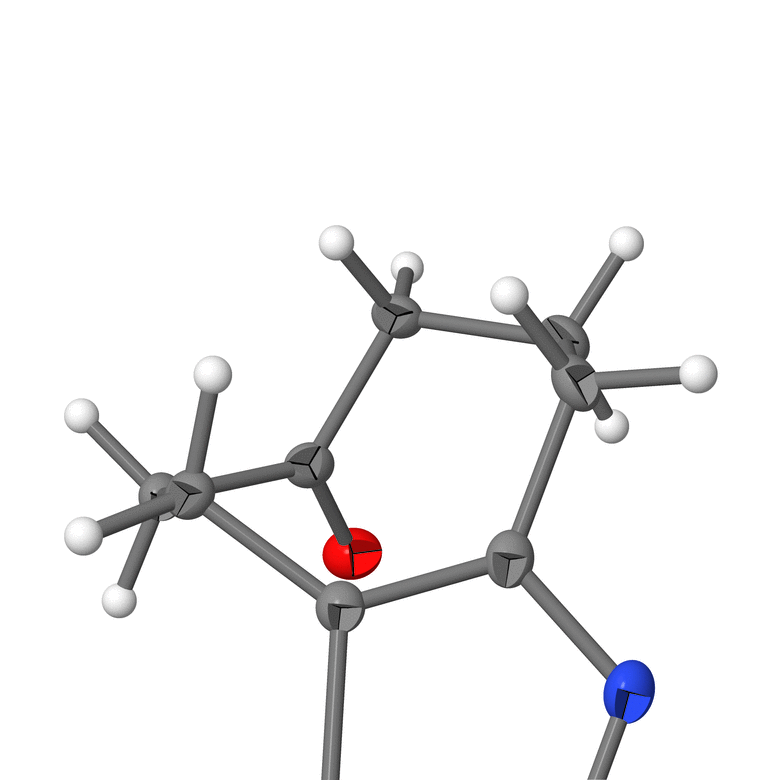
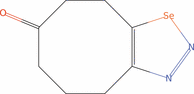
In the title compound, C8H10N2OSe, an almost planar 1,2,3-selenadiazole ring is annulated to a cyclooctenone ring with a twist-boat conformation. The heterocycle and C—C(=O)—C carbonyl moieties subtend a dihedral angle of 54.25 (11)°. In the extended structure, weak C—H⋯O and C—H⋯N interactions link the molecules into double layers lying parallel to the bc plane.
Keywords: crystal structure; selenium; Se-NMR; heterocycle; medium sized ring.
CCDC reference: 2599832
Structure description
The title compound, C8H10N2OSe (I) (Fig. 1 ), was prepared in a project on medium sized rings with geometrical strain (Bissinger et al. 1988; Detert & Meier, 1997a,b). 1,2,3-Selenadiazoles are important precursors for the synthesis of strained cycloalkynes (Yalpani et al. 1971; Meier & Voigt,1972). The title compound had been prepared for the first synthesis of cyclooctynone (Meier & Petersen, 1978). The crystal structures of related cycloocteno-1,2,3-selanadiazoles have been reported recently (Schollmeyer & Detert, 2020, 2025). The C4/C8/N7/N6/Se5 selenadiazole ring in (I) is planar to within 0.0044 (2) Å and the C2—C1(=O12)—C11 carbonyl moiety to within 0.004 (2) Å at C1; these planes subtend a dihedral angle of 54.25 (11)°. Further characteristics are a dihedral angle of 3.51 (19)° for the selenadiazole C4/C8 fragment and its adjacent methylene C atoms (C3—C4—C8—C9) and a twist-boat conformation of the cyclooctene ring.
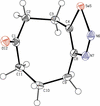 | Figure 1 The molecular structure of (I) with displacement ellipsoids drawn at the 50% probability level. |
In the extended structure of (I), the molecules are connected via weak C—H⋯O and C—H⋯N hydrogen bonds with H⋯X (X = O, N) lengths of 2.58 to 2.68 Å (Table 1, Fig. 2). These bridges connect the molecules into a double-layer system with the layers lying parallel to the bc plane. Within one layer, the molecules are related by translation symmetry along the b axis and a c glide plane; a centre of inversion connects molecules of both layers, as centrosymmetric dimers are formed. While the C—H⋯O and C—H⋯N hydrogen bonds are within a layer and connect the double layer, the selenadiazole rings are on both surfaces of this subsystem.
|
 ; (ii)
 ; (iii)
 ; (iv)
 .
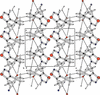 | Figure 2 Partial packing diagram of (I) viewed along the b-axis direction. Hydrogen bonds are shown as dashed lines. |
Synthesis and crystallization
The synthesis of the title compound was performed according to the literature (Meier & Petersen, 1978) from cyclooctadiene-1,5 via hydroboration/oxidation, partial oxidation of the diol, transformation of the ketone to a 1,2,3-selenadiazole and oxidation of the remaining alcohol group. After recrystallization from the mixed solvents of chloroform and propanol-2-ol, colourless blocks with m.p. 371 K were formed. Analytical data are given by Meier and Petersen (1978), 1H-NMR (400 MHz, CDCl2): δ = 3.45 (m, 2 H), 3.26 (m, 2 H), 2.73 (m, 2 H), 2.47 (m, 2 H), 1.98 (qui, 2 H). 77Se-NMR (73 MHz, CDCl3, SeO2/D2O as reference): δ = 223.7.
Refinement
Crystal data, data collection and structure details are summarized in Table 2.
|
Structural data
CCDC reference: 2599832
contains datablocks I, global. DOI: https://doi.org/10.1107/S2414314626011387/hb4580sup1.cif
Structure factors: contains datablock I. DOI: https://doi.org/10.1107/S2414314626011387/hb4580Isup2.hkl
Supporting information file. DOI: https://doi.org/10.1107/S2414314626011387/hb4580Isup3.cml
| C8H10N2OSe | Dx = 1.704 Mg m−3 |
| Mr = 229.14 | Melting point: 371 K |
| Monoclinic, P21/c | Mo Kα radiation, λ = 0.71073 Å |
| a = 12.7015 (6) Å | Cell parameters from 8908 reflections |
| b = 7.2450 (2) Å | θ = 2.6–28.6° |
| c = 9.7070 (5) Å | µ = 4.16 mm−1 |
| β = 90.288 (4)° | T = 120 K |
| V = 893.25 (7) Å3 | Block, colorless |
| Z = 4 | 0.95 × 0.53 × 0.21 mm |
| F(000) = 456 |
| Stoe IPDS 2T diffractometer | 2070 reflections with I > 2σ(I) |
| Detector resolution: 6.67 pixels mm-1 | Rint = 0.027 |
| rotation method, ω scans | θmax = 28.0°, θmin = 3.2° |
| Absorption correction: integration | h = −16→16 |
| Tmin = 0.071, Tmax = 0.405 | k = −9→9 |
| 4432 measured reflections | l = −11→12 |
| 2134 independent reflections |
| Refinement on F2 | Primary atom site location: dual |
| Least-squares matrix: full | Hydrogen site location: inferred from neighbouring sites |
| R[F2 > 2σ(F2)] = 0.031 | H-atom parameters constrained |
| wR(F2) = 0.084 | w = 1/[σ2(Fo2) + (0.0513P)2 + 0.6455P] where P = (Fo2 + 2Fc2)/3 |
| S = 1.14 | (Δ/σ)max = 0.001 |
| 2134 reflections | Δρmax = 0.47 e Å−3 |
| 109 parameters | Δρmin = −0.89 e Å−3 |
| 0 restraints |
Geometry. All esds (except the esd in the dihedral angle between two l.s. planes) are estimated using the full covariance matrix. The cell esds are taken into account individually in the estimation of esds in distances, angles and torsion angles; correlations between esds in cell parameters are only used when they are defined by crystal symmetry. An approximate (isotropic) treatment of cell esds is used for estimating esds involving l.s. planes. |
Refinement. Hydrogen atoms attached to carbons were placed at calculated positions and were refined in the riding-model approximation with C—H = 0.99 Å, and with Uiso(H) = 1.2 Ueq(C). |
| x | y | z | Uiso*/Ueq | ||
| C1 | 0.17825 (15) | 0.2685 (3) | 0.3378 (2) | 0.0186 (4) | |
| C2 | 0.27398 (16) | 0.2237 (3) | 0.4249 (2) | 0.0185 (4) | |
| H2A | 0.317187 | 0.129893 | 0.377209 | 0.022* | |
| H2B | 0.251056 | 0.170810 | 0.513922 | 0.022* | |
| C3 | 0.34108 (16) | 0.3969 (3) | 0.4520 (2) | 0.0179 (4) | |
| H3A | 0.303370 | 0.480159 | 0.515785 | 0.022* | |
| H3B | 0.408426 | 0.360662 | 0.496112 | 0.022* | |
| C4 | 0.36298 (15) | 0.4966 (3) | 0.3194 (2) | 0.0162 (4) | |
| Se5 | 0.47241 (2) | 0.43962 (3) | 0.20325 (2) | 0.01750 (10) | |
| N6 | 0.41692 (15) | 0.6158 (3) | 0.08121 (18) | 0.0211 (4) | |
| N7 | 0.33379 (14) | 0.6881 (2) | 0.13071 (18) | 0.0204 (3) | |
| C8 | 0.30090 (16) | 0.6286 (3) | 0.2587 (2) | 0.0177 (4) | |
| C9 | 0.20190 (17) | 0.7117 (3) | 0.3166 (2) | 0.0208 (4) | |
| H9A | 0.189133 | 0.831963 | 0.271053 | 0.025* | |
| H9B | 0.212906 | 0.735749 | 0.416032 | 0.025* | |
| C10 | 0.10337 (17) | 0.5907 (3) | 0.2989 (2) | 0.0222 (4) | |
| H10A | 0.097547 | 0.553333 | 0.201022 | 0.027* | |
| H10B | 0.040500 | 0.665579 | 0.321089 | 0.027* | |
| C11 | 0.10277 (17) | 0.4157 (3) | 0.3892 (2) | 0.0204 (4) | |
| H11A | 0.122305 | 0.449694 | 0.484777 | 0.024* | |
| H11B | 0.030593 | 0.364205 | 0.390915 | 0.024* | |
| O12 | 0.16234 (13) | 0.1908 (2) | 0.22902 (17) | 0.0251 (3) |
| U11 | U22 | U33 | U12 | U13 | U23 | |
| C1 | 0.0176 (9) | 0.0184 (9) | 0.0198 (9) | −0.0023 (7) | 0.0034 (7) | 0.0011 (7) |
| C2 | 0.0202 (9) | 0.0165 (9) | 0.0188 (9) | 0.0017 (7) | 0.0022 (7) | 0.0028 (7) |
| C3 | 0.0184 (9) | 0.0207 (9) | 0.0147 (8) | 0.0011 (7) | −0.0005 (7) | 0.0003 (7) |
| C4 | 0.0163 (9) | 0.0163 (9) | 0.0159 (8) | −0.0007 (7) | −0.0016 (7) | −0.0001 (7) |
| Se5 | 0.01565 (14) | 0.01792 (15) | 0.01893 (14) | −0.00037 (6) | 0.00089 (9) | 0.00129 (6) |
| N6 | 0.0239 (9) | 0.0198 (8) | 0.0195 (8) | −0.0040 (7) | −0.0010 (7) | 0.0037 (7) |
| N7 | 0.0231 (8) | 0.0181 (8) | 0.0200 (8) | −0.0025 (6) | −0.0021 (7) | 0.0037 (6) |
| C8 | 0.0203 (9) | 0.0152 (9) | 0.0176 (9) | −0.0014 (7) | −0.0028 (7) | 0.0010 (7) |
| C9 | 0.0215 (10) | 0.0173 (9) | 0.0237 (9) | 0.0059 (7) | −0.0026 (8) | −0.0003 (8) |
| C10 | 0.0170 (10) | 0.0250 (9) | 0.0245 (10) | 0.0058 (8) | −0.0007 (8) | 0.0002 (8) |
| C11 | 0.0152 (9) | 0.0247 (10) | 0.0212 (10) | 0.0030 (7) | 0.0019 (7) | −0.0004 (7) |
| O12 | 0.0256 (8) | 0.0265 (8) | 0.0232 (7) | −0.0025 (6) | 0.0001 (6) | −0.0048 (6) |
| C1—O12 | 1.213 (3) | N6—N7 | 1.275 (3) |
| C1—C2 | 1.513 (3) | N7—C8 | 1.381 (3) |
| C1—C11 | 1.520 (3) | C8—C9 | 1.506 (3) |
| C2—C3 | 1.539 (3) | C9—C10 | 1.537 (3) |
| C2—H2A | 0.9900 | C9—H9A | 0.9900 |
| C2—H2B | 0.9900 | C9—H9B | 0.9900 |
| C3—C4 | 1.503 (3) | C10—C11 | 1.542 (3) |
| C3—H3A | 0.9900 | C10—H10A | 0.9900 |
| C3—H3B | 0.9900 | C10—H10B | 0.9900 |
| C4—C8 | 1.371 (3) | C11—H11A | 0.9900 |
| C4—Se5 | 1.8410 (19) | C11—H11B | 0.9900 |
| Se5—N6 | 1.8766 (19) | ||
| O12—C1—C2 | 121.13 (19) | C4—C8—N7 | 115.38 (18) |
| O12—C1—C11 | 120.60 (19) | C4—C8—C9 | 126.73 (18) |
| C2—C1—C11 | 118.27 (17) | N7—C8—C9 | 117.89 (18) |
| C1—C2—C3 | 111.31 (16) | C8—C9—C10 | 114.28 (17) |
| C1—C2—H2A | 109.4 | C8—C9—H9A | 108.7 |
| C3—C2—H2A | 109.4 | C10—C9—H9A | 108.7 |
| C1—C2—H2B | 109.4 | C8—C9—H9B | 108.7 |
| C3—C2—H2B | 109.4 | C10—C9—H9B | 108.7 |
| H2A—C2—H2B | 108.0 | H9A—C9—H9B | 107.6 |
| C4—C3—C2 | 110.52 (17) | C9—C10—C11 | 114.31 (18) |
| C4—C3—H3A | 109.5 | C9—C10—H10A | 108.7 |
| C2—C3—H3A | 109.5 | C11—C10—H10A | 108.7 |
| C4—C3—H3B | 109.5 | C9—C10—H10B | 108.7 |
| C2—C3—H3B | 109.5 | C11—C10—H10B | 108.7 |
| H3A—C3—H3B | 108.1 | H10A—C10—H10B | 107.6 |
| C8—C4—C3 | 126.52 (18) | C1—C11—C10 | 112.67 (17) |
| C8—C4—Se5 | 109.12 (14) | C1—C11—H11A | 109.1 |
| C3—C4—Se5 | 124.05 (14) | C10—C11—H11A | 109.1 |
| C4—Se5—N6 | 87.23 (8) | C1—C11—H11B | 109.1 |
| N7—N6—Se5 | 110.53 (14) | C10—C11—H11B | 109.1 |
| N6—N7—C8 | 117.74 (18) | H11A—C11—H11B | 107.8 |
| O12—C1—C2—C3 | 122.5 (2) | C3—C4—C8—C9 | 4.8 (3) |
| C11—C1—C2—C3 | −56.7 (2) | Se5—C4—C8—C9 | 178.63 (17) |
| C1—C2—C3—C4 | −50.3 (2) | N6—N7—C8—C4 | 0.3 (3) |
| C2—C3—C4—C8 | 87.7 (2) | N6—N7—C8—C9 | −179.16 (19) |
| C2—C3—C4—Se5 | −85.2 (2) | C4—C8—C9—C10 | −79.8 (3) |
| C8—C4—Se5—N6 | 0.78 (15) | N7—C8—C9—C10 | 99.6 (2) |
| C3—C4—Se5—N6 | 174.77 (17) | C8—C9—C10—C11 | 70.4 (2) |
| C4—Se5—N6—N7 | −0.63 (15) | O12—C1—C11—C10 | −67.1 (3) |
| Se5—N6—N7—C8 | 0.3 (2) | C2—C1—C11—C10 | 112.1 (2) |
| C3—C4—C8—N7 | −174.62 (19) | C9—C10—C11—C1 | −73.7 (2) |
| Se5—C4—C8—N7 | −0.8 (2) |
| D—H···A | D—H | H···A | D···A | D—H···A |
| C2—H2A···Se5i | 0.99 | 3.11 | 4.025 (2) | 154 |
| C2—H2B···O12ii | 0.99 | 2.58 | 3.339 (3) | 133 |
| C3—H3A···N7iii | 0.99 | 2.68 | 3.473 (3) | 138 |
| C3—H3B···Se5ii | 0.99 | 3.07 | 3.825 (2) | 134 |
| C9—H9A···O12iv | 0.99 | 2.65 | 3.608 (3) | 162 |
| C9—H9B···N7iii | 0.99 | 2.64 | 3.547 (3) | 152 |
| C10—H10B···O12v | 0.99 | 2.63 | 3.461 (3) | 142 |
| C11—H11A···O12ii | 0.99 | 2.63 | 3.467 (3) | 143 |
| Symmetry codes: (i) −x+1, y−1/2, −z+1/2; (ii) x, −y+1/2, z+1/2; (iii) x, −y+3/2, z+1/2; (iv) x, y+1, z; (v) −x, y+1/2, −z+1/2. |
References
 Bissinger, H.-J., Detert, H. & Meier, H. (1988). Liebigs Ann. Chem. pp. 221–224. CrossRef Google Scholar
Detert, H. & Meier, H. (1997a). Liebigs Ann. Recl 1997, 1557–1563. CrossRef Google Scholar
Detert, H. & Meier, H. (1997b). Liebigs Ann. Recl 1997, 1565–1570. CrossRef Google Scholar
Meier, H. & Petersen, H. (1978). Synthesis pp. 596–598. Google Scholar
Meier, H. & Voigt, E. (1972). Tetrahedron 28, 187–198. CrossRef CAS Google Scholar
Schollmeyer, D. & Detert, H. (2020). IUCRData 5, x201585 Google Scholar
Schollmeyer, D. & Detert, H. (2025). IUCRData 10, x250324. Google Scholar
Sheldrick, G. M. (2015a). Acta Cryst. A71, 3–8. Web of Science CrossRef IUCr Journals Google Scholar
Sheldrick, G. M. (2015b). Acta Cryst. C71, 3–8. Web of Science CrossRef IUCr Journals Google Scholar
Spek, A. L. (2009). Acta Cryst. D65, 148–155. Web of Science CrossRef CAS IUCr Journals Google Scholar
Stoe (2020). X-AREA WinXpose, X-AREA Recipe and X-AREA Integrate. Stoe & Cie, Darmstadt, Germany. Google Scholar
Yalpani, M., Lalezari, I. & Shafiee, A. (1971). J. Org. Chem. 36, 2836–2838. CrossRef CAS Google Scholar
This is an open-access article distributed under the terms of the Creative Commons Attribution (CC-BY) Licence, which permits unrestricted use, distribution, and reproduction in any medium, provided the original authors and source are cited.
| IUCrDATA |