

 menu


metal-organic compounds
 | IUCrDATA |
 access
catena-Poly[2-amino-3-chloro-5-(trifluoromethyl)pyridinium [[chloridocuprate]-di-μ-chlorido]]

aSchool of Physical and Chemical Sciences, University of Canterbury, Private Bag 4800, Christchurch, New Zealand, bDepartment of Chemistry, Howard University, 2400 6th St NW, Washington, DC 20059, USA, and cCarlson School of Chemistry and Biochemistry, Clark University, 950 Main St., Worcester, MA 01610, USA
*Correspondence e-mail: [email protected]
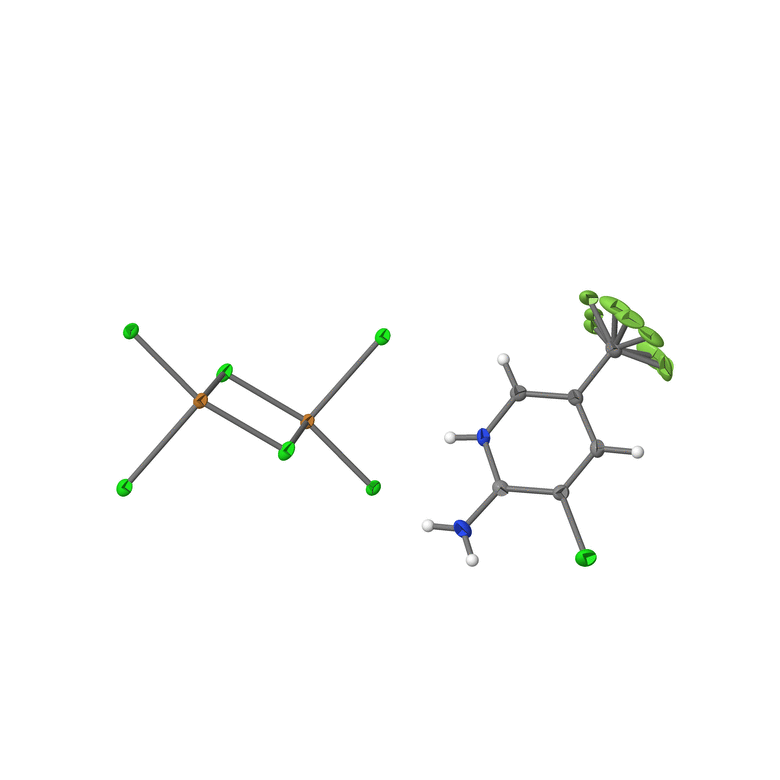
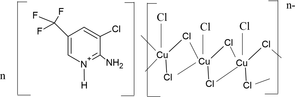
The reaction of 2-amino-3-chloro-5-trifluoromethylpyridine with copper(II) chloride dihydrate in aqueous HCl generated the title compound, {(C6H5ClF3N2)[CuCl3]}n. The structure comprises discrete cations and bichloride bridged chains of CuII ions with an additional terminal chloride ion attached to each Cu2+ ion. The Cu(II) ions are coordinated to five chloride ions (four bridging) in the form of a slightly distorted square pyramid with the terminal chloride ion in an equatorial site. The resulting chains run parallel to the crystallographic b-axis direction. The structure features N—H⋯Cl hydrogen bonds between the pyridinium and amino N—H donors and chlorido ions, and halogen bonds between the chlorido ions and fluorine atoms. The fluorine atoms of the trifluoromethyl group were refined as a three-fold disordered model.
Keywords: crystal structure; Cu(II) chain; aminopyridinium.
CCDC reference: 2600494
Structure description
Five-coordinate, bi-bridged chloridocuprate chains have been prepared with a wide variety of ancillary organic cations. Perhaps the first such structure reported is catena-dimethylammonium trichloridocuprate (Willett, 1966 ). Since that time, a similar structure was been reported with 4-benzylpiperidinium (Battaglia et al., 1980). Similar structures have been observed with chloride bridged chains, but where more than one coordination geometry is exhibited in the chain. The diethyldimethylammonium chloridocuprate salt (Fujii et al., 1995) comprises a repeating chain of CuII ions via three bichloride bridges followed by a trichloride bridge with four crystallographically unique Cu ions. The ethyltrimethylammonium compound (Bond et al., 1990) exhibits both octahedral and square-pyramidal chloridocuprate geometries with three bichloride bridges followed by two trichloride bridges. The tetramethylammonium complex crystallizes as a chain of trichloride bridged six-coordinate CuII ions (Weenk & Spek, 1976) and the tetramethylarsenium salt crystallizes as square-pyramidal chlorocuprate ions bridged by both monochloride and bichloride bridges into a two-dimensional layer (Murray & Willett, 1993).
We have been studying the copper(II) halide salts of various substituted 2-aminopyridinium ions (Bellesis et al., 2024; Bedford et al., 2023; Huynh et al., 2023) including salts and complexes of 5-trifluoromethyl-2-aminopyridine (Gale et al., 2013; Forman et al., 2014, 2015). Neutral complexes of the closely related 3-chloro-5-trifluoromethyl-2-aminopyridine (TFCAP) (Salah et al., 2025; Chakraborty et al., 2024) as well as the bichloride bridged cadmium chain salt (Karâa et al., 2023) and the neutral compound itself (Tan et al., 2008) are also known. In the course of our investigation of salts of this aminopyridine (Wikaira et al., 2010) we serendipitously prepared the title compound, {[C6H5ClF3N2][CuCl3]}n (I), and herein report its preparation and structure.
The asymmetric unit of (I) and copper coordination sphere are shown in Fig. 1. Selected bond lengths and angles are given in Table 1. The CuII ion is coordinated by five chloride ions (three independent) in a slightly distorted square pyramidal geometry (τ = 0.11; Addison et al., 1984) with Cl3 in the apical position. The equatorial chloride ions are roughly co-planar (mean deviation of constituent atoms = 0.065 Å) with the copper ion lying 0.202 (1) Å above that plane. As is typical, the axial Cu—Cl bond is lengthened by ∼0.5 Å relative to the equatorial Cu—Cl bonds.
|
 ; (ii)
 .
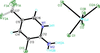 | Figure 1 The asymmetric unit and copper coordination sphere of (I) shown as 50% probability ellipsoids. Hydrogen atoms are show as spheres of arbitrary size. The copper coordination sphere and those hydrogen atoms whose positions were refined are labeled. Only the major component of the three disordered positions for the CF3 group is shown. Symmetry operations: (A) −x, 2 − y, −z; (B) −x, 1 − y, −z. |
As expected, the pyridine ring of the TFCAPH cation is virtually planar (mean deviation of constituent atoms = 0.006 Å) with N12 and Cl13 only slightly deviating from that plane (∼0.01Å). The –CF3 substituent is significantly disordered and was refined using a three-site model to yield final occupancies of 0.346 (3):0.501 (3):0.153 (3) (see Fig. 2). The structure of TFCAP itself exhibits twofold disorder of the CF3 group (Tan et al., 2008) as do the salt (TFCAPH)2CuCl4 (Wikaira et al., 2010) and the neutral (TFCAP)2CuCl2 complex (Salah et al., 2025]. The C12—N11 and C16—N11 bond lengths are ∼0.18 Å longer in (I) than in TFCAP while the C12—N12 bond is comparably shorter. Other bond lengths within the ring differ by < 0.01 Å. Bond lengths within the ring are within 0.1 Å of those observed in the TFCAPH cations seen in the (TFCAPH)2CuX4 salts (X = Cl, Br) (Wikaira et al., 2010). The greatest difference in angles within the ring is the C—N—C angle, 124.4 (1)° in 1 and 123–125° in the other pyridinium compounds, but only 118.4 (1)° in the free ligand (Tan et al., 2008) and 118.8 (1)° in the neutral copper chlorido complex (Salah et al., 2025).
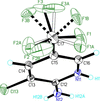 | Figure 2 The threefold disordered CF3 group of (I). |
The CuII ions are connected into a chain propagating parallel to the b axis via bibridged chloride linkages (Fig. 3). The position of the terminal chloride ion (Cl1) alternates up and down relative to the ab plane as one passes along the chain. The bridges, Cl2/Cl2A and Cl3/Cl3B, form an alternating chain (Fig. 3). It is interesting to note that while the Cl2/Cl2A chloride ions bridge equatorial positions on adjacent copper ions, the Cl3/Cl3A bridges bridge axial/equatorial. The TFCAPH ions are linked to neighboring species by both hydrogen bonds (see Table 2) and halogen bonds (Fig. 4). Hydrogen bonds are observed between both the pyridinium and amino N—H donors and the terminal chlorido ions, and between the amino N—H donors and Cl3 within the chains (Table 2).
|
 .
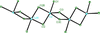 | Figure 3 The chain structure of the CuCl3− units in (I) shown as 50% probability ellipsoids viewed parallel to the a-axis direction (b horizontal). Symmetry operations: (A) −x, 1 − y, 1 − z; (B) −x, 1 − y, 1 − z; (C) −x, 2 − y, 1 − z. |
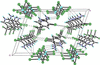 | Figure 4 The unit-cell packing of (I) viewed parallel to the b-axis direction (the chain axis) with c horizontal. Dashed lines represent hydrogen bonds and halogen bonds. Only the major component of the disordered CF3 group is shown. |
Type I halogen bonds (Cavallo et al., 2016) are observed between Cl13 (on the pyridone ring) and fluorine atoms on the CF3 group [Cl13⋯F1i = 3.043 (11) Å, C13—Cl13⋯F1i = 167.0 (3)°, Cl13⋯F1i—C17i = 139.4 (8); symmetry code: (i) x, –y +  , z + ] (see Fig. 4). Multiple short Cl⋯Cl contacts exist between chains, but only two are symmetry unique (see Table 3). Each Cl1 ion is close to two symmetry-equivalent Cl1 ions in neighboring chains and each Cl1 ion is close to one symmetry-equivalent Cl2 ion in a neighboring chain. These effectively link the chains into a sheet parallel to the bc plane. Such contacts have been shown to propagate magnetic exchange in CuX42– complexes (Turnbull et al., 2005).
| ||||||||||||||||||||||
 −
Synthesis and crystallization
5-Trifluoromethyl-3-chloro-2-aminopyridine (TFCAP) and hydrochloric acid were purchased from the Aldrich Chemical Company and used without purification. Copper(II) chloride was obtained from J. T. Baker and used without purification. The IR spectrum was recorded on a Perkin-Elmer Spectrum 100 IR spectrophotometer; s = strong and m = medium. Combustion analyses were performed by the Marine Science Institute, U. California, Santa Barbara.
TFCAP (0.394 g, 2.00 mmol) was dissolved in 2 ml of water and 1 ml of concentrated hydrochloric acid. Copper(II) chloride dihydrate (0.171 g, 1.00 mmol) was added and dissolved resulting in a bright green solution which was left at room temperature for slow evaporation. After three days, 0.382 g of green crystals of (TFCAPH)2CuCl4 (Wikaira et al., 2010) were removed by filtration and the filtrate left for further evaporation. After two more weeks, brown crystals (purple when viewed individually under a microscope) were harvested by filtration [0.011 g, 8% correcting for recovered (TFCAPH)2CuCl4]. Elemental analysis (%) calculated for C6H5Cl4CuF3N2, found (calculated): C 19.34 (19.61); H 1.49 (1.37); N 7.38 (7.62). IR, ν 3326m, 3198m, 3158m, 3113m, 3067m, 1661s, 1630s, 1325s, 1278s, 1178m, 1135m, 1100m, 1076m, 900m, 632m cm−1.
Refinement
Crystal data, data collection and structure details are summarized in Table 4. The fluorine atoms on the trifluoromethyl group were refined as a threefold disordered structure using both angle and distance restraints. Final occupancies for the three sets of fluorine atoms were 0.346 (3):0.501 (3):0.153 (3).
|
Structural data
CCDC reference: 2600494
contains datablocks I, publication_text. DOI: https://doi.org/10.1107/S2414314626011430/hb4575sup1.cif
Structure factors: contains datablock I. DOI: https://doi.org/10.1107/S2414314626011430/hb4575Isup2.hkl
| (C6H5ClF3N2)[CuCl3] | F(000) = 716 |
| Mr = 367.46 | Dx = 2.142 Mg m−3 |
| Monoclinic, P21/c | Mo Kα radiation, λ = 0.71073 Å |
| a = 12.2625 (4) Å | Cell parameters from 5156 reflections |
| b = 6.25540 (14) Å | θ = 5.1–32.7° |
| c = 15.7442 (4) Å | µ = 2.86 mm−1 |
| β = 109.341 (3)° | T = 110 K |
| V = 1139.53 (6) Å3 | Chip, purple |
| Z = 4 | 0.40 × 0.30 × 0.05 mm |
| Xcalibur, Ruby, Gemini diffractometer | 3080 reflections with I > 2σ(I) |
| ω scans | Rint = 0.027 |
| Absorption correction: multi-scan (CrysAlisPro; Oxford Diffraction, 2009) | θmax = 32.8°, θmin = 5.1° |
| Tmin = 0.477, Tmax = 1.000 | h = −15→18 |
| 9524 measured reflections | k = −8→9 |
| 3852 independent reflections | l = −23→22 |
| Refinement on F2 | Primary atom site location: structure-invariant direct methods |
| Least-squares matrix: full | Secondary atom site location: difference Fourier map |
| R[F2 > 2σ(F2)] = 0.026 | Hydrogen site location: mixed |
| wR(F2) = 0.059 | H atoms treated by a mixture of independent and constrained refinement |
| S = 0.96 | w = 1/[σ2(Fo2) + (0.0308P)2] where P = (Fo2 + 2Fc2)/3 |
| 3852 reflections | (Δ/σ)max = 0.005 |
| 211 parameters | Δρmax = 0.66 e Å−3 |
| 140 restraints | Δρmin = −0.57 e Å−3 |
Geometry. All esds (except the esd in the dihedral angle between two l.s. planes) are estimated using the full covariance matrix. The cell esds are taken into account individually in the estimation of esds in distances, angles and torsion angles; correlations between esds in cell parameters are only used when they are defined by crystal symmetry. An approximate (isotropic) treatment of cell esds is used for estimating esds involving l.s. planes. |
| x | y | z | Uiso*/Ueq | Occ. (<1) | |
| Cu1 | −0.03567 (2) | 0.75663 (3) | 0.03419 (2) | 0.01217 (5) | |
| Cl1 | −0.03525 (3) | 0.65126 (6) | 0.17039 (2) | 0.01435 (8) | |
| Cl2 | 0.06323 (4) | 1.06358 (6) | 0.09775 (2) | 0.01675 (8) | |
| Cl3 | 0.15439 (3) | 0.51549 (6) | 0.03919 (2) | 0.01443 (8) | |
| N11 | 0.22343 (13) | 0.4646 (2) | 0.26811 (9) | 0.0150 (3) | |
| H11 | 0.1725 (18) | 0.522 (3) | 0.2289 (13) | 0.018* | |
| C12 | 0.23527 (14) | 0.5451 (2) | 0.35078 (10) | 0.0141 (3) | |
| N12 | 0.17688 (14) | 0.7156 (2) | 0.35848 (11) | 0.0205 (3) | |
| H12A | 0.123 (2) | 0.764 (3) | 0.3128 (15) | 0.025* | |
| H12B | 0.1796 (19) | 0.759 (3) | 0.4064 (11) | 0.025* | |
| C13 | 0.31617 (15) | 0.4371 (3) | 0.42515 (10) | 0.0159 (3) | |
| Cl13 | 0.33428 (4) | 0.53453 (7) | 0.53112 (3) | 0.02626 (10) | |
| C14 | 0.37396 (15) | 0.2623 (3) | 0.41226 (11) | 0.0181 (3) | |
| H14 | 0.426057 | 0.190044 | 0.462444 | 0.022* | |
| C15 | 0.35667 (15) | 0.1878 (3) | 0.32427 (11) | 0.0168 (3) | |
| C16 | 0.28127 (15) | 0.2929 (3) | 0.25341 (11) | 0.0161 (3) | |
| H16 | 0.269356 | 0.245467 | 0.193687 | 0.019* | |
| C17 | 0.42110 (18) | −0.0020 (3) | 0.30815 (12) | 0.0247 (4) | |
| F1 | 0.3727 (10) | −0.100 (2) | 0.2304 (7) | 0.039 (3) | 0.346 (3) |
| F2 | 0.4362 (14) | −0.156 (3) | 0.3725 (9) | 0.0148 (17) | 0.346 (3) |
| F3 | 0.5303 (12) | 0.049 (3) | 0.3161 (10) | 0.044 (4) | 0.346 (3) |
| F1A | 0.3458 (7) | −0.1196 (15) | 0.2373 (5) | 0.0245 (12) | 0.501 (3) |
| F2A | 0.4471 (11) | −0.133 (2) | 0.3777 (7) | 0.033 (3) | 0.501 (3) |
| F3A | 0.5100 (9) | 0.039 (2) | 0.2849 (6) | 0.041 (2) | 0.501 (3) |
| F1B | 0.4390 (13) | 0.000 (2) | 0.2288 (6) | 0.044 (3) | 0.153 (3) |
| F2B | 0.4110 (15) | −0.181 (2) | 0.3420 (10) | 0.045 (4) | 0.153 (3) |
| F3B | 0.5484 (9) | 0.038 (2) | 0.3615 (8) | 0.032 (3) | 0.153 (3) |
| U11 | U22 | U33 | U12 | U13 | U23 | |
| Cu1 | 0.01617 (11) | 0.00918 (9) | 0.01099 (9) | −0.00211 (8) | 0.00428 (7) | 0.00018 (6) |
| Cl1 | 0.0186 (2) | 0.01280 (16) | 0.01214 (15) | −0.00121 (14) | 0.00580 (14) | 0.00118 (12) |
| Cl2 | 0.0246 (2) | 0.01226 (16) | 0.01185 (16) | −0.00598 (15) | 0.00398 (15) | 0.00014 (12) |
| Cl3 | 0.01687 (19) | 0.01198 (16) | 0.01357 (16) | −0.00331 (14) | 0.00389 (14) | 0.00033 (12) |
| N11 | 0.0130 (7) | 0.0142 (6) | 0.0150 (6) | 0.0017 (5) | 0.0009 (5) | 0.0020 (5) |
| C12 | 0.0114 (7) | 0.0136 (7) | 0.0172 (7) | −0.0022 (6) | 0.0045 (6) | −0.0016 (5) |
| N12 | 0.0189 (8) | 0.0190 (7) | 0.0218 (7) | 0.0057 (6) | 0.0043 (6) | −0.0028 (6) |
| C13 | 0.0154 (8) | 0.0180 (7) | 0.0141 (7) | 0.0006 (6) | 0.0047 (6) | −0.0004 (6) |
| Cl13 | 0.0313 (3) | 0.0310 (2) | 0.01625 (19) | 0.00717 (19) | 0.00749 (18) | −0.00405 (16) |
| C14 | 0.0172 (8) | 0.0191 (8) | 0.0170 (7) | 0.0040 (7) | 0.0046 (6) | 0.0041 (6) |
| C15 | 0.0184 (9) | 0.0147 (7) | 0.0181 (7) | 0.0026 (6) | 0.0070 (7) | 0.0018 (6) |
| C16 | 0.0180 (8) | 0.0143 (7) | 0.0165 (7) | −0.0012 (6) | 0.0066 (7) | −0.0008 (5) |
| C17 | 0.0330 (11) | 0.0189 (8) | 0.0253 (9) | 0.0105 (8) | 0.0139 (8) | 0.0053 (7) |
| F1 | 0.060 (8) | 0.043 (6) | 0.018 (2) | 0.033 (5) | 0.019 (4) | 0.003 (3) |
| F2 | 0.019 (3) | 0.005 (3) | 0.019 (3) | −0.007 (2) | 0.005 (3) | −0.002 (2) |
| F3 | 0.051 (7) | 0.024 (4) | 0.083 (10) | 0.008 (5) | 0.056 (7) | 0.010 (8) |
| F1A | 0.031 (2) | 0.0198 (14) | 0.025 (2) | 0.0052 (15) | 0.0116 (15) | −0.0084 (15) |
| F2A | 0.045 (5) | 0.015 (3) | 0.032 (3) | 0.015 (3) | 0.002 (3) | 0.004 (2) |
| F3A | 0.038 (3) | 0.0227 (17) | 0.082 (6) | 0.000 (2) | 0.045 (4) | −0.005 (4) |
| F1B | 0.061 (8) | 0.057 (7) | 0.017 (4) | 0.041 (6) | 0.016 (5) | 0.004 (4) |
| F2B | 0.035 (8) | 0.009 (4) | 0.096 (10) | −0.008 (4) | 0.028 (8) | −0.018 (6) |
| F3B | 0.017 (4) | 0.032 (6) | 0.048 (7) | 0.009 (4) | 0.012 (5) | −0.009 (5) |
| Cu1—Cl1 | 2.2418 (4) | C14—C15 | 1.410 (2) |
| Cu1—Cl2i | 2.2868 (4) | C14—H14 | 0.9500 |
| Cu1—Cl3ii | 2.2886 (4) | C15—C16 | 1.359 (2) |
| Cu1—Cl2 | 2.3141 (4) | C15—C17 | 1.494 (2) |
| Cu1—Cl3 | 2.7553 (4) | C16—H16 | 0.9500 |
| N11—C16 | 1.349 (2) | C17—F2B | 1.263 (13) |
| N11—C12 | 1.3578 (19) | C17—F3A | 1.286 (9) |
| N11—H11 | 0.80 (2) | C17—F2A | 1.318 (9) |
| C12—N12 | 1.312 (2) | C17—F1 | 1.322 (11) |
| C12—C13 | 1.429 (2) | C17—F1B | 1.339 (8) |
| N12—H12A | 0.85 (2) | C17—F3 | 1.342 (12) |
| N12—H12B | 0.792 (15) | C17—F2 | 1.363 (11) |
| C13—C14 | 1.354 (2) | C17—F1A | 1.399 (7) |
| C13—Cl13 | 1.7202 (16) | C17—F3B | 1.528 (11) |
| Cl1—Cu1—Cl2i | 165.097 (17) | C15—C14—H14 | 120.1 |
| Cl1—Cu1—Cl3ii | 93.655 (14) | C16—C15—C14 | 119.12 (15) |
| Cl2i—Cu1—Cl3ii | 91.679 (15) | C16—C15—C17 | 119.94 (15) |
| Cl1—Cu1—Cl2 | 89.738 (14) | C14—C15—C17 | 120.93 (15) |
| Cl2i—Cu1—Cl2 | 83.303 (15) | N11—C16—C15 | 119.84 (15) |
| Cl3ii—Cu1—Cl2 | 171.929 (17) | N11—C16—H16 | 120.1 |
| Cl1—Cu1—Cl3 | 94.459 (14) | C15—C16—H16 | 120.1 |
| Cl2i—Cu1—Cl3 | 99.461 (14) | F3A—C17—F2A | 111.6 (8) |
| Cl3ii—Cu1—Cl3 | 89.878 (14) | F2B—C17—F1B | 118.0 (9) |
| Cl2—Cu1—Cl3 | 97.164 (15) | F1—C17—F3 | 109.0 (8) |
| Cu1i—Cl2—Cu1 | 96.698 (15) | F1—C17—F2 | 105.6 (9) |
| Cu1ii—Cl3—Cu1 | 90.121 (14) | F3—C17—F2 | 102.3 (10) |
| C16—N11—C12 | 124.37 (14) | F3A—C17—F1A | 106.1 (5) |
| C16—N11—H11 | 122.8 (14) | F2A—C17—F1A | 104.5 (7) |
| C12—N11—H11 | 112.4 (14) | F2B—C17—C15 | 120.1 (8) |
| N12—C12—N11 | 120.11 (15) | F3A—C17—C15 | 115.7 (7) |
| N12—C12—C13 | 124.09 (15) | F2A—C17—C15 | 110.4 (6) |
| N11—C12—C13 | 115.77 (14) | F1—C17—C15 | 115.2 (6) |
| C12—N12—H12A | 120.3 (14) | F1B—C17—C15 | 114.3 (4) |
| C12—N12—H12B | 121.0 (16) | F3—C17—C15 | 111.2 (9) |
| H12A—N12—H12B | 117 (2) | F2—C17—C15 | 112.5 (7) |
| C14—C13—C12 | 120.98 (14) | F1A—C17—C15 | 107.9 (4) |
| C14—C13—Cl13 | 121.70 (13) | F2B—C17—F3B | 97.9 (9) |
| C12—C13—Cl13 | 117.31 (12) | F1B—C17—F3B | 93.4 (7) |
| C13—C14—C15 | 119.89 (15) | C15—C17—F3B | 106.1 (6) |
| C13—C14—H14 | 120.1 | ||
| C16—N11—C12—N12 | 178.72 (16) | C14—C15—C17—F3A | −99.3 (5) |
| C16—N11—C12—C13 | 0.7 (2) | C16—C15—C17—F2A | −152.3 (6) |
| N12—C12—C13—C14 | −179.67 (17) | C14—C15—C17—F2A | 28.6 (6) |
| N11—C12—C13—C14 | −1.7 (2) | C16—C15—C17—F1 | −22.8 (6) |
| N12—C12—C13—Cl13 | 1.8 (2) | C14—C15—C17—F1 | 158.1 (6) |
| N11—C12—C13—Cl13 | 179.76 (12) | C16—C15—C17—F1B | 27.8 (9) |
| C12—C13—C14—C15 | 1.6 (3) | C14—C15—C17—F1B | −151.3 (8) |
| Cl13—C13—C14—C15 | −179.95 (13) | C16—C15—C17—F3 | 101.9 (7) |
| C13—C14—C15—C16 | −0.3 (3) | C14—C15—C17—F3 | −77.2 (7) |
| C13—C14—C15—C17 | 178.78 (17) | C16—C15—C17—F2 | −143.9 (8) |
| C12—N11—C16—C15 | 0.5 (3) | C14—C15—C17—F2 | 36.9 (8) |
| C14—C15—C16—N11 | −0.7 (3) | C16—C15—C17—F1A | −38.7 (4) |
| C17—C15—C16—N11 | −179.82 (16) | C14—C15—C17—F1A | 142.2 (4) |
| C16—C15—C17—F2B | −121.3 (8) | C16—C15—C17—F3B | 129.3 (5) |
| C14—C15—C17—F2B | 59.6 (9) | C14—C15—C17—F3B | −49.9 (5) |
| C16—C15—C17—F3A | 79.8 (5) |
| Symmetry codes: (i) −x, −y+2, −z; (ii) −x, −y+1, −z. |
| D—H···A | D—H | H···A | D···A | D—H···A |
| N11—H11···Cl1 | 0.80 (2) | 2.54 (2) | 3.2496 (15) | 148.6 (18) |
| N11—H11···Cl3 | 0.80 (2) | 2.92 (2) | 3.4332 (14) | 123.8 (16) |
| N12—H12A···Cl1 | 0.85 (2) | 2.53 (2) | 3.2550 (17) | 142.9 (17) |
| N12—H12A···Cl1iii | 0.85 (2) | 2.70 (2) | 3.1823 (15) | 117.3 (16) |
| N12—H12B···Cl3iv | 0.79 (2) | 2.62 (2) | 3.3942 (15) | 165 (2) |
| Symmetry codes: (iii) −x, y+1/2, −z+1/2; (iv) x, −y+3/2, z+1/2. |
| d | angle | angle | τ | Symm. op. |
| Cl1···Cl1D 3.92144 (4) | Cu1—Cl1···Cl1D 107.886 (11) | Cl1···Cl1D—Cu1D 140.91 (5) | Cu1—Cl1···Cl1D—Cu1D –168.84 (1) | D: -x, y - 1/2, 3/2 - z |
| Cl1···Cl2A 3.8175 (5) | Cu1—Cl1···Cl2A 169.888 (16) | Cl1···Cl2A—Cu1F 109.423 (14) | Cu1—Cl1···Cl2A—Cu1F 175.51 (1) | A: x, 3/2 - y, z +1/2; F: -x, y + 1/2, 3/2 - z |
Acknowledgements
RJB wishes to acknowledge the NSF–MRI program (grant CHE-0619278) for funds to purchase the diffractometer. JLW is grateful for the support of a John Angus Erskine Fellowship from the University of Canterbury.
Funding information
Funding for this research was provided by: National Science Foundation (grant No. CHE-0619278 to RJB).
References
 Addison, A. W., Rao, T. N., Reedijk, J., van Rijn, J. & Verschoor, G. C. (1984). J. Chem. Soc. Dalton Trans. pp. 1349–1356. CSD CrossRef Web of Science Google Scholar
Battaglia, L. P., Bonamartini Corradi, A., Marcotrigiano, G., Menabue, L. & Pellacani, G. C. (1980). Inorg. Chem. 19, 125–129. CrossRef CAS Google Scholar
Bedford, C. P., Landee, C. P., Wikaira, J. L. & Turnbull, M. M. (2023). J. Coord. Chem. 76, 1353–1369. CrossRef CAS Google Scholar
Bellesis, A. G., Villani-Gale, A. J., Dickie, D. A., Jasinski, J. P., Landee, C. P., Wikaira, J. L., Willett, R. D. & Turnbull, M. M. (2024). J. Coord. Chem. 77, 1437–1456. Web of Science CSD CrossRef CAS Google Scholar
Bond, M. R., Willett, R. D. & Rubenacker, G. V. (1990). Inorg. Chem. 29, 2713–2720. CSD CrossRef CAS Web of Science Google Scholar
Bruker (1998). XP. Bruker AXS Inc., Madison, Wisconsin, USA Google Scholar
Cavallo, G., Metrangolo, P., Milani, R., Pilati, T., Priimagi, A., Resnati, G. & Terraneo, G. (2016). Chem. Rev. 116, 2478–2601. Web of Science CrossRef CAS PubMed Google Scholar
Chakraborty, P., Chatterjee, A., Mandal, R., Kumar, B., Mandal, S. & Dey, S. K. (2024). Struct. Chem. 35, 791–799. CrossRef CAS Google Scholar
Forman, R. L., Gale, A. J., Landee, C. P., Turnbull, M. M. & Wikaira, J. L. (2015). Polyhedron 89, 76–84. CrossRef CAS Google Scholar
Forman, R. L., Landee, C. P., Wikaira, J. L. & Turnbull, M. M. (2014). Eur. Chem. Bull. 3, 190–194. Google Scholar
Fujii, Y., Wang, Z., Willett, R. D., Zhang, W. & Landee, C. P. (1995). Inorg. Chem. 34, 2870–2874. CSD CrossRef CAS Web of Science Google Scholar
Gale, A. J., Landee, C. P., Turnbull, M. M. & Wikaira, J. L. (2013). Polyhedron 52, 986–991. CrossRef CAS Google Scholar
Huynh, N. V., Li, L., Landee, C. P., Dawe, L. N., Dickie, D. A., Turnbull, M. M. & Wikaira, J. L. (2023). Polyhedron 243, 116562. CrossRef Google Scholar
Karâa, N., Ben Ahmed, A. & Hamdi, B. (2023). J. Solid State Chem. 322, 123954. Google Scholar
Murray, K. & Willett, R. D. (1993). Acta Cryst. C49, 1739–1741. CSD CrossRef CAS Web of Science IUCr Journals Google Scholar
Oxford Diffraction (2009). CrysAlis PRO. Oxford Diffraction, Abingdon, England. Google Scholar
Salah, N., Karâa, N. & Hamdi, B. (2025). J. Mol. Struct. 1346, 143144. CrossRef Google Scholar
Sheldrick, G. M. (2008). Acta Cryst. A64, 112–122. Web of Science CrossRef CAS IUCr Journals Google Scholar
Sheldrick, G. M. (2015). Acta Cryst. C71, 3–8. Web of Science CrossRef IUCr Journals Google Scholar
Tan, S., Feng, G.-B., Chen, X.-J. & Shang, Z.-H. (2008). Acta Cryst. E64, o430. CrossRef IUCr Journals Google Scholar
Turnbull, M. M., Landee, C. P. & Wells, B. M. (2005). Coord. Chem. Rev. 249, 2567–2576. Web of Science CrossRef CAS Google Scholar
Weenk, J. W. & Spek, A. L. (1976). Cryst. Struct. Commun. 5, 805–808. CAS Google Scholar
Wikaira, J. L., Li, L., Butcher, R. J., Fitchett, C. M., Jameson, G. B., Landee, C. P., Telfer, S. G. & Turnbull, M. M. (2010). J. Coord. Chem. 63, 2949–2964. CrossRef CAS Google Scholar
Willett, R. D. (1966). J. Chem. Phys. 44, 39–42. CrossRef Google Scholar
This is an open-access article distributed under the terms of the Creative Commons Attribution (CC-BY) Licence, which permits unrestricted use, distribution, and reproduction in any medium, provided the original authors and source are cited.
| IUCrDATA |