

 menu


organic compounds
 | IUCrDATA |
 access
Triclinic polymorph of 5-(N-phthalimido)pentan-2-one

aNelson Mandela University, University Way, Port Elizabeth 6031, South Africa
*Correspondence e-mail: [email protected]
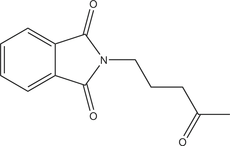
The structure of the title compound [systematic name: 2-(4-oxopentyl)-1H-isoindole-1,3(2H)-dione], C13H13NO3, was determined by X-ray crystallography and crystallizes in the space group P1 (No. 2), compared to C2/c for the known polymorph. Energy framework calculations show that non-classical C—H⋯O-type interactions, together with π–π ring and C=O⋯π ring interactions, set up a three-dimensional intermolecular framework.
Keywords: crystal structure; triclinic; polymorph; energy framework.
CCDC reference: 2604136
Structure description
N-Alkylated phthalimido derivatives are important compounds in organic synthesis that are used as protected sources of primary amines via Gabriel synthesis (Gibson & Bradshaw, 1968 ). They have also been reported to possess biological activity, such as anti-inflammatory, anti-Alzheimer, anti-epileptic, anticonvulsant, etc (Fernandes et al., 2023; Kushwaha & Kaushik, 2016). Herein, the synthesis and crystal structure of 5-(N-phthalimido)pentan-2-one, 1, a key intermediate towards primaquine diphosphate, an important API used in the treatment of malaria as a primary prophylaxis, radical cure and presumptive antirelapse therapy (Ashley et al., 2014), is discussed.
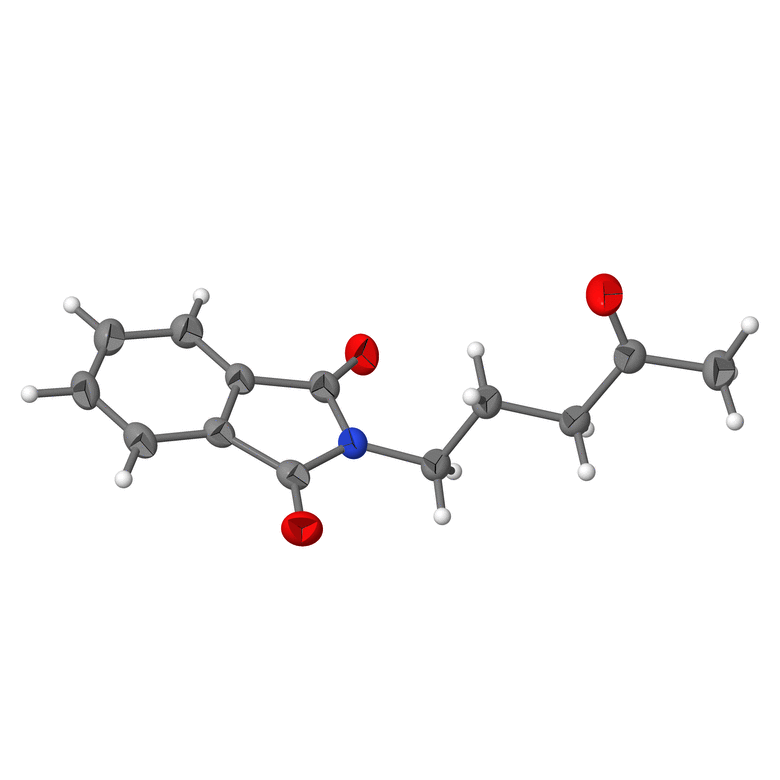
The title compound crystallizes in the triclinic space group P with one molecule in the (Fig. 1). All bond lengths, bond angles, torsions and dihedrals correspond with similar molecules whose crystal structures have been determined and whose metrical parameters have been deposited with the Cambridge Structural Database (CSD; Groom et al., 2016). A search in the CSD yielded one hit for 5-(N-phthalimido)pentan-2-one, which crystallizes in the monoclinic space group C2/c (Rheingold & Golen, 2020). The dihedral angles through the phthalimide and alkane groups least-squares planes is 74.71 (5)° here, which differs from the angle of 80.30° in the published monoclinic structure.
 | Figure 1 The molecular structure of compound 1, with displacement ellipsoids drawn at the 50% probability level. |
CrystalExplorer (Version 21.5) was utilized to calculate the energy framework (Mackenzie et al., 2017) and shows extensive three-dimensional intermolecular interactions (Fig. 2). The non-classical C—H⋯O-type interactions appear to dominate (Table 1). The C5—H5A⋯O1 interaction is centrosymmetric, linking two molecules with an R22(14) descriptor, and has an interaction energy of −26.4 kJ mol−1. The C15—H15⋯O2 and C7—H7B⋯O1 interactions link molecules in the a axis in chains with C(7) and C(9) descriptors, respectively, and a total interaction energy of −26.8 kJ mol−1. On one side of the phthalimide ring system there is a π–π ring interaction with a centroid-to-centroid (N1/C1/C2/C11–C16) distance of 3.6848 (8) Å and −35.3 kJ mol−1 interaction energy. On the other side of the phthalimide group there are two centrosymmetric C6=O3⋯π C1=O3 carbonyl interactions of 2.984 (2) Å between O3 and C1, 0.24 Å less than the sum of the van der Waal radii and an interaction energy of −37.9 kJ mol−1. These interactions alternate to form a chain linking molecules down vector [011].
| |||||||||||||||||||||||||||
 ; (ii)
 ; (iii)
 .
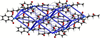 | Figure 2 Energy framework drawn for all molecules 3.8 Å around compound 1 and viewed down the b axis. Blue tubes represent the total calculated energy drawn at a cylinder scale of 80 and a cut-off at 5 kJ mol−1. |
The hydrogen-bond interactions, together with the π-interactions, result in a three-dimensional energy framework (Fig. 2). TopCryst (Shevchenko et al., 2022) determines the underlying net as gpu-x (Fig. 3).
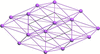 | Figure 3 Underlying net viewed down the b axis. The spheres represent the centroids of the title compounds and the violet lines the van der Waal interactions. Black lines show the unit cell. |
Synthesis and crystallization
The title compound 1 (Fig. 1) was synthesized via the phase-transfer-catalyzed N-alkylation of potassium phthalimide in 49% isolated yield (Akwi et al., 2025).
Spectroscopic data for 1: 1H NMR (400 MHz, DMSO-d6): δ 7.86 (s, 4H; Ar—H), 3.58 (t, J = 8 Hz, 2H; CH2), 2.53 (t, J = 8 Hz, 2H; CH2), 2.09 (s, 3H; CH3), 1.79 (q, J = 8 Hz, 2H; CH2). 13C NMR (100 MHz, DMSO-d6): δ 208.50, 168.55, 134.79, 131.94, 123.39, 40.17, 37.23, 30.10, 22.47. IR: ν = 3459, 3403, 2957, 2928, 2856, 1770, 1704, 1614, 1466, 1453, 1396, 1363, 1333, 1270, 1231, 1187, 1164, 1126, 1086, 1047, 955, 873, 792, 718, 710, 619, 596, 549, 529, 464, 434 cm−1.
Crystals of 1 were obtained at room temperature from a sample purified on a silica-gel column using a 9:1 ratio of hexane and ethyl acetate, respectively, as eluent> The N1—C3 bond length [1.459 (2) Å] confirms the formation of the product 1 and is consistent with a single-bond length.
Refinement
Crystal data, data collection and structure details are summarized in Table 2. H atoms were located in a difference map and refined as riding on their parent atom, with aromatic C—H = 0.95 Å and Uiso(H) = 1.2Ueq(C), methylene C—H = 0.99 Å and Uiso(H) = 1.2Ueq(C) or methyl C—H = 0.98 Å and Uiso(H) = 1.5Ueq(C). The methyl group was allowed to rotate to best fit the electron-density map.
|
Structural data
CCDC reference: 2604136
contains datablocks I, global. DOI: https://doi.org/10.1107/S2414314626012083/bt4214sup1.cif
Structure factors: contains datablock I. DOI: https://doi.org/10.1107/S2414314626012083/bt4214Isup2.hkl
checklist. DOI: https://doi.org/10.1107/S2414314626012083/bt4214sup3.pdf
Supporting information file. DOI: https://doi.org/10.1107/S2414314626012083/bt4214Isup4.cml
| C13H13NO3 | Z = 2 |
| Mr = 231.24 | F(000) = 244 |
| Triclinic, P1 | Dx = 1.328 Mg m−3 |
| a = 8.2691 (3) Å | Mo Kα radiation, λ = 0.71073 Å |
| b = 8.4687 (2) Å | Cell parameters from 9951 reflections |
| c = 9.3437 (3) Å | θ = 2.4–28.3° |
| α = 95.9247 (11)° | µ = 0.10 mm−1 |
| β = 107.8907 (11)° | T = 200 K |
| γ = 107.8754 (10)° | Block, brown |
| V = 578.36 (3) Å3 | 0.37 × 0.33 × 0.20 mm |
| Bruker D8 QUEST diffractometer | 2862 independent reflections |
| Radiation source: sealed x-ray tube | 2257 reflections with I > 2σ(I) |
| Graphite monochromator | Rint = 0.056 |
| Detector resolution: 7.3910 pixels mm-1 | θmax = 28.3°, θmin = 2.4° |
| φ and ω scans | h = −11→11 |
| Absorption correction: multi-scan (SADABS; Krause et al., 2015) | k = −11→11 |
| Tmin = 0.693, Tmax = 0.746 | l = −12→12 |
| 47140 measured reflections |
| Refinement on F2 | Secondary atom site location: difference Fourier map |
| Least-squares matrix: full | Hydrogen site location: inferred from neighbouring sites |
| R[F2 > 2σ(F2)] = 0.051 | H-atom parameters constrained |
| wR(F2) = 0.118 | w = 1/[σ2(Fo2) + (0.0306P)2 + 0.3292P] where P = (Fo2 + 2Fc2)/3 |
| S = 1.13 | (Δ/σ)max < 0.001 |
| 2862 reflections | Δρmax = 0.32 e Å−3 |
| 156 parameters | Δρmin = −0.18 e Å−3 |
| 0 restraints | Extinction correction: SHELXL2025 (Sheldrick, 2015b), Fc*=kFc[1+0.001xFc2λ3/sin(2θ)]-1/4 |
| Primary atom site location: dual | Extinction coefficient: 0.068 (6) |
Geometry. All esds (except the esd in the dihedral angle between two l.s. planes) are estimated using the full covariance matrix. The cell esds are taken into account individually in the estimation of esds in distances, angles and torsion angles; correlations between esds in cell parameters are only used when they are defined by crystal symmetry. An approximate (isotropic) treatment of cell esds is used for estimating esds involving l.s. planes. |
Refinement. All non-hydrogen atoms were refined anisotropically. Carbon-bound H atoms were placed in calculated positions and were included in the refinement in the riding model approximation, with Uiso(H) set to 1.2 Ueq(C). The H atoms of the methyl group were allowed to rotate with a fixed angle around the C—C bond to best fit the experimental electron density (HFIX 137 in the SHELXL program (Sheldrick, 2015b)), with Uiso(H) set to 1.5Ueq(C). |
| x | y | z | Uiso*/Ueq | ||
| O1 | 0.33366 (18) | 0.92114 (16) | 0.65108 (15) | 0.0431 (3) | |
| O2 | 0.77359 (17) | 0.77066 (19) | 0.97267 (16) | 0.0492 (4) | |
| O3 | 0.7372 (2) | 0.49359 (16) | 0.4168 (2) | 0.0607 (5) | |
| N1 | 0.57972 (18) | 0.85546 (16) | 0.78875 (16) | 0.0312 (3) | |
| C1 | 0.4078 (2) | 0.86654 (19) | 0.75650 (19) | 0.0309 (3) | |
| C2 | 0.6293 (2) | 0.7890 (2) | 0.91837 (19) | 0.0330 (4) | |
| C3 | 0.6938 (2) | 0.9008 (2) | 0.6963 (2) | 0.0359 (4) | |
| H3A | 0.820614 | 0.967434 | 0.765326 | 0.043* | |
| H3B | 0.650510 | 0.973163 | 0.628514 | 0.043* | |
| C4 | 0.6898 (2) | 0.7437 (2) | 0.5981 (2) | 0.0362 (4) | |
| H4A | 0.723131 | 0.666816 | 0.665158 | 0.043* | |
| H4B | 0.564695 | 0.682156 | 0.523295 | 0.043* | |
| C5 | 0.8199 (2) | 0.78890 (19) | 0.51145 (18) | 0.0313 (3) | |
| H5A | 0.781560 | 0.860219 | 0.440167 | 0.038* | |
| H5B | 0.943225 | 0.857472 | 0.586275 | 0.038* | |
| C6 | 0.8293 (2) | 0.6367 (2) | 0.42067 (19) | 0.0330 (4) | |
| C7 | 0.9579 (3) | 0.6708 (2) | 0.3350 (2) | 0.0426 (4) | |
| H7A | 0.945904 | 0.563217 | 0.274776 | 0.064* | |
| H7B | 1.083010 | 0.725947 | 0.408522 | 0.064* | |
| H7C | 0.929202 | 0.745517 | 0.265540 | 0.064* | |
| C11 | 0.3420 (2) | 0.80079 (18) | 0.87790 (18) | 0.0287 (3) | |
| C12 | 0.4736 (2) | 0.75079 (19) | 0.97349 (18) | 0.0297 (3) | |
| C13 | 0.4493 (2) | 0.6798 (2) | 1.0948 (2) | 0.0373 (4) | |
| H13 | 0.539334 | 0.644504 | 1.158850 | 0.045* | |
| C14 | 0.2880 (2) | 0.6617 (2) | 1.1202 (2) | 0.0399 (4) | |
| H14 | 0.267184 | 0.612860 | 1.202981 | 0.048* | |
| C15 | 0.1575 (2) | 0.7137 (2) | 1.0269 (2) | 0.0383 (4) | |
| H15 | 0.048980 | 0.701090 | 1.047213 | 0.046* | |
| C16 | 0.1824 (2) | 0.7843 (2) | 0.9037 (2) | 0.0354 (4) | |
| H16 | 0.092661 | 0.819922 | 0.839577 | 0.042* |
| U11 | U22 | U33 | U12 | U13 | U23 | |
| O1 | 0.0478 (7) | 0.0441 (7) | 0.0426 (7) | 0.0236 (6) | 0.0136 (6) | 0.0166 (6) |
| O2 | 0.0324 (7) | 0.0695 (9) | 0.0590 (9) | 0.0288 (6) | 0.0201 (6) | 0.0249 (7) |
| O3 | 0.0701 (10) | 0.0309 (7) | 0.0867 (11) | 0.0049 (6) | 0.0531 (9) | −0.0001 (7) |
| N1 | 0.0313 (7) | 0.0307 (7) | 0.0354 (7) | 0.0122 (5) | 0.0158 (6) | 0.0072 (6) |
| C1 | 0.0320 (8) | 0.0260 (7) | 0.0329 (8) | 0.0116 (6) | 0.0097 (7) | 0.0015 (6) |
| C2 | 0.0294 (8) | 0.0329 (8) | 0.0375 (9) | 0.0121 (7) | 0.0128 (7) | 0.0059 (7) |
| C3 | 0.0396 (9) | 0.0293 (8) | 0.0437 (10) | 0.0101 (7) | 0.0240 (8) | 0.0079 (7) |
| C4 | 0.0383 (9) | 0.0286 (8) | 0.0440 (10) | 0.0078 (7) | 0.0230 (8) | 0.0049 (7) |
| C5 | 0.0349 (8) | 0.0285 (8) | 0.0321 (8) | 0.0094 (6) | 0.0154 (7) | 0.0082 (6) |
| C6 | 0.0332 (8) | 0.0326 (8) | 0.0320 (8) | 0.0093 (7) | 0.0128 (7) | 0.0059 (7) |
| C7 | 0.0456 (10) | 0.0431 (10) | 0.0409 (10) | 0.0120 (8) | 0.0231 (8) | 0.0050 (8) |
| C11 | 0.0274 (8) | 0.0251 (7) | 0.0306 (8) | 0.0096 (6) | 0.0082 (6) | 0.0001 (6) |
| C12 | 0.0263 (7) | 0.0297 (8) | 0.0330 (8) | 0.0109 (6) | 0.0107 (6) | 0.0034 (6) |
| C13 | 0.0354 (9) | 0.0424 (9) | 0.0378 (9) | 0.0173 (7) | 0.0134 (7) | 0.0119 (7) |
| C14 | 0.0416 (10) | 0.0418 (10) | 0.0396 (10) | 0.0125 (8) | 0.0216 (8) | 0.0089 (8) |
| C15 | 0.0302 (8) | 0.0381 (9) | 0.0462 (10) | 0.0092 (7) | 0.0195 (8) | −0.0005 (7) |
| C16 | 0.0277 (8) | 0.0373 (9) | 0.0402 (9) | 0.0151 (7) | 0.0097 (7) | 0.0015 (7) |
| O1—C1 | 1.207 (2) | C5—H5B | 0.9900 |
| O2—C2 | 1.210 (2) | C6—C7 | 1.496 (2) |
| O3—C6 | 1.207 (2) | C7—H7A | 0.9800 |
| N1—C2 | 1.389 (2) | C7—H7B | 0.9800 |
| N1—C1 | 1.395 (2) | C7—H7C | 0.9800 |
| N1—C3 | 1.459 (2) | C11—C16 | 1.382 (2) |
| C1—C11 | 1.489 (2) | C11—C12 | 1.387 (2) |
| C2—C12 | 1.487 (2) | C12—C13 | 1.376 (2) |
| C3—C4 | 1.522 (2) | C13—C14 | 1.391 (2) |
| C3—H3A | 0.9900 | C13—H13 | 0.9500 |
| C3—H3B | 0.9900 | C14—C15 | 1.383 (3) |
| C4—C5 | 1.519 (2) | C14—H14 | 0.9500 |
| C4—H4A | 0.9900 | C15—C16 | 1.391 (3) |
| C4—H4B | 0.9900 | C15—H15 | 0.9500 |
| C5—C6 | 1.504 (2) | C16—H16 | 0.9500 |
| C5—H5A | 0.9900 | ||
| C2—N1—C1 | 111.82 (13) | O3—C6—C7 | 121.41 (15) |
| C2—N1—C3 | 122.93 (14) | O3—C6—C5 | 121.68 (15) |
| C1—N1—C3 | 125.21 (14) | C7—C6—C5 | 116.91 (14) |
| O1—C1—N1 | 125.12 (16) | C6—C7—H7A | 109.5 |
| O1—C1—C11 | 128.98 (15) | C6—C7—H7B | 109.5 |
| N1—C1—C11 | 105.89 (13) | H7A—C7—H7B | 109.5 |
| O2—C2—N1 | 124.74 (15) | C6—C7—H7C | 109.5 |
| O2—C2—C12 | 128.90 (16) | H7A—C7—H7C | 109.5 |
| N1—C2—C12 | 106.36 (13) | H7B—C7—H7C | 109.5 |
| N1—C3—C4 | 111.51 (13) | C16—C11—C12 | 120.79 (15) |
| N1—C3—H3A | 109.3 | C16—C11—C1 | 131.06 (15) |
| C4—C3—H3A | 109.3 | C12—C11—C1 | 108.14 (13) |
| N1—C3—H3B | 109.3 | C13—C12—C11 | 121.71 (15) |
| C4—C3—H3B | 109.3 | C13—C12—C2 | 130.54 (15) |
| H3A—C3—H3B | 108.0 | C11—C12—C2 | 107.75 (14) |
| C5—C4—C3 | 111.88 (13) | C12—C13—C14 | 117.60 (16) |
| C5—C4—H4A | 109.2 | C12—C13—H13 | 121.2 |
| C3—C4—H4A | 109.2 | C14—C13—H13 | 121.2 |
| C5—C4—H4B | 109.2 | C15—C14—C13 | 120.98 (16) |
| C3—C4—H4B | 109.2 | C15—C14—H14 | 119.5 |
| H4A—C4—H4B | 107.9 | C13—C14—H14 | 119.5 |
| C6—C5—C4 | 113.70 (13) | C14—C15—C16 | 121.14 (15) |
| C6—C5—H5A | 108.8 | C14—C15—H15 | 119.4 |
| C4—C5—H5A | 108.8 | C16—C15—H15 | 119.4 |
| C6—C5—H5B | 108.8 | C11—C16—C15 | 117.76 (15) |
| C4—C5—H5B | 108.8 | C11—C16—H16 | 121.1 |
| H5A—C5—H5B | 107.7 | C15—C16—H16 | 121.1 |
| C2—N1—C1—O1 | 179.33 (15) | N1—C1—C11—C12 | −1.28 (16) |
| C3—N1—C1—O1 | −2.9 (2) | C16—C11—C12—C13 | 1.5 (2) |
| C2—N1—C1—C11 | 0.07 (17) | C1—C11—C12—C13 | −178.19 (15) |
| C3—N1—C1—C11 | 177.81 (13) | C16—C11—C12—C2 | −178.44 (14) |
| C1—N1—C2—O2 | −177.99 (16) | C1—C11—C12—C2 | 1.91 (17) |
| C3—N1—C2—O2 | 4.2 (3) | O2—C2—C12—C13 | −2.8 (3) |
| C1—N1—C2—C12 | 1.06 (17) | N1—C2—C12—C13 | 178.25 (17) |
| C3—N1—C2—C12 | −176.73 (13) | O2—C2—C12—C11 | 177.15 (17) |
| C2—N1—C3—C4 | 74.3 (2) | N1—C2—C12—C11 | −1.86 (17) |
| C1—N1—C3—C4 | −103.22 (18) | C11—C12—C13—C14 | −0.9 (2) |
| N1—C3—C4—C5 | −175.34 (14) | C2—C12—C13—C14 | 179.01 (16) |
| C3—C4—C5—C6 | 176.35 (15) | C12—C13—C14—C15 | −0.2 (3) |
| C4—C5—C6—O3 | 1.5 (2) | C13—C14—C15—C16 | 0.6 (3) |
| C4—C5—C6—C7 | −178.61 (15) | C12—C11—C16—C15 | −1.0 (2) |
| O1—C1—C11—C16 | −0.1 (3) | C1—C11—C16—C15 | 178.60 (15) |
| N1—C1—C11—C16 | 179.12 (16) | C14—C15—C16—C11 | −0.1 (2) |
| O1—C1—C11—C12 | 179.51 (16) |
| D—H···A | D—H | H···A | D···A | D—H···A |
| C3—H3B···O1 | 0.99 | 2.60 | 2.938 (2) | 100 |
| C5—H5A···O1i | 0.99 | 2.44 | 3.384 (2) | 158 |
| C7—H7B···O1ii | 0.98 | 2.53 | 3.449 (2) | 156 |
| C15—H15···O2iii | 0.95 | 2.44 | 3.251 (2) | 143 |
| Symmetry codes: (i) −x+1, −y+2, −z+1; (ii) x+1, y, z; (iii) x−1, y, z. |
Acknowledgements
We thank the National Research Fund and Nelson Mandela University for financial support.
Funding information
Funding for this research was provided by: National Research Fund (grant No. 85103).
References
 Akwi, F. M., Swartbooi, S. & Watts, P. (2025). Chem. A Eur. J. 31, e02183. CrossRef Google Scholar
Ashley, E. A., Recht, J. & White, N. J. (2014). Malar. J. 13, 418. CrossRef PubMed Google Scholar
Bruker (2019). APEX5, SAINT, SADABS and TWINABS. Bruker AXS Inc., Madison, Wisconsin, USA. Google Scholar
Farrugia, L. J. (2012). J. Appl. Cryst. 45, 849–854. Web of Science CrossRef CAS IUCr Journals Google Scholar
Fernandes, G. F. S., Lopes, J. R., Dos Santos, J. L. & Scarim, C. B. (2023). Drug Dev. Res. 84, 1346–1375. CrossRef PubMed Google Scholar
Gibson, M. S. & Bradshaw, R. W. (1968). Angew. Chem. Int. Ed. Engl. 7, 919–930. CrossRef CAS Web of Science Google Scholar
Groom, C. R., Bruno, I. J., Lightfoot, M. P. & Ward, S. C. (2016). Acta Cryst. B72, 171–179. Web of Science CrossRef IUCr Journals Google Scholar
Hübschle, C. B., Sheldrick, G. M. & Dittrich, B. (2011). J. Appl. Cryst. 44, 1281–1284. Web of Science CrossRef IUCr Journals Google Scholar
Krause, L., Herbst-Irmer, R., Sheldrick, G. M. & Stalke, D. (2015). J. Appl. Cryst. 48, 3–10. Web of Science CSD CrossRef ICSD CAS IUCr Journals Google Scholar
Kushwaha, N. (2016). J. Appl. Pharm. Sci. 6, 159–171. CrossRef Google Scholar
Mackenzie, C. F., Spackman, P. R., Jayatilaka, D. & Spackman, M. A. (2017). IUCrJ 4, 575–587. Web of Science CrossRef CAS PubMed IUCr Journals Google Scholar
Macrae, C. F., Sovago, I., Cottrell, S. J., Galek, P. T. A., McCabe, P., Pidcock, E., Platings, M., Shields, G. P., Stevens, J. S., Towler, M. & Wood, P. A. (2020). J. Appl. Cryst. 53, 226–235. Web of Science CrossRef CAS IUCr Journals Google Scholar
Rheingold, A. L. & Golen, J. A. (2020). CSD Communication (CCDC 922964; CSD refcode ZUWTOD). CCDC, Cambridge, England. Google Scholar
Sheldrick, G. M. (2015a). Acta Cryst. A71, 3–8. Web of Science CrossRef IUCr Journals Google Scholar
Sheldrick, G. M. (2015b). Acta Cryst. C71, 3–8. Web of Science CrossRef IUCr Journals Google Scholar
Shevchenko, A. P., Shabalin, A. A., Karpukhin, I. Y. & Blatov, V. A. (2022). Sci. Technol. Adv. Mater. Meth. 2, 250–265. Google Scholar
Spek, A. L. (2020). Acta Cryst. E76, 1–11. Web of Science CrossRef IUCr Journals Google Scholar
This is an open-access article distributed under the terms of the Creative Commons Attribution (CC-BY) Licence, which permits unrestricted use, distribution, and reproduction in any medium, provided the original authors and source are cited.
| IUCrDATA |